The Somerton Man: What the Record Actually Says
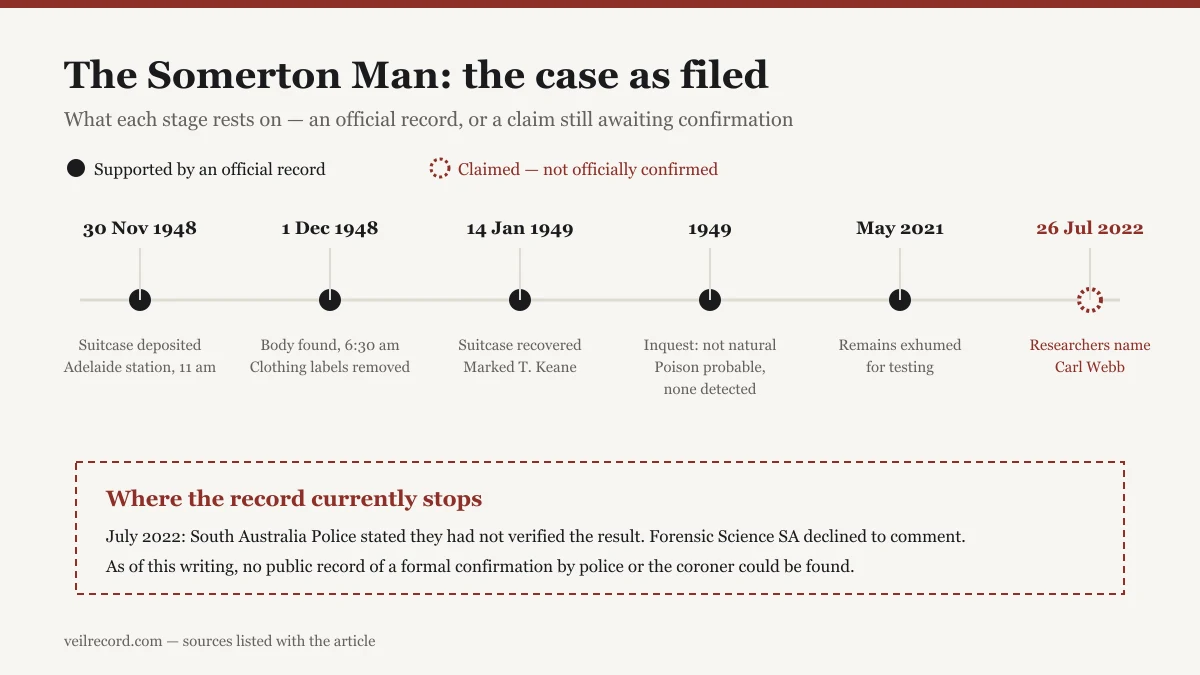
At 6:30 on the morning of 1 December 1948, a couple walking on Somerton Park beach near Adelaide, South Australia, found a man propped against the seawall. He was dead.
Over the next seventy-odd years that body accumulated a remarkable amount of story: a Soviet spy, a Cold War assassination, an unbreakable cipher, a jilted lover. The stories have travelled far further than their evidence ever did — which makes this exactly the kind of case this site exists for.
So this piece is organised differently. Rather than tell the mystery, it sorts the case into two piles: what the file actually supports, and what was added later. The first pile is thicker than you might expect. The second is thinner.
Pile one: what the record holds
Start with the body.
The post-mortem describes a man about 180 cm tall, 75 to 80 kg, estimated at forty to fifty years old. Grey eyes. Clean-shaven. A receding hairline, hair a mousy ginger going grey at the sides and behind the ears.
Two details have been quoted ever since. He was broad-shouldered, narrow-waisted and physically fit, with unusually well-developed calf muscles. And he was missing eighteen teeth — nine top, nine bottom, mostly at the back.
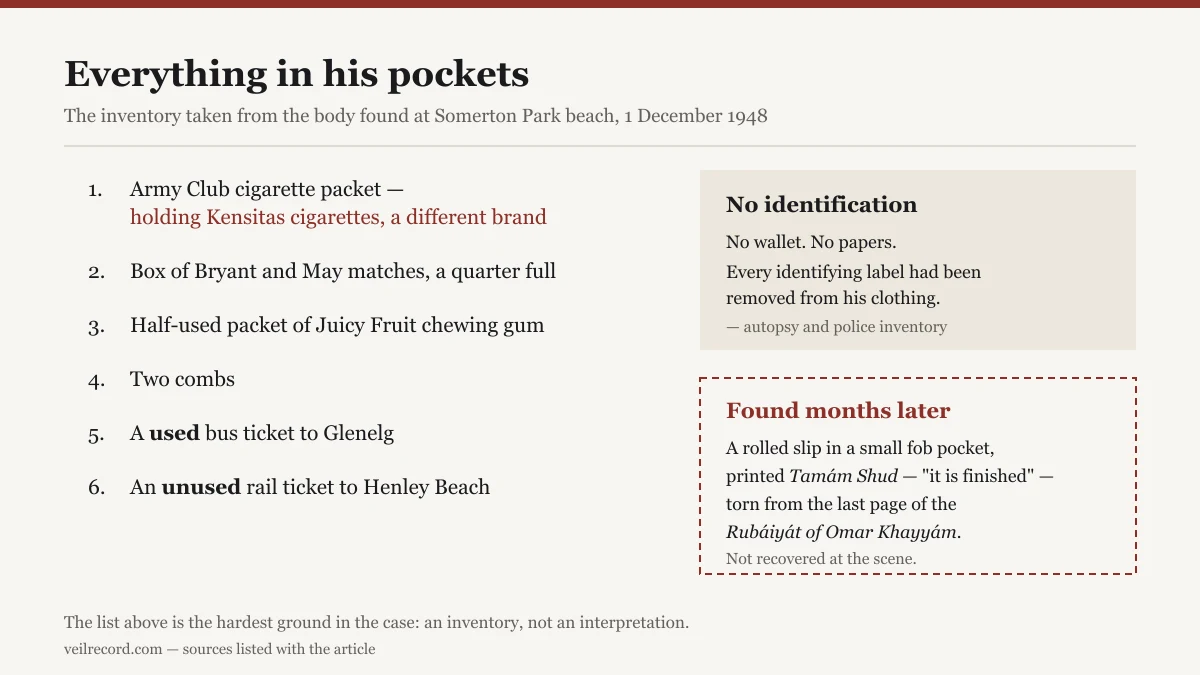
He wore a coat, shirt, pullover, trousers, underwear, socks, tie and shoes. Every identifying label had been removed from his clothing.
His pockets were inventoried item by item. The list is worth reading in full, because it is the hardest ground the whole case stands on:
- an Army Club cigarette packet — containing Kensitas cigarettes, a different brand
- a box of Bryant and May matches, about a quarter full
- a half-used packet of Juicy Fruit chewing gum
- two combs
- a used bus ticket to Glenelg
- an unused rail ticket to Henley Beach
The inquest ran in 1949. Three medical witnesses testified the death was not natural. Coroner Thomas Erskine Cleland worded his conclusion carefully: he was, he said, prepared to find that the man died from poison, and that the poison was probably a glucoside — but he could not determine whether it was administered by the deceased himself or by someone else.
Here is the part most retellings drop. Testing found no foreign substance in the body. Poisoning was inferred from what the autopsy showed — organ congestion, gastritis — not demonstrated by chemistry.
Which means that even “he was poisoned” is not, at the level of the record, an established fact. It is an inference a coroner was willing to accept without direct evidence for it. Seventy years of confident writing about a poisoning traces back to that single hedged sentence.
The famous scrap turned up months later
“Tamám Shud” is the most quoted element of this case, and the timing is almost always lost in the retelling.
It was not found at the scene. It surfaced during a later re-examination of the clothing, rolled up in a tiny fob pocket in the trousers: a slip of paper printed with the Persian words Tamám Shud — “it is finished.”
The slip was matched to the final page of the Rubáiyát of Omar Khayyám.
Police then appealed publicly for the book it had been torn from. Someone produced one, saying it had been found in a car on Jetty Road, Glenelg, with no idea how it got there. It was an edition published by Whitcombe and Tombs in New Zealand.
The book carried two things.
First, the letters. Pencilled very faintly on the inside back cover were several lines of capital letters, some struck out. The writing was so light that police needed an ultraviolet lamp to read it at all. No solution has ever been generally accepted — note the wording. Claimed solutions are numerous. Accepted ones are not.
Second, a telephone number, and an unlisted one. It led police to a woman living nearby. In the decades of public discussion that followed, she was known for a long time only by the alias “Jestyn.”
Everything above corresponds to a file, a report, or contemporary documentation.
A suitcase and a surname
On 14 January 1949, police found an unclaimed suitcase in the cloakroom at Adelaide railway station. It had been deposited at 11 am on 30 November 1948 — the day before the body was found.
Inside was what a travelling man carries: a dressing gown, clothing, shaving gear, scissors, an electrician’s screwdriver, a stencilling brush, and thread.
Two details matter.
The thread microscopically matched the seams of the dead man’s clothing — the firmest physical link between the case and the man.
And several garments carried names: “T. Keane,” “Keane,” “Kean.” Police searched for a missing Keane and found none.
In 1949 that surname was a dead end. Seventy years later it became the hinge.
Pile two: how the spy grew
Now the other pile.
The espionage theory is assembled from these ingredients: a body stripped of identification, an inquest that could not settle a cause of death, a line of letters nobody could read, an unlisted phone number — and a date that lands in Australia’s early Cold War.
Put those together and “intelligence officer” is a natural thing to think. But a natural thought is not evidence, and in seventy years this particular one has never crossed that line.
Notice what it actually rests on. Rarely a document. Usually an interpretation of how a person reacted — the woman police traced through the phone number. Accounts of her response have been read, and re-read, into “she recognised him” and then “she was hiding something.”
Let me put that plainly: “a witness appeared shocked” is not a record. It is a reading of one. The gap between those two things is wide enough to support an entire industry.
There is also a cautionary example that rarely gets repeated. An early and popular lead held that the dead man might be one Alf Boxall, because the same woman had given Boxall a copy of the Rubáiyát. That lead ended in the simplest way available: Boxall was alive. Police found him.
One living man collapsed an entire chain of reasoning — in 1949, when that chain sounded every bit as reasonable as the spy theory sounds today.
2022: hair, a database, and four thousand relatives
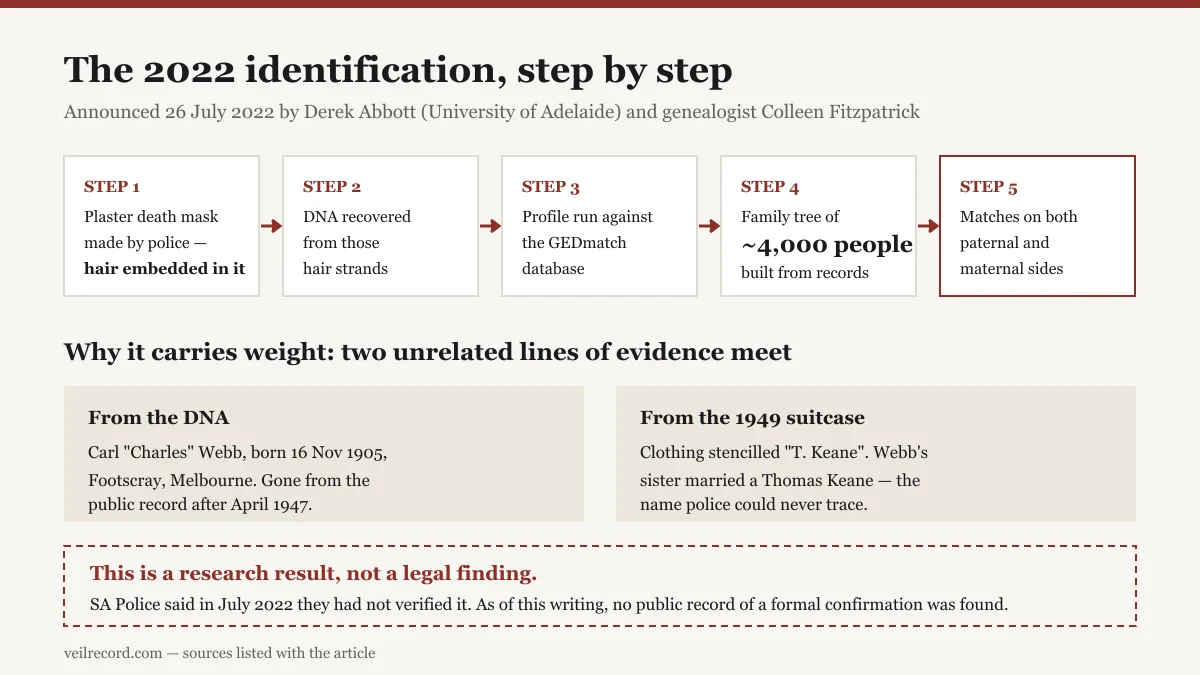
On 26 July 2022, University of Adelaide professor Derek Abbott and forensic genealogist Colleen Fitzpatrick announced they believed the dead man was Carl “Charles” Webb, born 16 November 1905 in Footscray, Melbourne — an electrical engineer and instrument maker.
The chain runs like this:
- South Australian police made a plaster death mask of the man in the late 1940s, and hair was embedded in it.
- DNA was recovered from those strands.
- The profile was run against the GEDmatch genealogical database, producing distant-cousin matches.
- Archival records were used to build a family tree of roughly 4,000 people.
- On that tree, matches connected on both the paternal and the maternal side — as Fitzpatrick put it, out of an ocean of DNA cousins they were able to connect one to Carl’s father and one to Carl’s mother.
Webb’s biography fits the shape of the hole. He married Dorothy Jean Robertson in October 1941, and he disappears from the public record after April 1947.
And then the surname. Webb’s sister married a man named Thomas Keane — the name stencilled into clothing in a suitcase that police could never trace.
That is what gives this identification its weight. It is not merely consistent with the case. Two unrelated bodies of evidence meet at one point: DNA genealogy from one end, a 1949 laundry marking from the other, both pointing into the same family.
Where the record stops: no official finding
This next part is, in this site’s view, the most important paragraph in the piece — and the one most often written out.
The identification is a research result, not an official determination.
- In May 2021 the remains were exhumed for independent testing.
- When the announcement came in July 2022, South Australia Police said they had not verified the result, but were “cautiously optimistic that this may provide a breakthrough.”
- Forensic Science South Australia, still investigating, declined to comment on Abbott’s findings.
- Abbott said it most cleanly himself: they were only reporting what the DNA told them, and the legal determination is the job of the police.
As of this writing, I could find no public record of South Australia Police or the coroner having issued a formal confirmation.
Read that sentence carefully. It does not say officials never confirmed it — that would be a claim about the world, and I cannot guarantee it. It says I did not find it, which is what I actually know.
The distinction sounds pedantic. It is the entire lesson of this case. Every “close enough” substitution moves the final version one step further from the file. “Could not determine whether self-administered or given by another” becomes “he was poisoned.” “Letters nobody has decoded” becomes “a cipher.” “A woman who was interviewed” becomes “a lying spy mistress.”
What is known now
Two piles, summarised.
Supported by the record: a man was found dead at Somerton Park beach on 1 December 1948; identifying labels had been removed from his clothing; a Tamám Shud slip torn from the Rubáiyát was in his fob pocket; the matching book carried uncracked letters and an unlisted phone number; a railway-station suitcase was tied to him by matching thread and carried the name Keane; the inquest found the death unnatural and leaned toward poison, while testing found no foreign substance.
Claimed by researchers, awaiting official determination: the man was Carl Webb, on the basis of DNA from hair in the death mask, a 4,000-person family tree, and the convergence with the Keane surname.
Only ever asserted: spies, assassination, letters concealing intelligence. No document has ever supported these. They rest on readings of people, and on the atmosphere a Cold War date lends to anything ambiguous.
That last pile travels furthest, and it is not hard to see why. It is the best story. But this site takes a different position: the most interesting thing about a case is rarely the ending someone supplied for it. It is the precise point where the record stops.
In the Somerton Man case, that point is currently very well defined — an identification that is probably right, and has not yet been stamped.