The Voice in the Last Stall at Tat Tak School
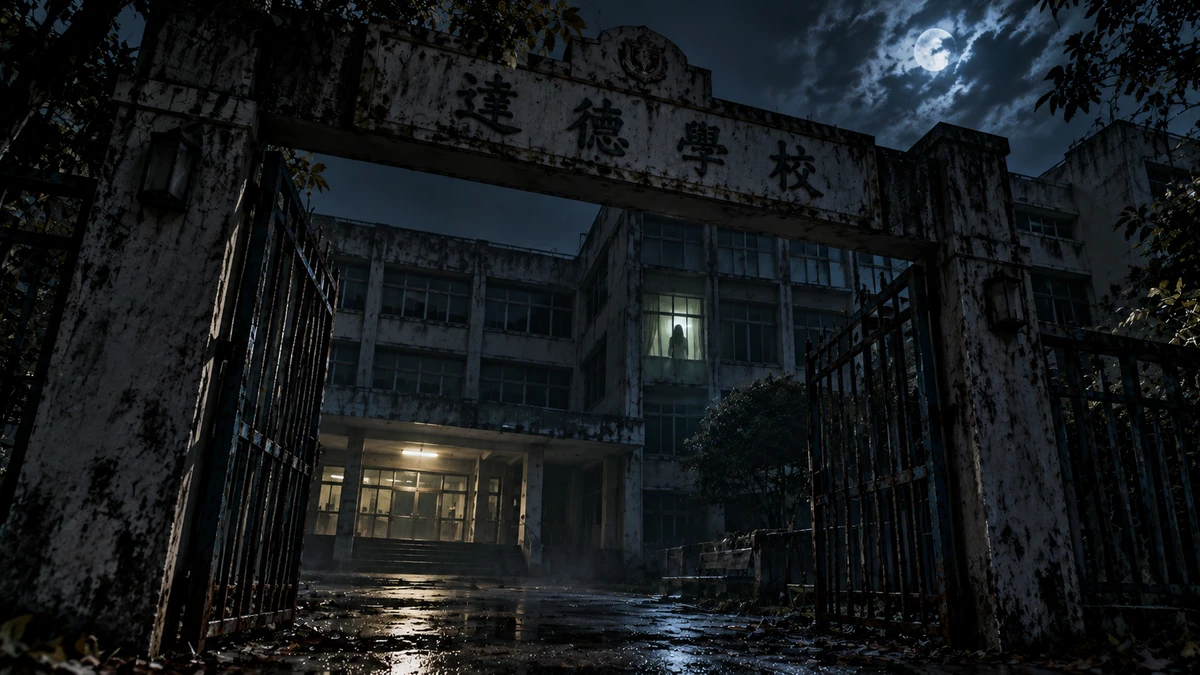
In Ping Shan, in the Yuen Long district of Hong Kong’s New Territories, a narrow path leaves Ping Shan Nam Pak Road and climbs a slope. There are graves on both sides. Beside the path stands the Hau Sze Tong, the hall where Ping Shan’s villagers hold their funerals. At the end of the path is a U-shaped, two-storey school, its assembly hall in the middle and a classroom wing reaching forward on either side, and the trees on the slope beside its gate hang so low they almost cover the name.
There is another grave inside, an old tomb between the school building and the basketball court. For years the pupils did their exercise classes in front of it.
Hardly a pane of glass is left in the windows now. People in Ping Shan will tell you the school was built on a mass grave, and that the one place inside you must never go is a certain stall in the girls’ toilet. In 2013 a foreign television programme put it on a list of Asia’s ten scariest places. Its host called it the perfect place for ghost stories and the supernatural. The road to the school, the programme said, is so surrounded by graves that even taxi drivers refuse to go.
Two characters on a temple door
The school did not start on the hillside. In 1931 the Tang clan of Ping Shan opened a school inside the Yu Kiu Ancestral Hall in the village, for the children of Ping Shan’s villages. Over the hall’s front door hangs a couplet, roughly “reach out to do good for all, cultivate virtue in yourself,” and the first character of each line, put together, gives the school its name: Tat Tak. It had a good name in those days, and children came from as far away as Hung Shui Kiu and Mong Tseng Wai.
The pupils kept coming until there were more than seven hundred and the ancestral hall could not hold them. In the 1960s the school moved to the slope beside Ping Shan Nam Pak Road. Between the new building’s two classroom wings lay a basketball court. Trees all round. Beyond the trees, graves.
In 1998 the school ran out of pupils and closed. It has stood empty ever since.
As for the mass grave, the story begins in 1899. That year the British came to take over the New Territories, and the people of Ping Shan met in their village’s communal hall, posted a notice and called on the villagers to take up arms. Many people from Ping Shan died in the fighting. The communal hall where they met was also called Tat Tak. People from outside the village say the dead were buried on this hillside, right where the school now stands. Another version puts it in 1941, when the Japanese army invaded Hong Kong. Whichever year it was, the storytellers agree on one thing: the school was built on top of them, and so, once the new building went up, things began to happen.
The paper figure in the classroom corner
After the school closed, the building emptied but the ghost stories multiplied. Once a television programme on the supernatural had filmed there, ghost hunters and thrill seekers came in wave after wave, until the authorities locked the gate, hired a security guard and brought in dogs to keep people out. That is why an abandoned school still has someone watching its gate.
But people in Ping Shan tell another story about that locked gate. Someone came to the front of the school in the middle of the night, and just as the visitor stood before it, the locked iron gate swung open on its own. It stayed open, as if it were waiting.
Villagers who live nearby have looked up at night and seen a man floating on the school balcony. Only half of him. Thin wisps of smoke curled from his mouth. Where the other half was, nobody saw.
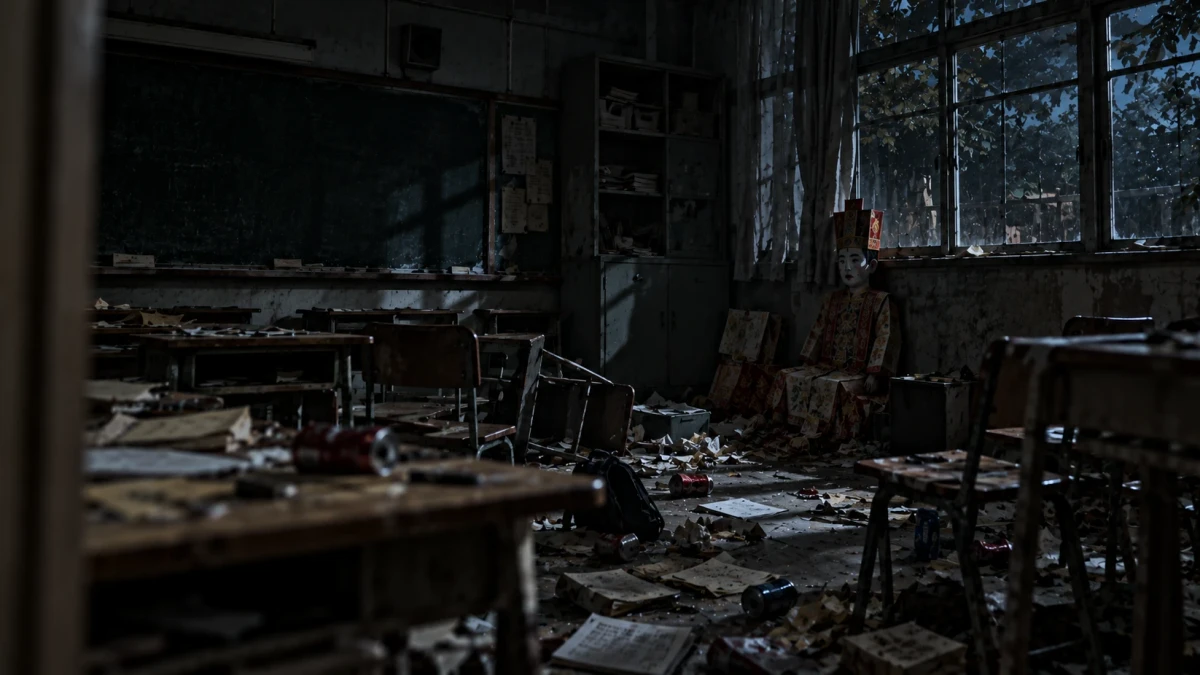
Then there was a visitor to Hong Kong who spoke very little Cantonese. On a second trip to the school, the visitor found the gate standing open, with no one around, and walked in. Moss covered the outer walls. Inside, plaster was peeling off in patches and spiders had spun webs in every corner. The silence was unsettling, and now and then there was the feeling of being watched from somewhere. The classroom floors were strewn with rubbish, scraps of paper, soft-drink cans, and in the corner of one classroom stood a paper figure, the kind burned as an offering to the dead. Some villager must have left it, the visitor supposed, and thought no more about it.
On the way out, passing the gate, a head suddenly popped out of a white booth in the corner. It was the guard who watches over the school, a woman. She had stepped out to fetch something, she said, which was why the gate was unlocked. Ten more minutes and she would have locked up and gone home.
The light was starting to fade. In halting Cantonese, the visitor mentioned the paper figure in the classroom corner. Villagers must still come to make offerings here, then.
The guard’s friendly face went hard. If the visitor understood her correctly, this is what she said: “Stop joking. I’ve never seen anyone bring paper offerings here, and the school gate has always been locked. How could there be a paper figure!”
If it was not a paper figure, then what had been standing in that classroom corner?
The last stall
This is the story they tell in Ping Shan. A woman once hanged herself in one of the stalls of the girls’ toilet, dressed all in red. Ever since, a woman in red has appeared in that stall, and it is the worst place in the whole school. Some say they have seen her late at night, out in the school grounds.
One night a group of young men walked into that toilet. There was no sound at all. Then, out of the silence, right at their ears, a woman’s voice spoke:
“What are you doing here so late?”
There were several of them in the room. The voice asked “you,” singular, not all of them. They were frightened out of their wits.
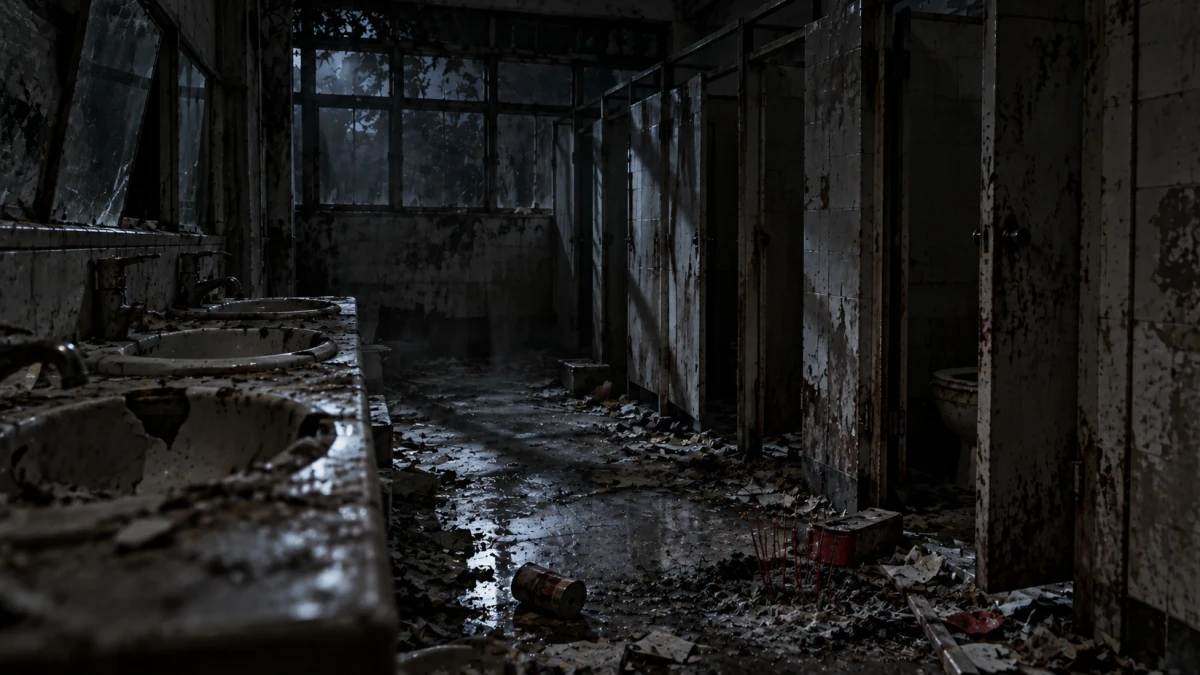
A reporter once came to write about the place. The gate was half open and weeds had taken the grounds. Most of the windows were smashed. The floors of the assembly hall and the classrooms were littered with plastic pellets from airsoft guns, the walls sprayed with graffiti, and the reporter walked through all of it without feeling anything unusual. Then the reporter stepped into the girls’ toilet and felt a heavy, unmistakable pressure. A broken washbasin. A cubicle door hanging half open. Rubble on the floor, and the ashes of burnt incense and candles.
At that moment a dark shadow flashed past behind the reporter’s back.
The reporter backed straight out of the toilet, and there, right outside, stood a schoolgirl in uniform. It took a long, careful look to be completely certain she was a living person. She had arranged to meet some classmates there to hang out. “I come here all the time,” she said. “There’s nothing to be scared of.”
Her three male classmates arrived. Asked whether they were afraid of ghosts, they glanced at one another and hesitated. Then one of them answered: “I’ve never seen one. But I usually leave before the sun goes down.”
A film director once shot a movie at the school. One day the crew was filming in the school toilet when the camera suddenly died. No matter how many times they pressed record, nothing happened, and the lights would not stop flickering. They struggled with it for a long time. A colleague suggested burning incense and saying a prayer. They did, and everything worked again.
Not long after, the lights began to flicker again, and the camera would not record. Nobody could work out why, until they looked at the incense. It had burned out, and the shooting time they had silently promised when they prayed had just run over. “Very punctual,” the director said.
People who come looking for ghosts still walk into that toilet to burn paper offerings. The floor is covered in spirit money and the stubs of burnt incense.
They lit incense
It was a September afternoon in 2011, a little after three o’clock, when twelve junior secondary students set out. The boy who led them had gone to the school alone a few days earlier, found it fun, and come back to gather his friends for a second visit. Eight girls and four boys, classmates and friends, all of them interested in ghosts. They carried incense and candles, and from Ping Shan Nam Pak Road they turned onto the winding path.
Once they were on the path, they did what they had read online. They lit incense, to “lead the way.”
With the incense burning, they walked on. The closer they came to the school, the more of them said there were ghosts over by the graves near the school. Others said they heard strange noises. One girl stopped. She pointed toward a grave, and her voice was shaking. She said she could see a woman in red with long hair, lying face down on the open ground in front of the grave.
The others answered together: “We can’t see anything.”
A chill ran through all of them. The more they talked, the more frightened they became, until they gave up, turned around and walked back, faster and faster, all the way to the MTR station at Ping Shan.
At the station, three of the girls collapsed, one after another. They were between fourteen and sixteen. Their friends crowded round, and after a while the three slowly came to. Then one of them lost control. She began to scream, and she clamped both hands around her own throat and squeezed.
A boy threw bottled water over her to bring her round. To his shock, she sank her teeth into his arm and scratched him. It took several of them together to hold her down, and someone called the police.
The ambulance came and two of the girls were taken to hospital, where they turned out not to be seriously hurt. But the girl who had gripped her own throat told reporters one thing from her hospital bed. While she was unconscious, she said, she kept seeing people killing themselves, and people being murdered. It was terrifying.
Leading the way
The girl who said she saw a woman in red at the graves was the same girl who came round at the station and gripped her own throat.
The woman in red that Ping Shan talks about hanged herself in a stall of the girls’ toilet. What the girl said she saw at the graves was also a woman in red, with long hair. She walked all the way to the station, collapsed, came round, and then clamped her own hands around her own neck and squeezed.
Once they were on the path, they had lit incense to lead the way, just as the internet told them to. With it burning, they followed the path to the graves, and then followed the same path back down. The incense led them up. It also led them down.
In hospital she said that while she was unconscious she kept seeing people killing themselves, and people being murdered. Whether one of them was a woman in red, she did not say.