A Quarter Past Three: The House at Amityville
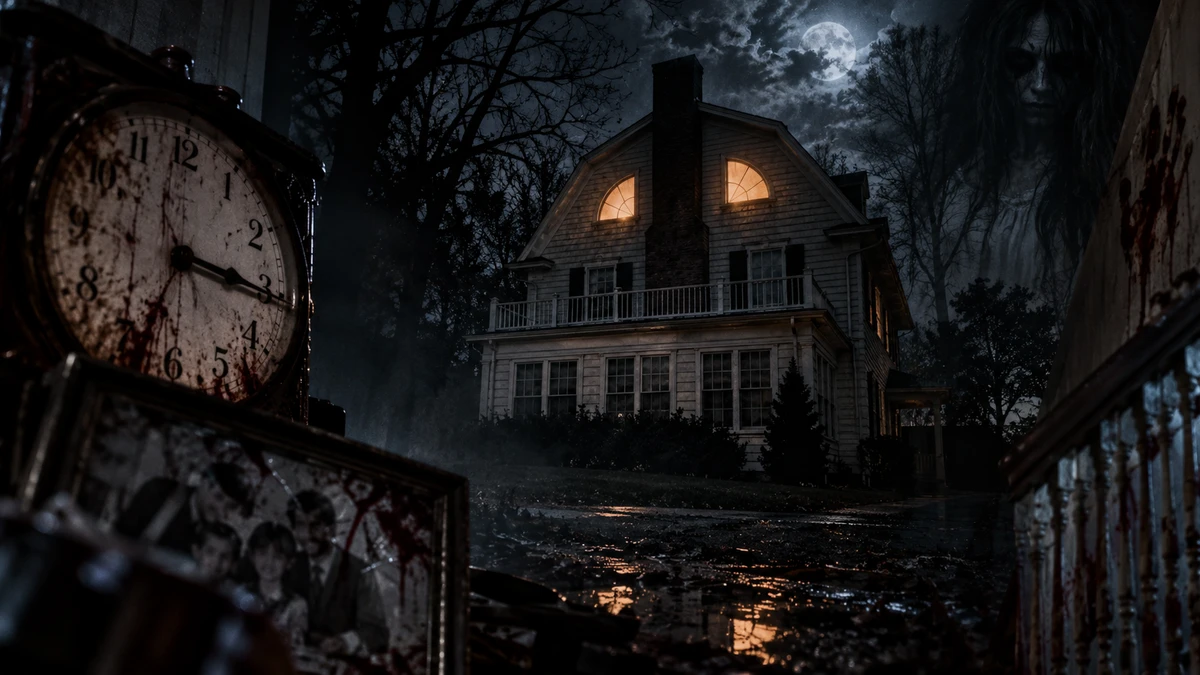
On the south shore of Long Island, New York, in a village called Amityville, the house at 112 Ocean Avenue is a three-storey Dutch Colonial with dark shingles and a gambrel roof. Two quarter-round windows sit in the attic gable, facing the street, and when the lights are on at night they look like a pair of eyes. A lamp post on the front lawn carries a sign that reads “High Hopes”. Behind the sign stands a statue of St. Joseph holding the infant Jesus, and in front of it three small stone children kneel in prayer. The lot runs long and narrow to the back, all the way down to a canal, and at the end of it is a boathouse.
One night in 1974, the six people living in this house died face down in their beds. The house stood empty for thirteen months with the furniture still inside. Then a family moved in. They stayed twenty-eight days, and when they left they took nothing with them.
The husband woke every night at a quarter past three.
That night
It was 13 November 1974, some time after three in the morning, when a .35 calibre Marlin lever-action rifle went off eight times inside the house. The rifle had no suppressor. Each shot meant working the lever before the next. And yet all six of them were found lying face down in their own beds, tucked under the covers, with no sign of a struggle. The father and mother had each been shot twice, the four children once. The eldest daughter was eighteen, the younger thirteen, and the two boys were twelve and nine.
No neighbour heard a shot. A twelve-year-old girl next door later said she had woken once at three, and what woke her was not gunfire but the family’s dog.
At half past six that evening the eldest son burst into the bar on the corner. Ronald DeFeo, twenty-three, shouted from the doorway: “You got to help me! I think my mother and father are shot!” Then he dropped to his knees. Five men from the bar crammed into his car with him. The house was a block away. It took seconds.
The front door was unlocked. The house was silent except for the dog barking at the kitchen door. They went up to the second floor, and the corridor smelled of death. The first man to reach a light switch stood in the doorway of the master bedroom. The father lay face down, a hole in the middle of his bare back. The mother lay under an orange blanket. The wall behind the bed was one long mirror, so the two of them were there twice. Another man went into the boys’ room, where the wallpaper was clipper ships, cannons and eagles. The two boys lay face down in their own beds, one in a basketball sweatshirt, and beside the other bed stood a pair of crutches and a wheelchair, because he had hurt himself playing ball not long before.
The son said first that the Mafia had done it. The next day he confessed. He told the detectives: “Once I started, I just couldn’t stop. It went so fast.” He also said, at some point, that the voices from the house had made him do it.
In December of the following year a judge gave him six sentences of twenty-five years to life. He died in prison in March 2021, aged sixty-nine.
The house stayed as it was. The mirror, the piano, the clipper ships on the wallpaper, all of it in its place.
Thirteen months later
In December 1975 a couple who had not been married long bought the house: George and Kathy Lutz, and they moved into the house together with Kathy’s three children from her first marriage and a dog.
On the afternoon they moved in, a priest came to bless the house. He walked alone into one of the rooms on the second floor, flicked the first drops of holy water and had only just begun to pray when a man’s voice, out of nowhere, said to him: “Get out.”
He did not tell the couple.
A few days later he telephoned George and said only one thing: do not use that room upstairs as a bedroom, and do not let anyone sleep in it. He did not get to finish. Static swallowed the line. The room had been the two boys’ bedroom.
That room
They did as he said. Nobody slept there. Kathy made the room her sewing room.
It was the dead of winter and the windows were shut, and the sewing room filled with flies, hundreds of them.
The house was cold. The fire burned from morning to night and George spent his days feeding it, and with the fire going he was still cold. Some days there were smells in the house, perfume, then excrement, rising from places where no draught and no pipe could account for them. Black stains began to appear on the toilets and the basins.
Sometimes Kathy felt herself held from behind, gently, as if by a pair of hands she could not see.
They said later that in those weeks it was as if each of them was living in a different house.
A quarter past three
Within days of moving in, George began waking in the night.
It was always the same time, 3:15 a.m. He opened his eyes, got out of bed, went out of the house, crossed the back garden to the boathouse on the canal and opened its door to look inside. What he was looking for, he could not have said. He only knew that at a quarter past three every night he would be standing there.
Some nights what woke him was the front door slamming, loud enough to wake the whole house. He ran downstairs. The dog was asleep by the door, the door was shut, and nobody else in the house had stirred.
Some nights it was a sound from downstairs, like a marching band tuning up, or like a clock radio not quite on the station. He went down and the sound stopped.
Kathy began to dream. She dreamed of that night in 1974, the order in which the six of them had died and the rooms in which it had happened. Kathy’s three children changed the way they slept. All three now slept on their stomachs, faces down, which was how the six had been found.
Later they looked into the case, and learned that a quarter past three was the time the police believed that family had died.
George stopped taking care of himself. He noticed that the face in the mirror was starting to look like the son who had fired the eight shots.
The red room behind the shelves
In the basement, behind a set of shelves, George found a door.
Behind the door was a very small room, about 120 by 150 centimetres, its walls painted red. It was not on the plans of the house. The dog would not go near the door. It cowered and barked at it.
Their five-year-old daughter told them she had a new friend called Jodie. Jodie, she said, was like a pig, with red eyes, and nobody could see Jodie unless Jodie wanted to be seen.
One morning around Christmas, George woke at a quarter past three as usual, went to the boathouse, and on his way back stopped in the garden and looked up. His daughter was standing at her bedroom window. Behind her stood a pair of red eyes, looking down at him. And when he ran upstairs, the girl was asleep in her rocking chair, and the chair was still moving.
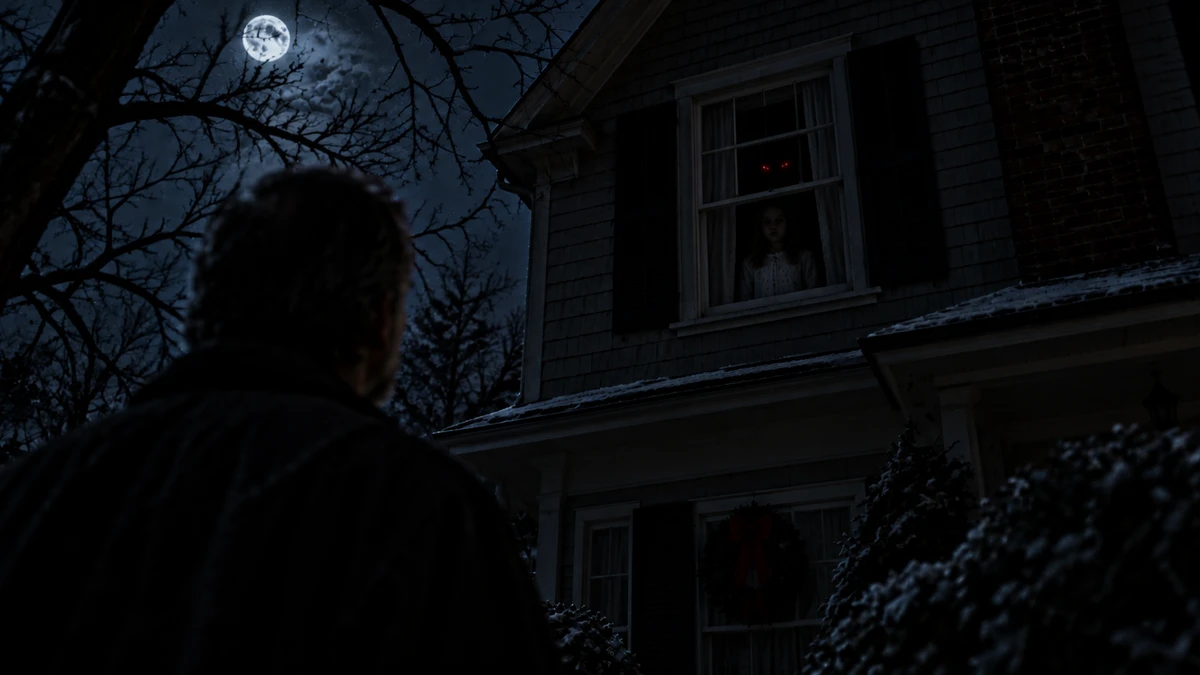
Another night Kathy went into the girl’s room to close the window. The girl said Jodie had just climbed out through it. As Kathy closed it, a pair of red eyes on the other side of the glass looked straight at her.
On the morning of 1 January there were prints in the snow outside the house, a line of cloven hoofprints, as if a very large pig had walked past.
So the friend the girl talked about, and the door the dog would not go near, had now left a trace in the snow as well.
The last night
On 8 January, George took a silver crucifix and Kathy followed him, and they went from room to room saying the Lord’s Prayer. When they reached the living room, a chorus of voices spoke to them together: “Will you stop?”
There were other things they were able to say afterwards. The thirty-centimetre crucifix Kathy had hung in the living room turned by itself until it was upside down, and gave off a sour smell. Green, jelly-like slime seeped from the walls of the hallway and from the keyhole of the playroom door in the attic. Kathy lay in bed and red welts rose across her chest, and then she rose too, sixty centimetres above the mattress. One night George looked at his wife beside him and saw a woman of ninety, “the hair wild, a shocking white, the face a mass of wrinkles and ugly lines, and saliva dripping from the toothless mouth”, and then Kathy again, who knew nothing about it.
Then came the last night.
What happened that night, they never said. They said only that it was “too frightening”. Everything before it they could describe: how many flies, how big the red room was, which way the crucifix had turned. Of that night there is nothing.
On 14 January they left 112 Ocean Avenue with the three children and the dog. Everything they owned stayed in the house. They went to Kathy’s mother’s house. It did not end there. In that house too, they said, a mass of greenish-black slime came up the staircase, one step at a time, towards them.
The boy on the film
Twenty days after the family fled, on the night of 6 March 1976, the paranormal investigators the Warrens, a husband and wife, walked into the empty house with a crew from a television station. The Lutzes would not come back inside.
This is how the Warrens themselves told that night. In the basement the husband recited prayers out loud, line after line, demanding that whatever was in the house show itself, and halfway through he was pushed to the floor. The wife, from the moment she stepped inside, felt a pressure holding her back, as if she were being pushed away from the house, and in front of her, again and again, were the six who had died there, laid out along the floor, each under a white sheet, and they stayed there wherever she looked. A photographer set up an infrared camera and left it taking pictures at intervals through the night.
There were no children in the house. The people who went in that night were reporters, investigators and a photographer. The three Lutz children had left with their parents more than a month before, and the four DeFeo children had died in their beds in this house more than a year before that.
Three years later, one of the frames was made public. At the top of the stairs on the second floor, a boy is leaning out of a doorway, his eyes bright, his face turned to the camera.
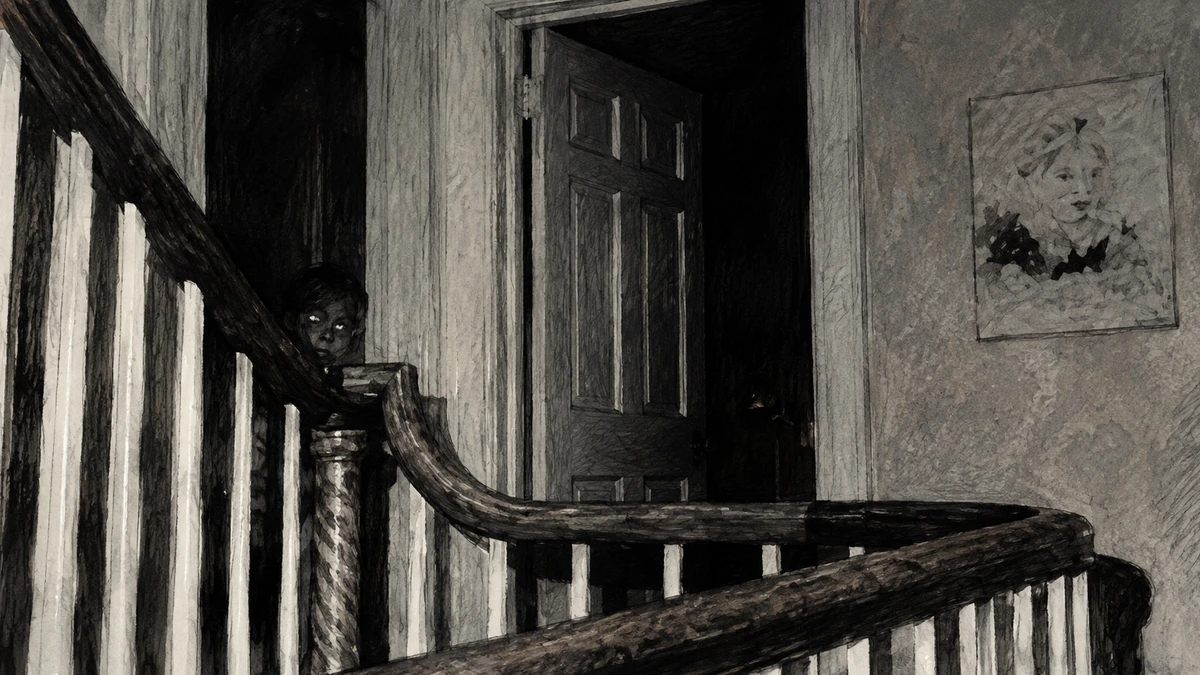
Every person who went into the house that night can be counted. The one extra on the film stood on the second floor and watched them, and perhaps had been watching since the moment they opened the front door.