Dead Mountain: The Boots Were Still in the Tent
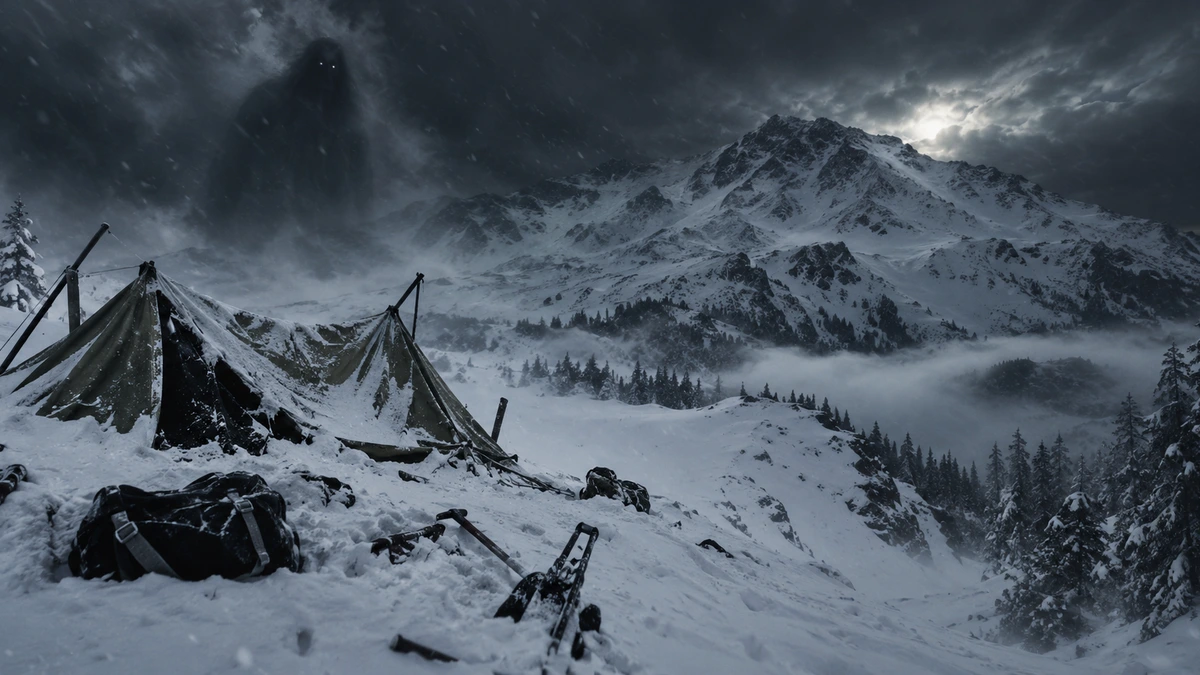
On 26 February 1959 two students were climbing a ridge with no trees on it, looking for nine people. This is the northern Urals, the Sverdlovsk region of the Soviet Union, in what is now Russia. The ridge is bare. The wind packs the snow into a crust. The Mansi people who live in that country call the mountain Kholat Syakhl, a dead mountain, a mountain with no game on it, a place nobody hunts and nobody grazes reindeer.
The nine they were looking for had pitched a tent on its eastern slope twenty-five days earlier.
Part way up the slope the two students saw a corner of canvas in the snow.
The Next Page of the Diary Was Blank
The nine were students and young engineers from the Ural Polytechnic Institute, most of them in their early twenties. The oldest was nearly forty, an instructor from a mountain tourist base. On 23 January ten of them had left Sverdlovsk by train, heading north into the mountains. At an abandoned settlement part way in, one of them fell ill and turned back. That left nine. He was the only one of the ten who came home.
The group diary runs to 31 January. The last page is in the leader’s hand, and his name was Dyatlov. The wind was from the west, he wrote, a warm wind, but it cut the face, and it came with the force of the jet from an aircraft at take-off. Eighteen to twenty-four below. They had left the river valley and were climbing. It was nearly four, and they had to start looking for a place to pitch the tent.
The page after that is blank.
On the morning of 1 February they dug a cache in the forest and left the food and the spare gear for the way back in it. They meant to come back for it. They went up towards the ridge carrying less, and in the afternoon they pitched the tent on the eastern slope of the dead mountain. The last frames on their film show that afternoon: a few bundled figures climbing into the wind, then bending, cutting a platform into the snow, raising the canvas. The light goes early up there, and by the time the tent was standing the mountain was dark.
After that the film is blank.
They had agreed to send a telegram from the village below by 12 February. The twelfth came and went. The thirteenth, the fourteenth, the fifteenth. After a week the families went to the institute and to the party offices, and on 21 February the first search parties went into the mountains, with parties of student volunteers from the institute going up behind them. On the twenty-sixth, two of those students saw a corner of canvas in the snow.
The Tent Was Cut Open From the Inside
One end of the tent was still standing. The other had collapsed under the snow. The first thing anyone saw, walking up to it, was the canvas: there were slits in it, several, and they were not tears. They were cuts.
Then they lifted the canvas and looked inside.
Everything was there. All nine rucksacks. Blankets lying open. Storm jackets and padded trousers where they had been put down, the stove, the maps, the food, a handful of diaries, all in their places. Almost every pair of boots was still in the tent. Nobody had put them on. It looked like nine people who had just stepped out for a moment, together.
There was no one in the tent, and no one outside it, and only the wind.
The cuts were on the right-hand slope of the roof. Three of them, the longest nearly ninety centimetres, the shortest a little over thirty, and the expert who examined the canvas later put it plainly: they had been made with a knife, and they had been made from the inside. Whoever opened that tent had not stopped to lift the door flap. They had not stopped for their boots. They had cut a way out through the wall and walked into the freezing night.
Below the tent, something was waiting in the snow.
They Went Down in Their Socks
A line of footprints. Eight people, perhaps nine, coming out of the tent and walking in single file down towards the valley.
Most of them were not boot prints. They had been made by feet in socks, one of them in a single cotton sock, almost bare. Only a few had the flat print of felt boots. The wind up there was strong enough for the diary to compare it to a jet engine, and they walked into it in their socks.
The prints stood up above the surface. The wind had scoured the loose snow away and left the packed snow under each step behind, so that the trail ran down the slope as a row of raised soles, as if the snow itself had kept a record of that night.
They kept their line. Nobody broke away, nobody fell behind. Eight or nine people walked down the mountain in the dark in single file, not hurrying, for about a kilometre, until the trail reached the edge of the forest and stopped.
The Cedar and the Two Men Beside the Fire
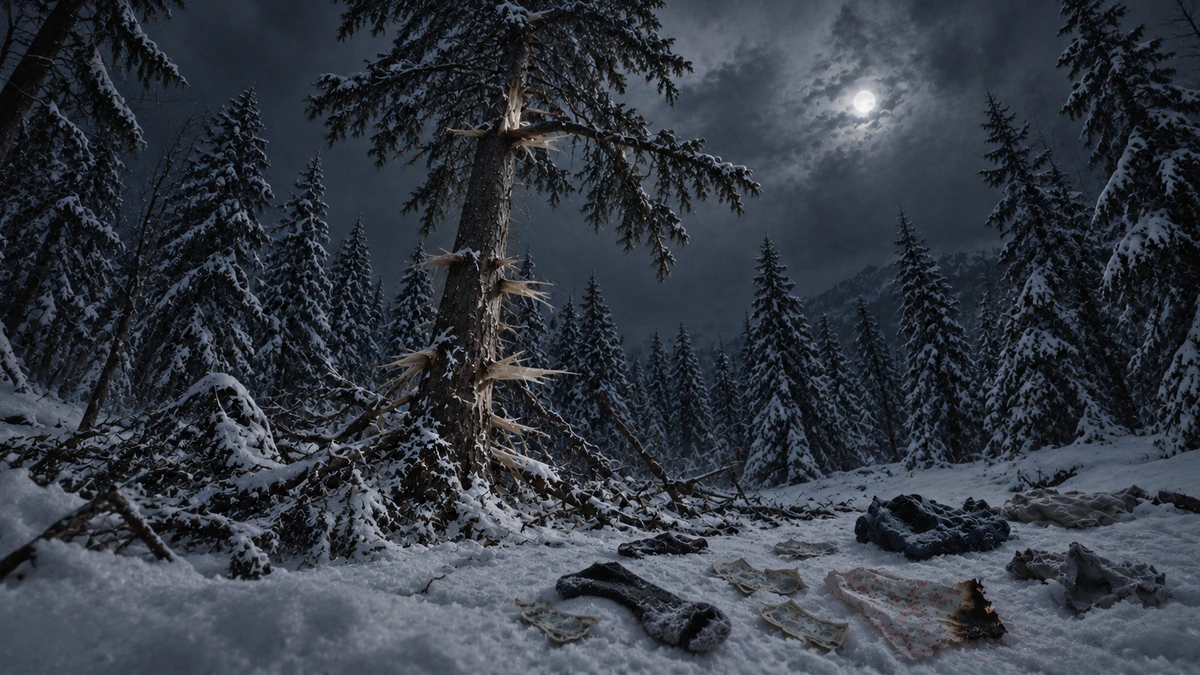
The next day the searchers went on down in the direction the footprints had been heading. Fifteen hundred metres from the tent, at the edge of the trees, there was a big cedar, and under it the remains of a fire.
The fire had been out a long time. The ash was cold. Two men lay beside it in their underwear. There were burns on them, third-degree burns on one of them, and between his teeth was a small piece of skin, torn from his own hand.
The cedar had been stripped of every branch up to two metres from the ground. Higher, four or five metres up, there was another broken stub. Somebody in underwear, on that night, had climbed four or five metres up a tree to break branches.
Around the fire the snow was scattered with torn socks, a woman’s handkerchief with a burnt corner, a few banknotes and scraps of cloth. And some of the clothing on the two bodies had not been taken off. It had been cut off.
The pieces that had been cut away were not there. Somebody had taken them.
Three of Them Were Facing the Tent
The same day the searchers worked back up the slope from the cedar towards the tent, and at intervals there was a body, as if they had been laid out along a line nobody could see.
The first lay three hundred metres from the fire, on his back, head towards the tent, his jacket unbuttoned. That was the leader, Dyatlov, whose name the whole pass carries now. The watch on his wrist had stopped at 5:31.
Further up, the second was under half a metre of snow, and the searchers did not get him out until 5 March. He lay face down, with a six-centimetre crack in his skull.
Further up again lay the older of the two women, face down, her arms and legs set as though she had been crawling towards the tent.
They had been going back. Up, towards the tent they had cut their way out of, towards the place they had fled with a knife. None of the three reached it.
Two under the cedar, three on the slope. Five. Through March and through April the searchers worked the mountain with long probes, pushing them down through the snow a hand’s width at a time, and every time a probe went down it might touch a person, and it never did. The mountain had put them away somewhere.
Four Empty Seats Under the Snow
In early May the snow began to go. A Mansi hunter walking his dog near the cedar noticed a trail of cut branches on the ground, leading away into the trees. He followed it, and a few dozen metres in, the ground fell away under his feet into a ravine.
Clothes came out first. A pair of black cotton trousers with the right leg cut off. The left half of a light-brown woman’s sweater. Fifteen metres up the stream, half a beige sweater and a pair of ski trousers.
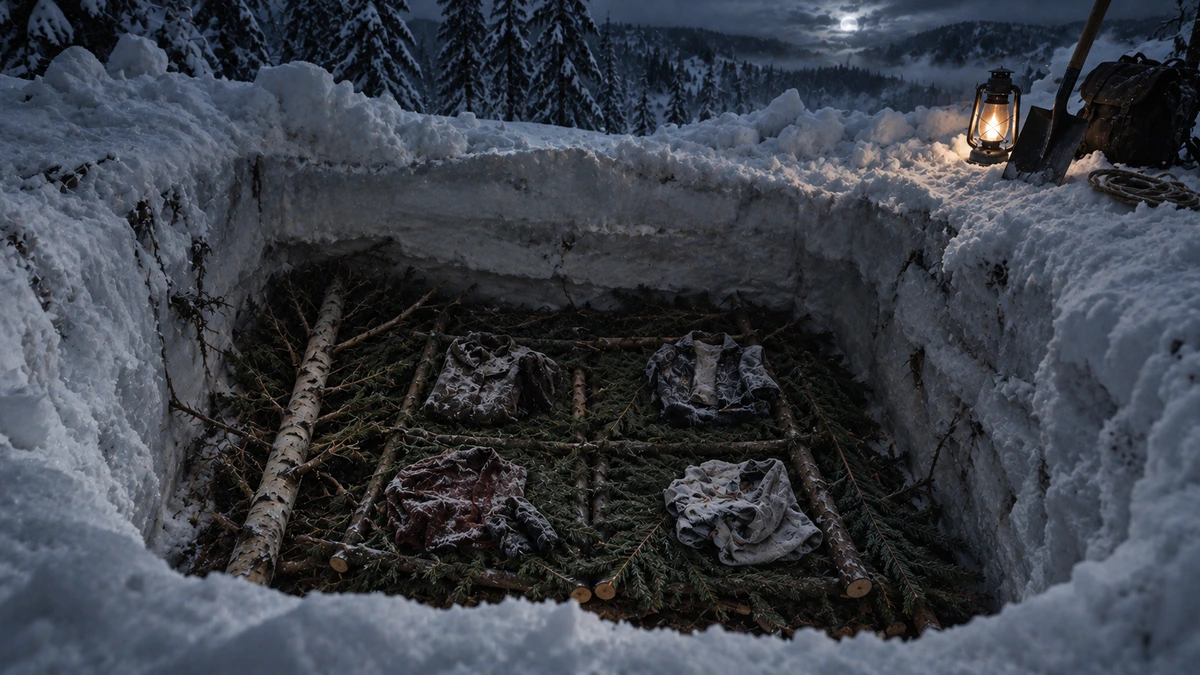
Deeper, more than three metres down, was a floor. Fourteen fir tops and one birch top, laid flat and even across the bottom of a hollow in the snow, and on them the clothes had been arranged in four places, like four seats. Someone, under the snow, had made four people a place to sit.
The seats were empty.
The four of them were in the bed of the stream, seventy-five metres from the fire, under more than four metres of snow, lying in the meltwater. Two of them had massive rib fractures, one broken on both sides of the chest. The skull of a third had been crushed in a patch seven centimetres by three. And there were no wounds on the outside. Nothing on the skin matched what had happened to the bones, as if something had reached in through the skin and crushed what was underneath.
On the autopsy page for the younger of the two women, twenty years old, the examiner wrote two lines: “The tongue in the oral cavity is absent.” “The eyeballs are absent.” The eyes of the oldest man in the group were gone too.
Half a beige sweater was wrapped around her right foot, a piece of burnt grey wool from a jacket around her leg, and her trousers were burnt through in places. The clothing that had been cut from the two men under the cedar was here, on her and on one of the others. So somebody had walked back from the fire to the ravine, carrying clothes cut from their friends.
In the middle of May the clothing of the four was sent for radiological testing. Her brown sweater gave nine thousand nine hundred beta decays a minute over a hundred and fifty square centimetres. After three hours of washing it still gave five thousand two hundred. Nobody could say what, on a mountain with no trees on it, those clothes had touched.
The Sentence on the Last Page of the File
On 28 May the forensic examiner was called in for questioning.
Of the crushed skull, this is what he said for the record: it “could be the result of an impact of an automobile moving at high speed”, or of the man being “thrown and fallen and hit his head against rocks, ice, etc., by a gust of strong wind”. It could not have been done with something held in the hand, he said: “there would have been damage to the soft tissue, and this was not evident.” Of the broken ribs of the other two he said: they were “very similar to the type of trauma that results from the shock wave of a bomb”, and there was nothing on the outside of the chest. A person with those injuries, he said, could last ten minutes, perhaps twenty. What happened at the bottom of that ravine in those ten or twenty minutes, nobody knows.
The same day the case was closed. The resolution gave the cause of death of the nine in one line: “overwhelming force, which the hikers were not able to overcome.” The prosecutor signed it, his superior approved it, and the file went into the archive under seal. What kind of force, the file did not say.
Inside it, alongside the autopsies, were a few statements that had nothing to do with bodies. Half a month after that night, before dawn on 17 February, a soldier on sentry duty down in the valley watched a bright white ball rise out of the south. A dense white fog closed around it and opened again, and at the centre of the fog there was a point of light the size of a star. It drifted north, unhurried, for eight or ten minutes before he lost it.
At four in the morning on 31 March the searchers were still up on the mountain looking for the last four. The man on watch saw a large ring of fire in the south-east, and it came towards the camp, and for twenty minutes it kept coming, and the whole camp was roused and stood in the snow watching it. Before it slid behind a hill, a star appeared at the centre of the ring, swelled to the size of the moon, and fell away from it. At half past nine that morning the search party sent a report down the mountain, and the report ended with one request: “We ask you to explain this phenomenon and if it is safe, since under the circumstances it left us with anxiety.”
All of it went into the file with the tent, the footprints, the cedar and the floor of fir branches, and the file was closed.
A file can be sealed. A mountain cannot, and every winter the snow covers that slope over again.
What happened inside the tent that night, the file does not say, and the only nine people who knew never walked off that slope.