The Water at the Cecil — The Elisa Lam Case
Los Angeles, 2013. A 21-year-old Canadian student vanished from an old hotel downtown; the elevator surveillance footage the police released unsettled the entire internet; nineteen days later, she was found inside a water tank on the hotel’s roof. The file gives the cause of death as an accident — but how she got up there, and how she ended up in the water, no one has managed to answer in more than a decade.
This is the Elisa Lam case: a mystery that has confounded people for over ten years.
And the way it all came to light began with the water.
In mid-February 2013, at the Cecil Hotel in downtown Los Angeles, guests noticed the shower pressure dropping until it was little more than a thread. When some of them opened a tap, the water ran black for a second or two before it cleared. A British couple who spent eight days in the hotel later told reporters that the tap water had a funny, sweet, disgusting taste — and that for a whole week they said nothing to anyone.
“We thought it was just the way it was here.”
Nobody thought to look up. On the roof stood four water tanks, feeding the guest rooms, the kitchen, and the coffee shop. All those days, guests brushed their teeth with that water. They bathed in it. They drank it.
The hotel that collected misfortune
The Cecil opened on Main Street in 1927, and after the Great Depression it sank with the rest of the block, down into the edge of Skid Row. Over nearly a century the building collected police visits the way other hotels collect stars: falls from windows, suicides, and a 1964 killing in one of its rooms that has never been solved. In 1985 the serial killer Richard Ramirez stayed here. In 1991, another serial killer, Jack Unterweger, did the same.
In 2011 the hotel renovated a few floors and hung out a new sign: Stay on Main. One building, two names, two prices.
In late January 2013, a 21-year-old Canadian booked a bed under the newer sign.
A solo trip that ended at the Cecil
Her name was Elisa Lam — in Chinese, Lam Ho-yi, 藍可兒 — from Vancouver, the daughter of immigrants from Hong Kong, a student at the University of British Columbia. She kept a blog: fashion, everyday life, and her long wrestle with bipolar disorder and depression. As an epigraph she used a line from the novelist Chuck Palahniuk — “You’re always haunted by the idea you’re wasting your life.”
In January 2013 she travelled south into California alone, by train and intercity bus. She visited the San Diego Zoo and posted the photos online — and in those photos she looks perfectly calm, nothing out of the ordinary. On January 26 she reached Los Angeles; she then checked into a shared room on the Cecil’s fifth floor, bunking with strangers. Her planned next stop was Santa Cruz, in Northern California.
Soon, however, her roommates began complaining to the front desk. The hotel’s manager would later testify that Lam had been leaving notes on their beds — “go home,” “go away” — and had set a password on the door, refusing entry to anyone who couldn’t answer it. After two days of complaints the hotel could no longer hold out, and moved her to a room of her own.
From that room she called her family in Vancouver every evening.
But on January 31, the phone in the family home in Vancouver never rang.
The last day anyone saw her
That was the day she was due to check out and head north to Santa Cruz. During the day she was seen a few blocks from the hotel in The Last Bookstore, where the manager remembered her as lively and outgoing, picking out gifts for her family and weighing whether the books she wanted would be too heavy to carry on the rest of the trip.
That evening, alarmed that the nightly call had not come, her anxious parents contacted the Los Angeles police, then flew down with her sister.
The police searched the whole hotel as far as the law allowed: they went through her room, and walked a search dog through the building, including the roof. The dog caught nothing. Without probable cause, the police explained afterwards, they could not go room by room. On February 6 they held a news conference, and flyers with her face went up around the neighbourhood.
Another week passed, and there was nothing.
Then the police released a video.
Two and a half unsettling minutes
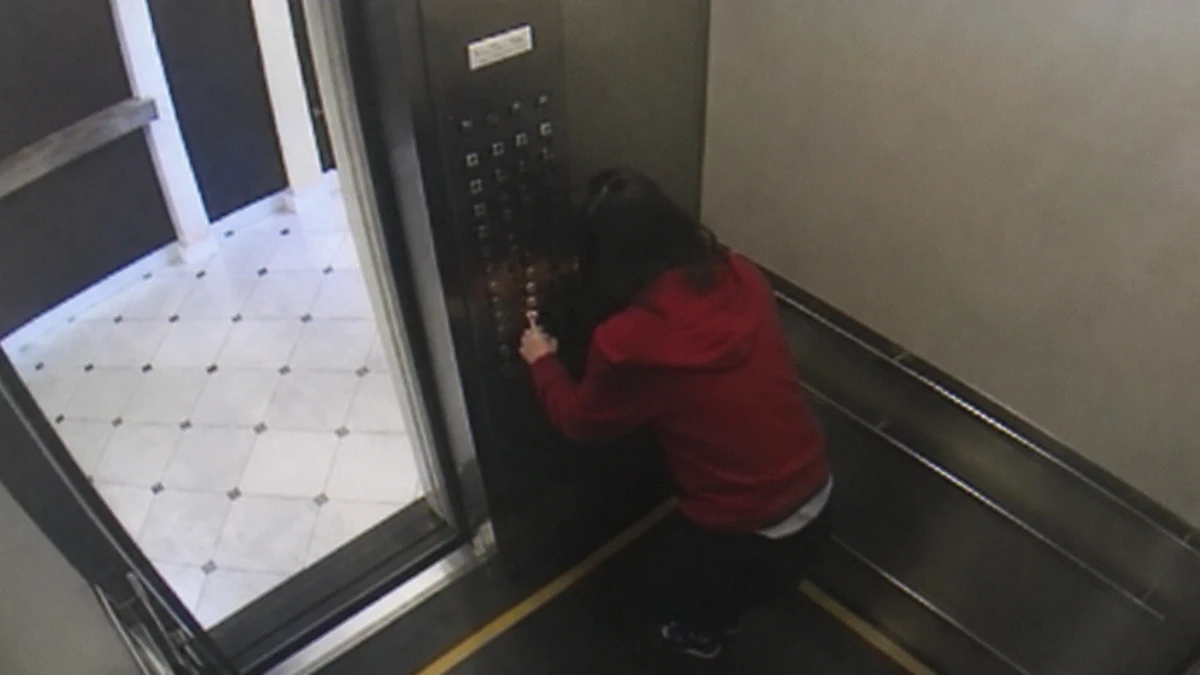
On February 13, the LAPD published a piece of surveillance footage. It is the last known image of her — recorded in one of the Cecil’s elevators on the day she disappeared, an unsettling clip about two and a half minutes long.
She steps in alone, wearing a red hoodie. She bends over the panel and presses a whole row of floor buttons. The doors do not close. She waits. They still do not close. She leans out into the corridor, looks one way, then the other, then pulls back and presses herself into the corner beside the panel, as if hiding from someone. She walks out. She comes back and pushes the buttons again. The doors stay open the entire time. Finally she stands outside the car, gesturing towards the corridor, bending her fingers one by one as though counting — and then she walks out of the frame and never comes back into it.
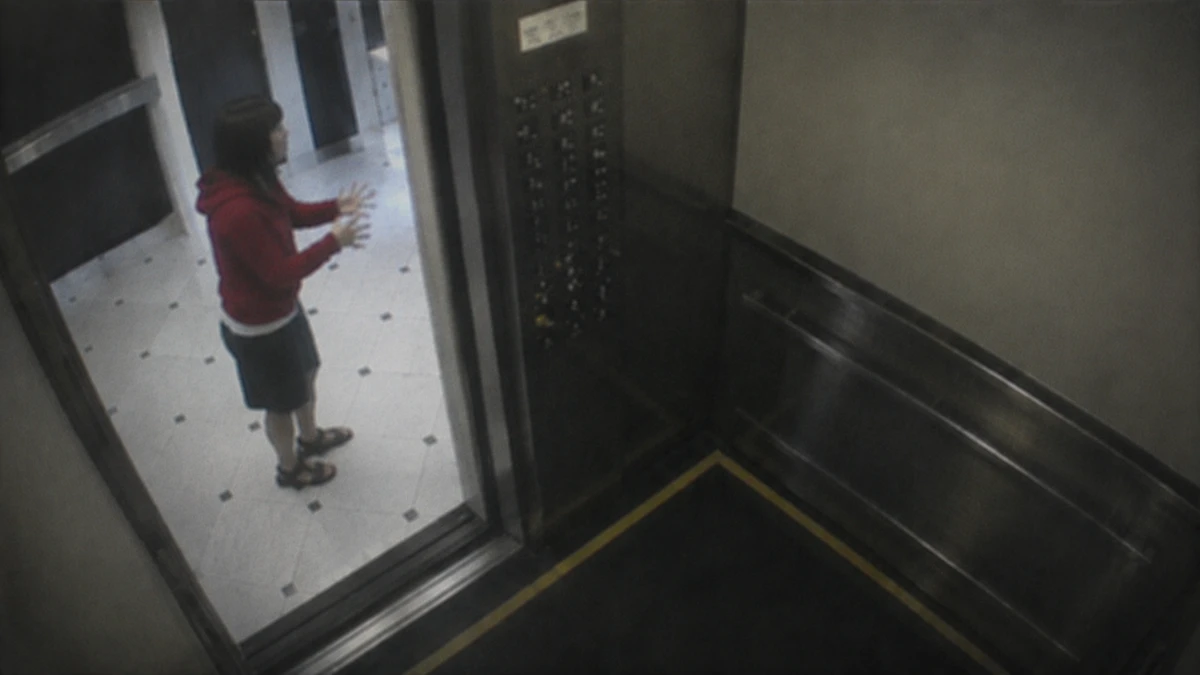
The doors stand open a while longer, then slowly close. Afterwards the elevator goes about its business, up and down, opening and closing — and every time the doors part, nobody gets in and nobody gets out.
The clip went around the world. On Youku, a Chinese video site, it gathered three million views and forty thousand comments in ten days; Chinese-language media chased the story from Hong Kong to Vancouver, and her Chinese name, 藍可兒, became one the whole Chinese-speaking internet knew. People replayed it frame by frame. Some noticed the timestamp had been obscured; some argued the footage had been slowed down, and that nearly a minute of it was missing. The clip has been rewatched, recut and re-enacted ever since.
For nineteen days she hung there on the internet, walking into that elevator over and over.
Nobody knew where she was.
The open hatch on the roof
On the morning of February 19, following up on the complaints about the water, a maintenance worker climbed to the roof to check the four tanks.
They were cylinders, about eight feet tall, propped on concrete blocks, with no fixed ladder — to check the water level you carried one up yourself. On one of the tanks, the hatch stood open.
He leaned over and looked inside.
There was someone in the water.
On the nineteenth day of the search, Elisa Lam was found inside a water tank. The maintenance hatch was too small for the recovery equipment, so firefighters drained the tank and cut it open to bring her out. Her clothes were floating in the water, similar to what she wears in the elevator footage, coated with a sand-like grit. Her watch and her room key were in the water with her.
Her phone was not. Not in the tank, not in her room. It has never been found.
Downstairs, guests packed and left. Some of them counted back through the days — the black water, the sweet taste, how long they had been using it.
At most, nineteen days.
People have imagined and re-staged those days of water ever since: a white basin, and a thin black thread running from the tap.

The report, and what it could not answer
The autopsy was performed two days later. The cause of death was left open, pending toxicology — and it stayed open for months.
On June 20, the Los Angeles County coroner’s office released its conclusion: accidental drowning, with bipolar disorder as a significant contributing factor. The report recorded no injuries and no evidence of sexual assault. The toxicology found only her own prescription medication, at levels low enough to indicate she had not been taking it properly in the days before her death, along with a trace of alcohol. No recreational drugs.
That is where the record is complete. What the record does not answer is everything else.
The doors and stairways to the roof were locked and wired to an alarm — and the keys and codes to that alarm were held only by staff. Whether it sounded that night, and whether anyone heard it, the record does not say. The building did have fire escapes on the outside that could bypass that door; and yet the search dog had lost her scent at a window that opened onto one of them. After her death, someone filmed themselves reaching the roof by the fire escape without difficulty, and the video showed something else: of the four tanks, two lids were open. The worker who found her testified in court that when he got there, the hatch was already open.
How she got up there, and how she ended up in the water — the report has a cause of death, yet no answer to either question. In September that year her parents sued the hotel for negligence. The hotel’s defence was simple: since no one knows how she got into the tank, there was nothing it could have foreseen and nothing it could have prevented. In 2015, the suit was dismissed.
Legally, the case stops there.
The case stopped. The questions didn’t.
After her death, her blog updated itself a few more times. The usual explanation is the queue — posts she had scheduled while alive, publishing on their own when their time came. But is that really what happened? No one can say for certain.
Someone online dug up the 2005 American horror film Dark Water: a run-down building, a faulty elevator, taps running dark — and, at the end, the body of a missing girl in the rooftop water tank. Made eight years before the case, and chillingly close to how it unfolded.
On February 10, 2021, Netflix released a four-part documentary series, Crime Scene: The Vanishing at the Cecil Hotel. The series records what the eye can see; what it never truly explains is what she does in that elevator. Why does she press the whole row of buttons at once? Why do the doors refuse to close in front of her, minute after minute? Why does she fold herself into the blind corner beside the panel, as if hiding from someone the camera cannot find? Why does she stand in an empty corridor gesturing, bending her fingers one by one, as fluently as if someone were standing right there? Viewers keep returning to the same detail — not any single movement, but the fact that from the first frame to the last, nobody else ever appears in that corridor.
The Cecil still stands on Main Street. In 2017 the city of Los Angeles declared the building a Historic-Cultural Monument. The signs have changed, the management has changed, but the building is the same building. The elevator still runs — up, down, doors opening, doors closing.
Only the phone that used to call Vancouver every evening is still out there somewhere, in a place nobody has ever found.