The Village at the Bottom of the Ravine — Fengmen, Henan
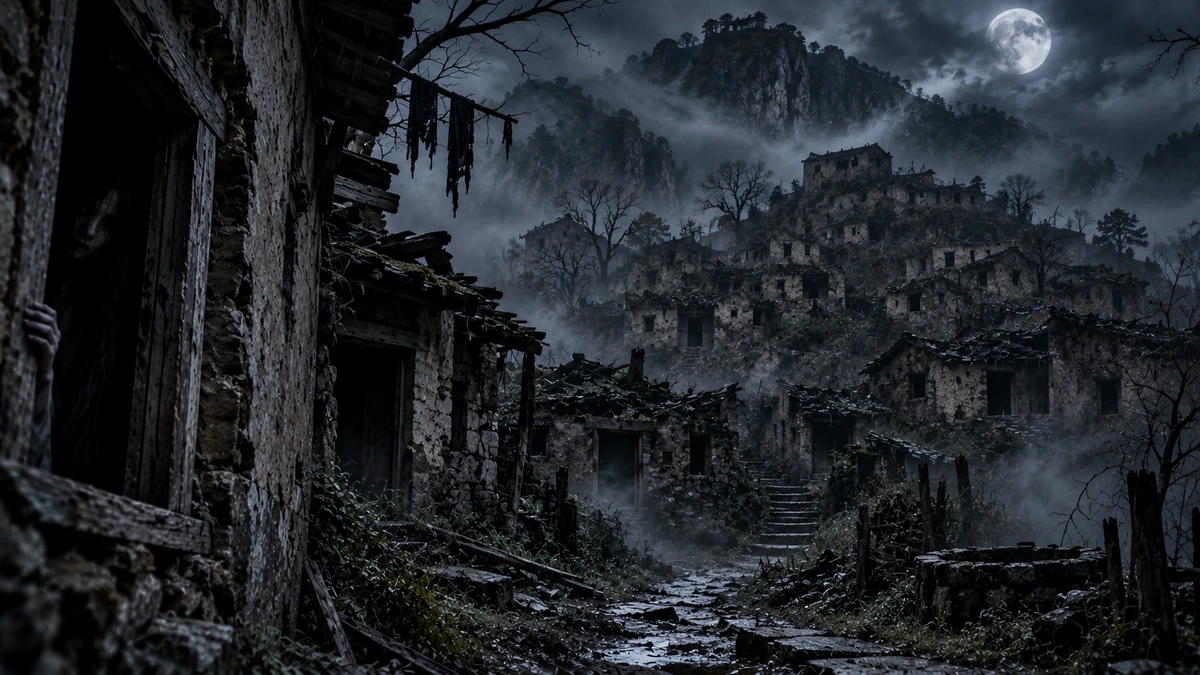
To get in you walk ten li and more of rough mountain path, and it takes over three hours.
Ranges stand behind ranges on either side, and the vegetation is primeval.
Then the village appears.
The buildings are mostly three storeys, stone, timber and stone together, roofed with small grey tiles, and a good many of them are in the Ming and Qing styles. Only one building in the whole village has four storeys, and to reach it you cross a bridging structure from the building next door. Households are joined to one another by stone steps. The steps are not wide, and space had to be left for the turns when the buildings went up, so some of the corners are rounded off.
Thirty-nine stone buildings, more than two hundred rooms between them. Thirty-odd households once lived here, more than a hundred and forty people, with only three surnames among them — Wang, Zhang and Li — and half of them were Wang.
Four fifths of the buildings have lost their roofs.
Scrub and weeds have closed in around the whole village.
Four fifths of the houses have no door panels either, and most of the doorways simply stand open.
This is the mountain country outside Qinyang, in Jiaozuo, Henan Province, where the Taihang range comes down to meet the North China Plain. The village is ringed by mountains and built into the slope, at the bottom of a ravine.
The whole settlement is packed into less than a kilometre, laid out to follow the ground, the buildings stepping up and down against the slope.
There is an old road here, and old buildings, an old mill, old stone tablets, old temples and a stone bridge. There is also a honey locust tree a thousand years old, thick-rooted and heavy with leaf, too wide for four people to reach around with their hands joined.
The river ran dry, and they left one household at a time
For a thousand years this was an obscure little village in the hills, and nobody had any reason to know its name.
It was not called Fengmen then either. It was Fengmen written another way: Wind Gate.
In the old language a wind gate meant a place the terrain made formidable, hard to take and easy to hold.
It did not start out in Henan, either. On 11 August 1956, three settlements that had belonged to Xiyao township in Jincheng county, Shanxi — Yuntai, Fengmen and Xidongshui — were transferred to Qinyang county in Henan. Only from that day was this a Henan village at all.
Later the name changed. The character for wind became the character for sealing shut: one is an opening that lets the wind through, the other is a door being closed.
From 1981 the families began moving down to the plain, and by 2007 nobody was living in the village.
There were four reasons.
The first was water. The river ran dry, the mountain was desperately short of water, and the harvests kept falling. In 1988 a flood came down and destroyed almost all of the village’s terraced fields, and the same storm left signs of landslip on the ridge above.
The second was school. There was one composite class going up to second year, life on the mountain was hard and teachers would not come, so a child who wanted to carry on had to travel more than ten kilometres to do it.
The third was the road. From the village it is a four-hour climb to reach Yuntai, and from Yuntai another five hours to get clear of the mountains.
The fourth was marriage. The girls of the village married down the mountain, the girls below would not come up it, and the young men here could not find anyone.
The living left, one household at a time.
Fengmen had its own burial custom, put locally in eight characters: the living and the dead share the village, and the dead do not leave it. Nobody was carried out to be buried. A space was found near the dead person’s own house, and they were buried there. Generation after generation of this produced the other phrase people use about the ravine — that there are bones in every gully and spirits at every bend.
There are three temples in the village.
Inside one of them stand two stone figures, a man and a woman, dressed in official robes, poised and dignified in bearing. By the clothing, the robes are Ming.
Around 2008, people who hike for sport found the empty village. When they got home, they posted what had happened to them inside it on internet forums.
That is when it started being called a ghost village, and then China’s first ghost village. Television crews came up the ravine after that, and then the film-makers, and then the people who write horror fiction for the internet.
The things posted on those forums were given names, one by one: the mystery of the empty village, the mystery of the coffin, the mystery of the photographs, the mystery of the possession, the mystery of the armchair.
The mystery of the empty village is the ravine itself: thirty-odd households, more than a hundred and forty people, and by 2007 not one of them left.
The rest were brought out by the people who went in afterwards. The first of them has to do with photographs.
There was a face on the wall when they looked at the pictures later
They took photographs in Fengmen.
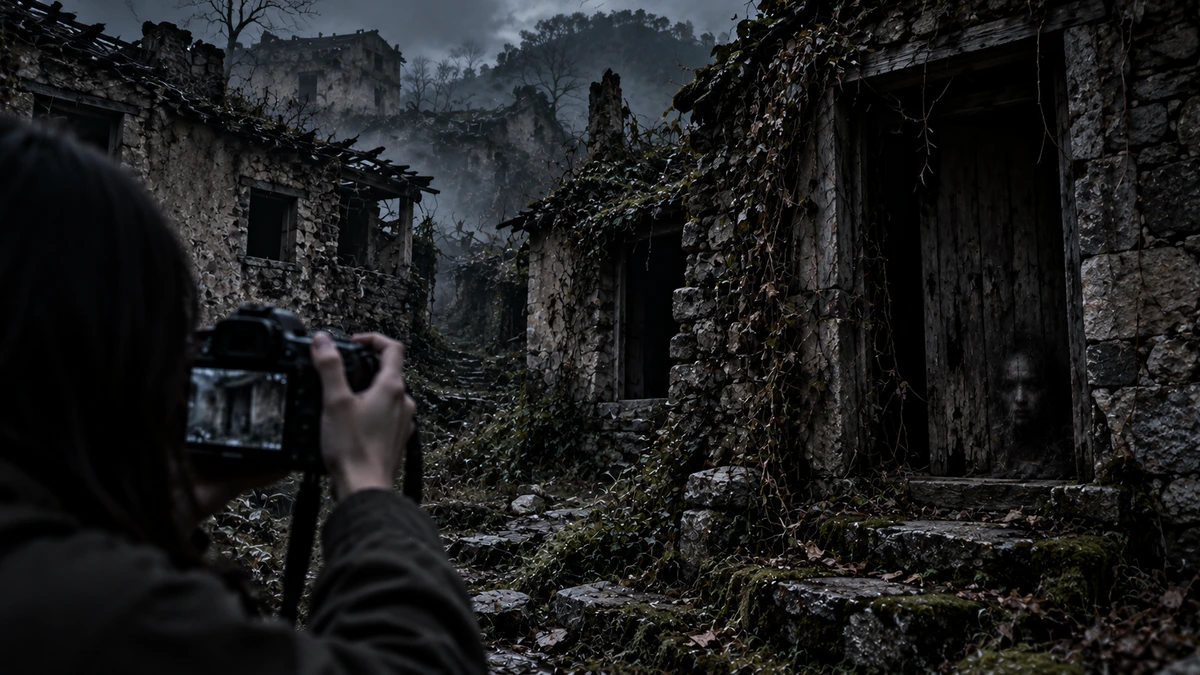
Going through the pictures afterwards, there seemed to be a face on the wall in one of them.
Very faint.
Another person who had been into the village said the same thing had happened to them. The difference was that their face was not on a wall. It was on a door.
One face on a wall, one face on a door.
That story was given its own name: the mystery of the photographs.
In one of the houses there was a coffin
Fengmen has a custom more than a hundred years old. When an old person of the village died and their husband or wife was still living, the descendants who had already moved down the mountain would carry the coffin back to the family’s house in Fengmen, and when the other one died the two of them would be buried together.
So in a village where nobody lives, there are houses with coffins standing in them.
They are waiting for somebody.
Someone who had been inside said that on an earlier visit to Fengmen they had seen a coffin in one of the houses.
They went back to that house later and the coffin was gone.
That story got its name too: the mystery of the coffin.
They slept in the village, and came back with scratches
Once the village became well known, more and more people went up.
Not the sort who look for an hour and leave. Large numbers of them slept in Fengmen overnight, group after group.
What they brought back out with them comes down to a short list: phones that stopped working, the coffin, scratches, the photographs.
And belongings that vanished out of their packs.
A dead phone can be a mountain with no signal. A missing thing can be a thing you dropped on the path. A coffin can be somebody else’s business. A face in a picture can be a trick of the light.
Scratches are harder.
In the accounts that spread, they are not grazes. They are blood marks and scratch marks appearing on the body with no explanation for them.
Not something seen and not something heard. Something found on yourself once you are back down.
Not in somebody else’s house. On your own skin.
The one house in the village that faces the wrong way
Every building in the village is set along the slope. One is not.
It stands on its own, oriented north to south, at odds with every other house around it.
Inside there is the armchair and nothing else, no other objects at all.
A Qing dynasty armchair, sitting there.
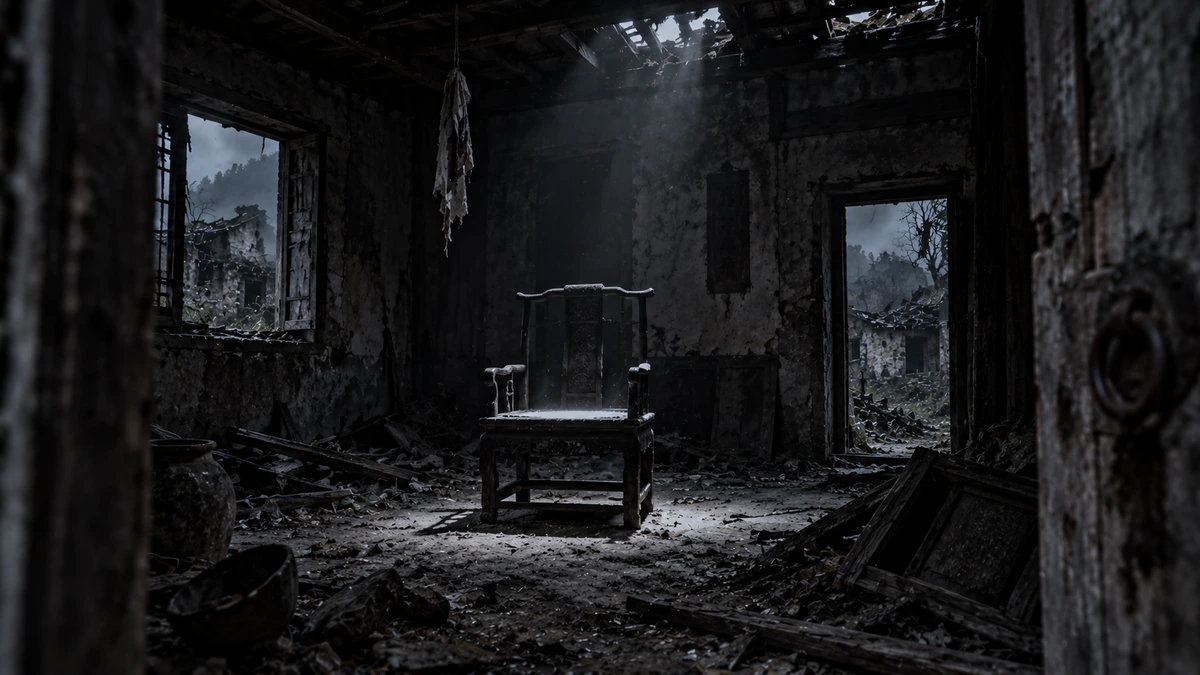
Nobody has lived in this village for years, and the seat of that chair is clean.
Not cleaner than the rest. Clean the way a chair is clean when somebody has just been sitting in it.
And everyone who went into that room and sat down in it came off badly afterwards, to one degree or another: fevers, talking nonsense, getting up in the night and walking in their sleep.
That is the common version.
There is another that has travelled further, which holds that anyone who sits in that chair will not live long.
The mystery of the armchair, as the forums put it: sit in it and you die.
Nothing has ever settled on that seat
Four fifths of the buildings have lost their roofs, four fifths have no door panels left, and the scrub is closing in from every side.
The mountain is taking the village back a year at a time, one building and one room after another, and the old road with it, and the mill, and the stone tablets, and all three temples.
Nothing has come down on that one seat.
It is clean the way a chair is clean when somebody has just stood up out of it.