Gonjiam: Three Knocks on the Second-Floor Door
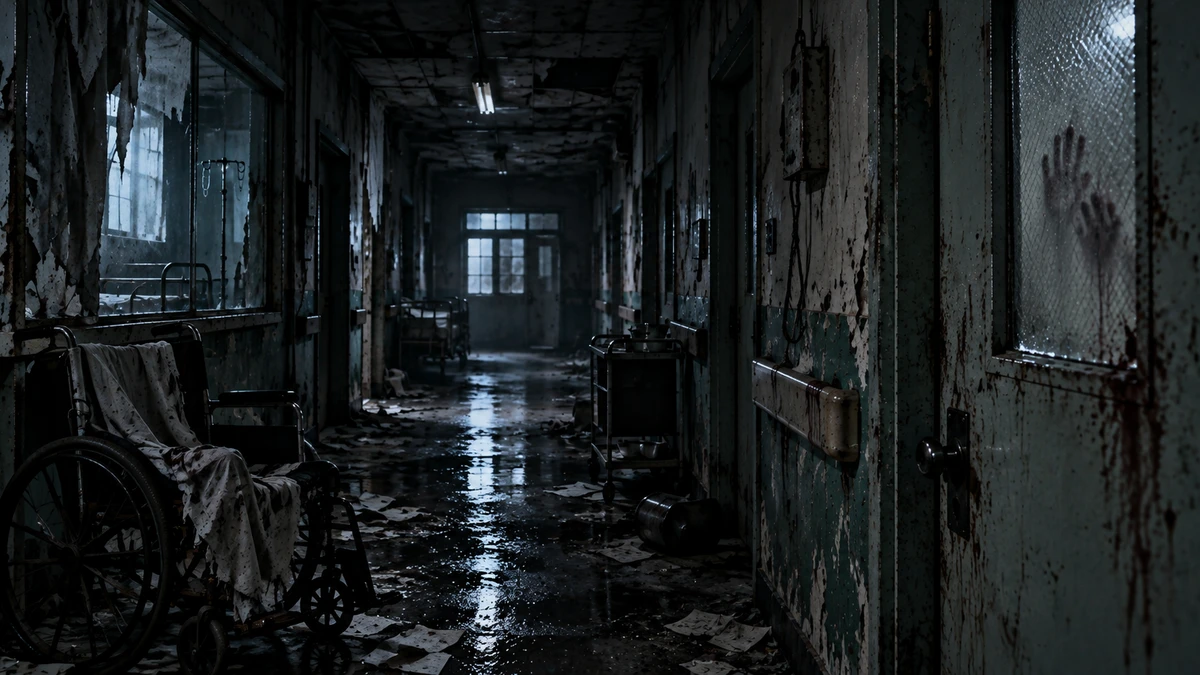
In Gonjiam-eup, part of the city of Gwangju in South Korea’s Gyeonggi Province, at the foot of the hill behind a village, stood a three-storey building with one more floor below ground and a low annexe on either side. Every window was broken. The iron doors had rusted through. Wind went in one end of the building and out the other, the rooms of the annexe ran on one after another, all empty, and the clock on the wall had stopped at four.
Across the gate hung a chain, a padlock, and a board: managed private land, trespassers prosecuted. Barbed wire ran over the top of the gate, and creepers ran over the wire. After dark, seen from the village, not one window in the building showed a light.
The way the village tells it
The director went mad.
That is how the village tells it. In the psychiatric hospital at the foot of the hill, the director began, one day, to be not quite right. Patients began to die in the wards, one after another, with no cause anyone could write down. The nurses left. The doctors left. In the end the director hanged himself inside the building, and his two sons, later, went the same way.
Others say the ground was never clean to begin with. It had been a prison once. People had been held there, and people had been killed there.
The ones who died there did not leave.
A television crew brought a shaman in with the cameras, and the shaman said the place was full of spirits. There are stories about the roof, too: that of all the people who climbed up there, more than a few went up meaning to come down the quick way. The woman at the restaurant on the edge of the village has a warning for anyone who stops to ask the way. A lot of people died in there, what do you want to go for? People with a weak constitution bring a ghost back with them.
Why everything is still inside
The hospital was built where the water mains did not reach, and its water came up the hill by tanker, one load at a time. Then the area was made a water-source protection zone, the law required a sewage plant of the hospital’s own, and the hospital never built one. In July 1996 it closed. The patients were moved out. After that the owner was gone too, and nobody came back.
The building was never cleared, and it was never pulled down. The beds stayed in the wards. The blankets stayed on the beds. The long tables and benches stayed in the dining hall. Paper charts with patients’ names and diagnoses lay scattered over the floor. Broken glass lay under every window, sofas lay on their sides in the standing water, and a single milk crate stood in front of one window, as if someone had used it to climb in. The floor below ground, they say, had been the morgue. Its door was shut, and shut tight, and the people who had been down there said that of the whole building, that floor was the place for a real test of nerve.
The doors were locked, and the building, with everything inside it, was left at the foot of the hill. In 2012 an American news network named it one of the seven creepiest places in the world. From that year on, about a thousand people a year climbed in.
Footsteps in high heels
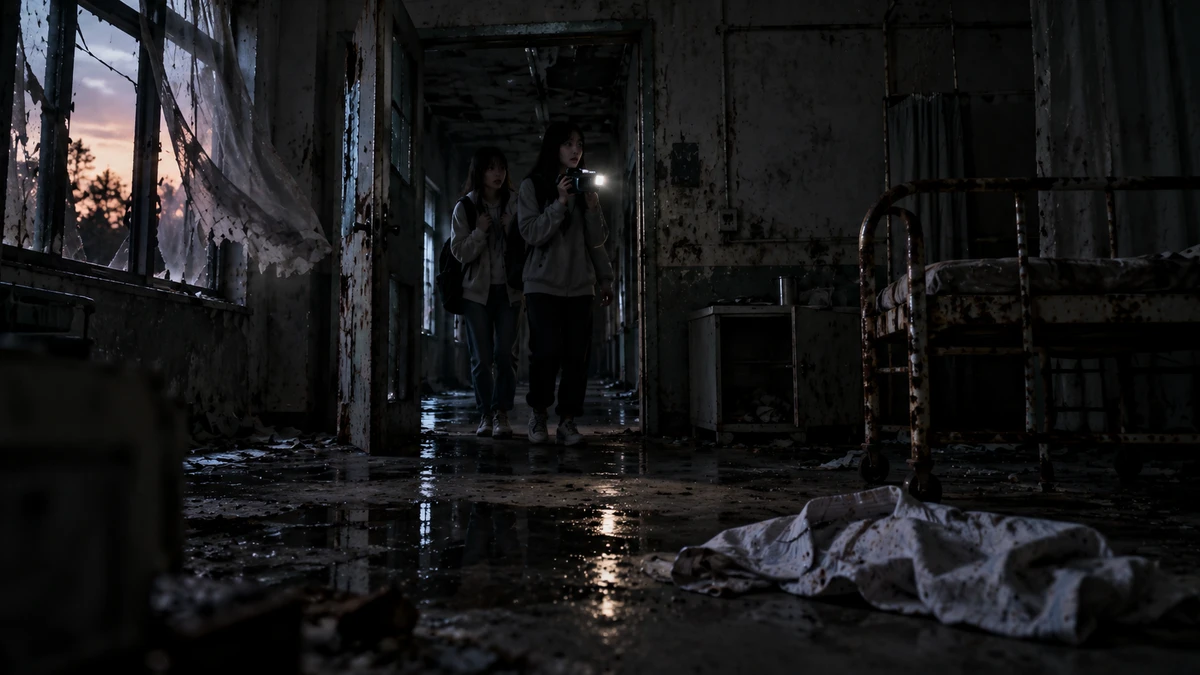
In the spring of 2018 two young women from Hong Kong came over the hill behind the building and went in by the back door. She kept the camera running the whole way. It was for the people watching online, she said.
There were two hours of daylight left, but inside it was far darker than out. Water dripped somewhere, one drop at a time. Wind came in through the broken windows and moved through the whole building.
On the floor of one ward lay a shirt. New. So new it might have been taken off there the day before.
She asked the empty room: who is here?
Nobody answered.
Further in, the two of them stopped at the same moment. The camera had picked up footsteps. Not theirs. Just ahead, in the next stretch of corridor. One step. Another.
They walked towards the sound, to the place where it had to be.
There was nothing there.
One door had been knocked flat. In one ward a mattress had burned down to its blackened springs. The building had been on fire at some point, and when, nobody knows.
They went up to the roof and came down again. A cup of coffee stood there. Who had carried it in, nobody knows either. Then the sound came back, like someone walking the corridor in high heels, and this time they counted. Ten. Twelve. It did not stop, so they took a different way.
The wind had dropped. The door kept going. One bang. Another. As if someone were slamming it shut, opening it, slamming it shut again.
They switched off their headlamps and stood in the dark and listened.
Then someone came in downstairs. They crawled out through a hole on the far side and went back over the hill, and at the bottom two local men sat waiting in a white car and said only one thing. You cannot go in there.
She watched the footage again when she got home. The footsteps were on it, she said. Her friend said only one thing about them. That was not a person. She had not come to look for ghosts, she said. She only could not work out how, in broad daylight, it could have happened at all.
After eleven at night
The people in the village will tell you that the building starts to scream after eleven at night.
From eleven until dawn, the sounds that reach the village from the foot of the hill are the noise of tuned cars, car horns, screaming, sometimes a whole group screaming at once, singing, and the people who have come out of the building drinking and shouting in the village pavilion until nobody can sleep. The police box takes a call a day. Officers patrol every thirty minutes. From eleven at night until four in the morning, four of them stand watch below the hill. One summer they brought in a riot squad, put cameras on the gate, and talked of closing the hill path.
A villager who had lived below the hill for decades put it this way: “If they played quietly and left, we wouldn’t be like this either.” The villagers complained all the way up to the presidential office.
People still go in. People still scream.
One night two young men walked in holding a phone out in front of them, streaming live.
“Ah! The sound of water dripping. There’s some strange sound. Aaah!”
“Hey, you scared the life out of me.”
Several hundred thousand people heard them scream through the screen.
What they had heard, a moment before, nobody knows.
The next night, after eleven, someone at the foot of the hill began to scream again.
The other side of the door
One very hot summer night in 2011, ten young people stood outside the fence. The building was famous by then, and they thought a test of nerve would be simple.
Out of the two-storey house next door came an old woman with a torch, and the beam passed over their faces one by one. “You’re going in there? Don’t. I’ll call the police.”
They said they were going to a friend’s house.
She kept at them to the last, the beam never leaving them, and still they went in under the fence.
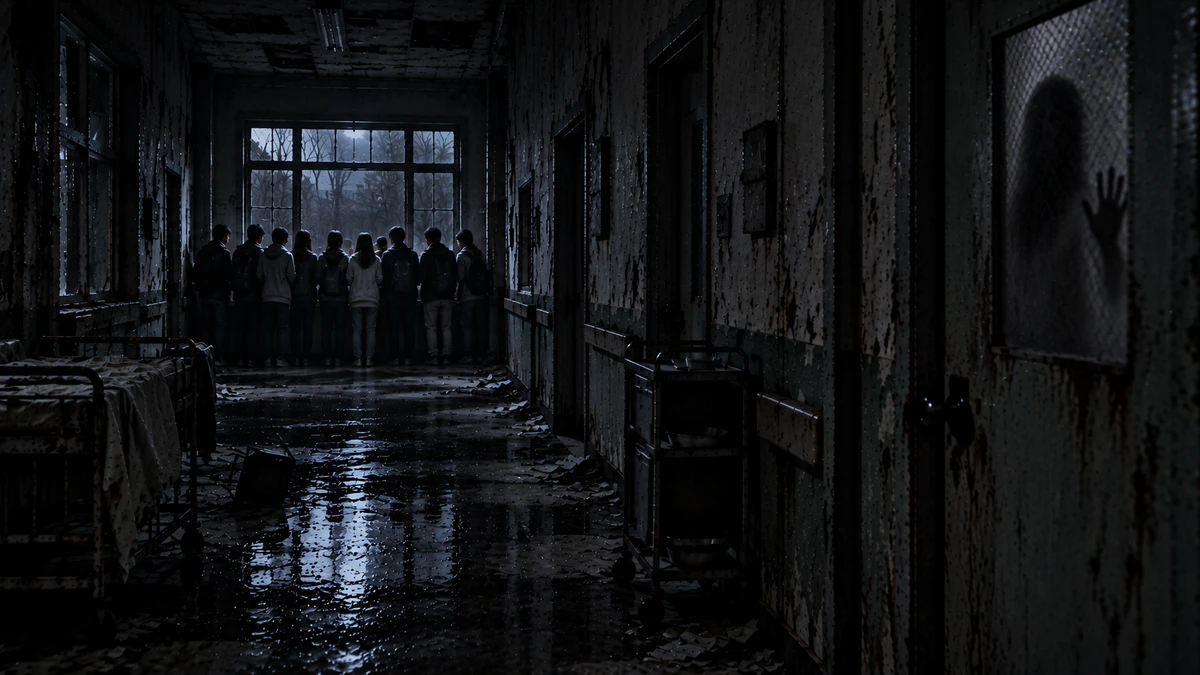
The ground-floor door had to be forced. Past a room heaped with patient charts, and up to the second floor.
The corridor on the second floor ended at a window, and beyond the window was open ground, and ten people crowded at the window arguing about whether to climb out. There was another door in the corridor. It stood some distance from every one of them. Nobody’s hand could have reached it.
One of them spoke to the door. Can we go through this way? If not, knock again.
Knock. Knock. Knock.
Three times.
Somebody swore and told whoever it was to stop messing about.
But there was nobody in front of the door. And among the ten of them, nobody had knocked.
So ten people ran screaming for the stairs, and on the ground floor the door they had forced on the way in was already closed.
Outside the gap in the fence the old woman was still standing, the torch still lit, the beam coming across to them, and she asked only one thing.
“You saw it, didn’t you? It’s real.”
The police were waiting in the car park. They did not ask much. They said never to come back. Five years later the young man told the story on a livestream, and by the end there was only one thing left to say. Never go to Gonjiam alone. Go, and you will see.
Four o’clock
On 28 May 2018 the excavators came in under the hill. The three storeys, the annexes, the roof, the corridors, the floor below ground, all of it went down into one heap of rubble.
The beds, the blankets, the charts all over the floor, and the pendulum clock on the annexe wall: where any of it went, nobody knows.
The clock had stopped at four.
Houses are to be built on the ground. The people who move in will have clocks of their own, and doors of their own.
At four in the morning, when they hear a knock, should they open the door?