Five Shots After Closing Time at a Hachioji Supermarket
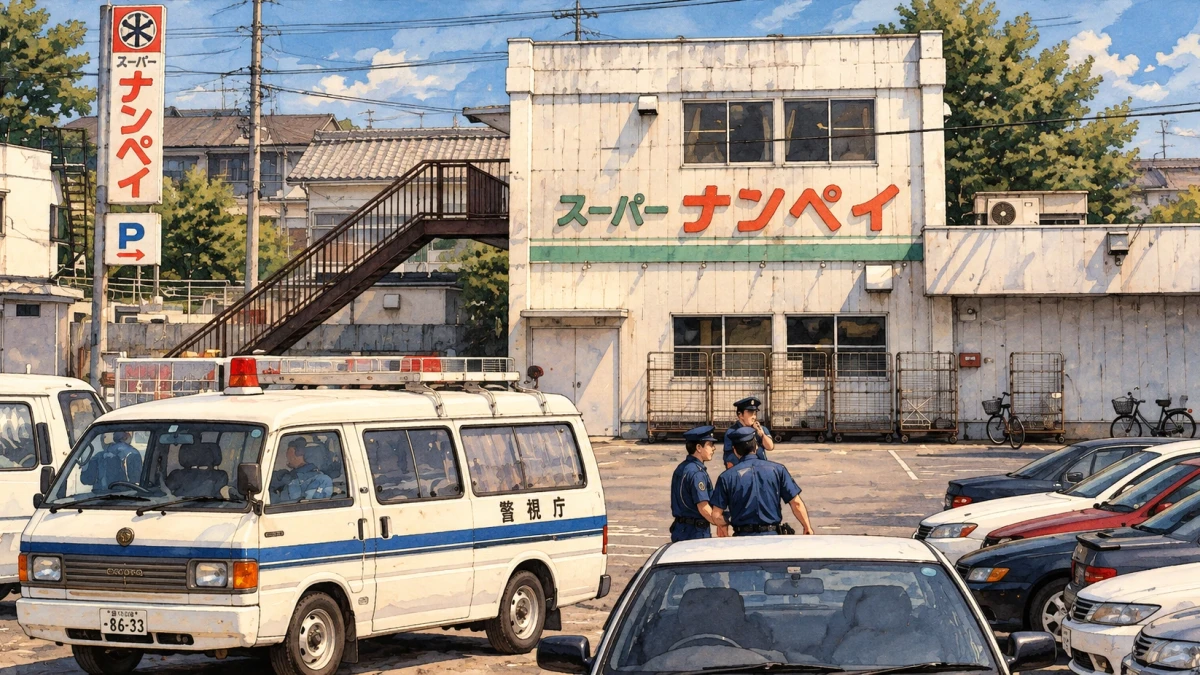
In Hachioji, Tokyo, Japan, Sunday 30 July 1995 was a scorching day. Across the road from the Owada branch of the Nanpei supermarket, less than thirty metres away, Kitanohara Park was holding its summer festival. It started at six in the evening, plenty of locals came, and the park stayed busy until just after nine.
At nine o’clock the supermarket closed. It was a two-storey building, with the shop on the ground floor and the office upstairs, and the only way up to the office was a staircase on the outside of the building.
After closing, three people were still in the upstairs office: Noriko Inagaki, a 47-year-old part-time worker; Megumi Yabuki, a 17-year-old in her second year of high school; and Hiromi Maeda, 16, also in her second year, who was not working that night and had come in to see her friend.
Within a quarter of an hour, all three had been shot dead in that office, yet not a single note of the more than five million yen in the safe was missing.
The phone call at 9:15
That evening Inagaki and Yabuki were working the till, going through the day’s takings figure by figure. Inagaki was on the night shift, and she had the key to the safe. When the counting was done, the three of them got ready to go home.
At 9:15, Inagaki rang an acquaintance who lived nearby and asked him to come and pick her up. He had already arranged to go out to eat with one of the women from the shop. The police later found the call in the phone records. It was the last time Inagaki spoke to anyone outside that room.
Two or three minutes later, at about 9:17 or 9:18, a passer-by in the street heard a noise. Several households nearby heard it too: bang, bang, a run of them, one after another. Because the park across the road had been noisy all evening, some took it for festival drums and others for fireworks. Nobody thought of gunfire, and nobody called the police.
But by then, the festival in the park had been over for about ten minutes.
So those bangs had not come from the park. They had come from the second floor of the supermarket.
The man waiting at the bottom of the stairs
Just after 9:20, the acquaintance who had come for Inagaki arrived. He went to the bottom of the outside staircase and waited there.
In the few minutes before he got there, someone had climbed those same stairs and come back down them. The two of them may have missed each other by only a few minutes. They may even have passed each other in the street.
Still Inagaki and the girls did not come down, and the longer he waited, the stranger it seemed. In the end he asked a woman he knew to come with him, and together they climbed the outside stairs and went into the office. All three women were lying inside.
The police received the call at 10:08 p.m., almost fifty minutes after the bangs.
The shop had a security camera, but it had no way of recording. The alarm was set by hand by the last employee to leave, and that night none of the three ever left the office, so the alarm was never set and never went off.
So from the gunman’s climb up the stairs to the walk back down, the camera recorded nothing and not a single alarm went off.
The bullet mark on the safe
In the office, Yabuki and Maeda had tape over their mouths, and the two girls’ hands had been bound together.
All three had been shot in the head at close range. Inagaki was shot twice, each of the girls once, and the fifth bullet hit the door of the safe.
The bullets were sent for forensic analysis. Both the ammunition and the gun turned out to be Philippine-made: a .38-calibre handgun with a short barrel, small enough to carry hidden on the body.
That one bullet had left a mark on the door of the safe. Inside was about 5.26 million yen, and not one note was missing. The office had not been searched. Inagaki had the key to the safe, and the sheet of paper with the instructions for opening it was lying in the same room.
This is the part of the case that makes no sense. If the gunman came for money, more than five million yen was right there. If not, why fire at the safe at all? And if it was about money, why kill three people? So from the very first day, the special investigation headquarters set up for the case refused to settle on any single motive.
Investigators laid the times side by side: the phone call, the bangs the passer-by heard, the moment the acquaintance arrived below. They worked out that the gunman had a window of about two and a half minutes. A retired detective from the Tokyo police’s first investigation division put it this way: “Four or five minutes at the very most.”
In two and a half minutes, someone climbed those stairs, taped two girls’ mouths shut, bound their hands, fired five shots, then went back down empty-handed into a night the festival crowd had only just left.
The white car with its lights off
Before the shots, at around nine o’clock, someone noticed a white saloon car parked by the road to the south-east of the supermarket with a man sitting in the driver’s seat. It was a summer night, yet every window was shut and the lights were off. The man sat with his elbow propped up, looking towards the upstairs office.
The witness later said: “Was he waiting for someone, or waiting for something? It felt really suspicious.”
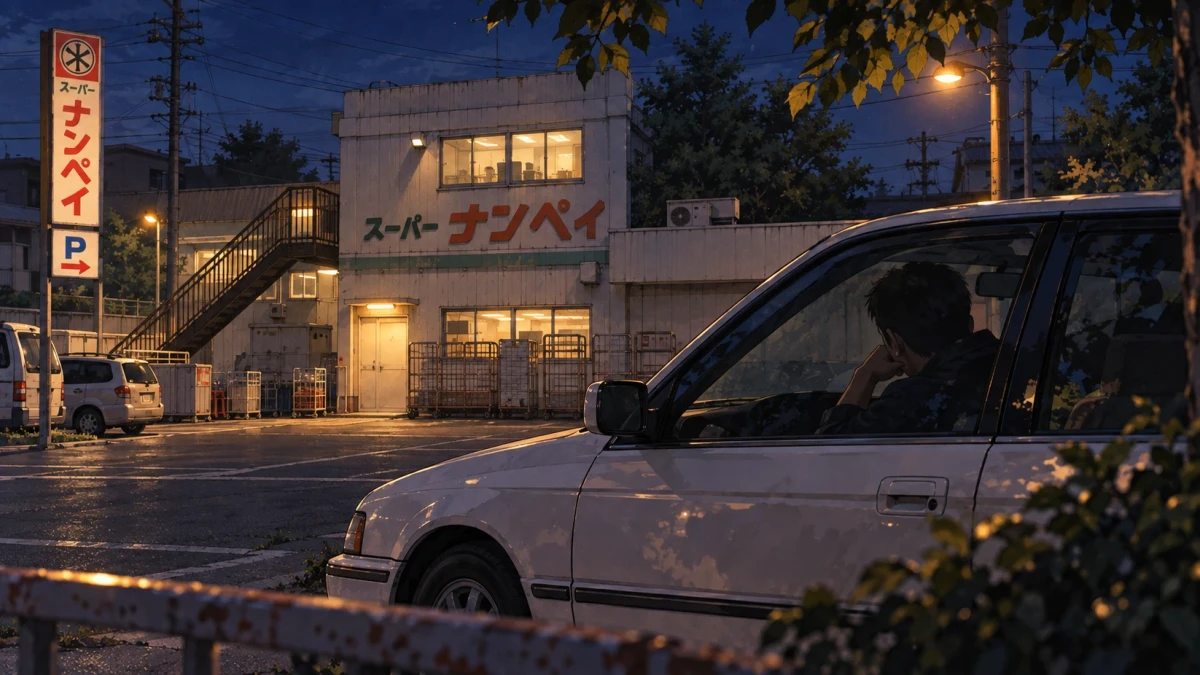
At about the same time, another resident saw a man in a white short-sleeved top standing near the supermarket, also looking towards the office. The moment he noticed he was being watched, he ducked out of sight.
That night, at least two people saw someone keeping watch on that office.
With the park so crowded for the festival, the police reasoned that someone might have seen the killer. They started at the scene and went door to door until they had spoken to every household around it. Yet no one remembered the number plate of any car, and no one had clearly seen a single face. Three white cars had been parked to the east, south and west of the supermarket that night. Their registration papers had since been destroyed, or the cars had been scrapped, and the police were never able to establish who owned them at the time.
The man in the car, elbow propped up and eyes on the second floor, was never found.
The 26-centimetre footprints
The footprints at the scene came from a 26-centimetre trainer, worn rather than new, and two models on the market matched them. One model sold 439 pairs in 1990 and 1991. The other was on sale in 1993 and 1994, and only 94 pairs were sold in the whole of Japan. One pair among those few hundred had climbed the stairs to the second floor.
The tape used to bind the two girls held something too. There was sweat on it that did not belong to any of the three victims, but the DNA recovered from it was too incomplete to identify anyone.
About ten years after the killings, investigators lifted a fingerprint from the same tape. Eight points on it matched the prints of one man, but the police require twelve matching points before they will call it a match. On top of that, the man had died of illness in 2003, eight years after the killings, so by the time the print was lifted he was already dead. The police later established that he was most likely nowhere near the scene that night. That lead ended there.
At 8:56 p.m., four minutes before closing, the day’s last customers, a man and a woman, paid at the till, walked out to the car park and drove away in a white car. The two behind the till that night were Inagaki and Yabuki. The couple may have been the last customers to see them that night. The police have been looking for them for thirty-one years, and they have never come forward.
The clock at 9:15
The supermarket closed within a few years and the building was pulled down. Where it stood there is now a car park, with a sign beside it asking passers-by for information about the case.
In April 2010, Japan abolished the statute of limitations for murder, the rule that bars prosecution once a set number of years has passed. This case was about three months from expiring. So the investigation is still open today, and over thirty-one years the inquiry has drawn on a cumulative total of almost 230,000 officers.
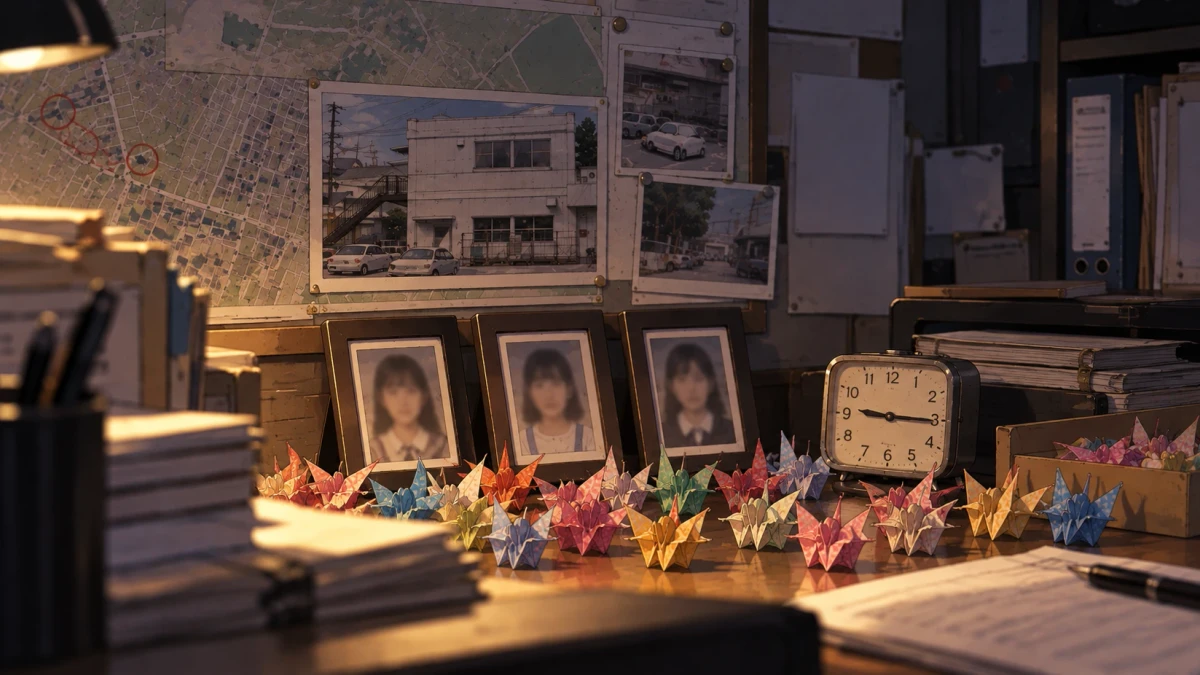
In the investigation headquarters there is still a clock, its hands at 9:15 p.m. Beside it are photographs of the three women and the paper cranes their friends folded, one by one.
The face no one saw clearly
At the top of the police appeal for this case is a single line: “The culprit may be someone close to you.”
The police have searched for those 26-centimetre trainers for thirty-one years and never found them, and whoever climbed those stairs in them may long since have changed into another pair, and may walk past that car park every day, just as on that night thirty-one years ago, without anyone getting a clear look at their face.