The Hat Above the Hedge — Hasshaku-sama
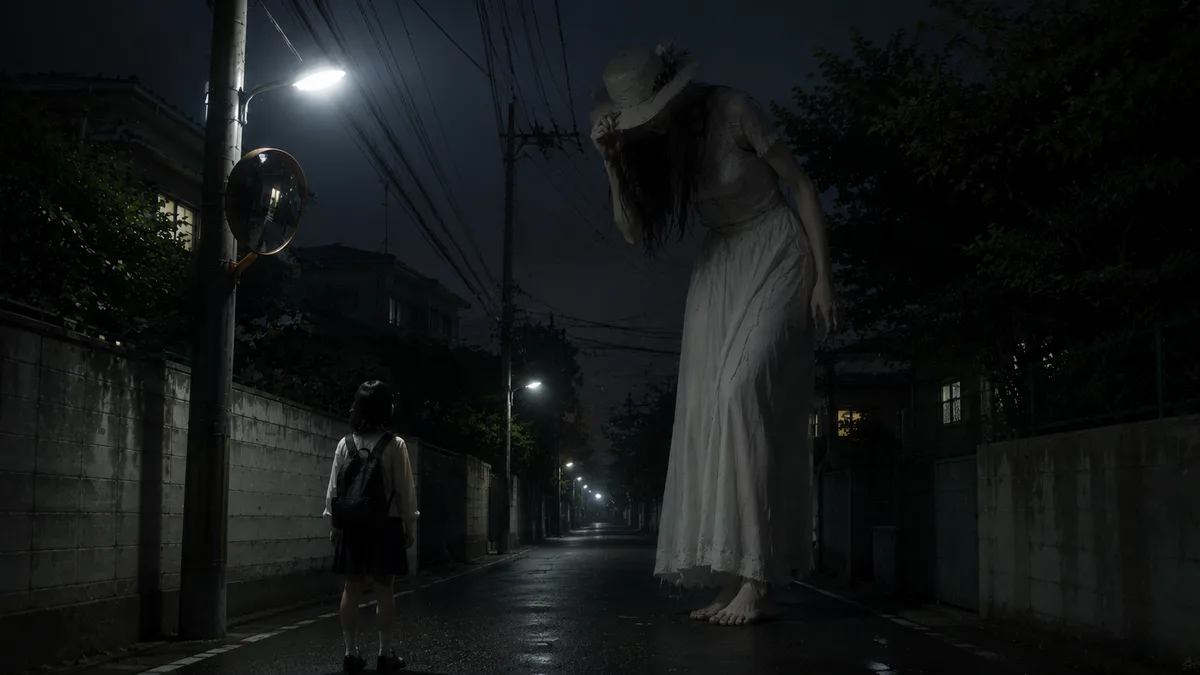
The sound came from the far side of the hedge.
Po… po, po…
Not a bird. Not an insect. It was closer to a man’s voice, pitched as low as a voice can go, imitating a laugh — except the rhythm was wrong. It broke in places a laugh doesn’t break. A machine learning to laugh, stalling halfway.
He was sitting on the veranda. The spring holidays had just begun; the mountain air was still cold, and the veranda boards were the one warm place, soaked in afternoon sun. His grandparents’ garden was so quiet that the only sound was the wind combing through the hedge.
He looked up to see who was out there.
The garden hedge stands two metres tall.
Above the hedge was a white hat.
The hat was at the wrong height
A wide-brimmed white hat, the kind a woman wears against the sun. It slid along the top of the hedge, slow and level, the brim tilting slightly with each step of whoever was wearing it.
His first thought was ordinary. Someone is standing on the other side of the hedge.
His second thought was not. The hedge is two metres tall. For the hat to be up there, the head under it had to clear the hedge by a full head.
Po. Po. Po.
The sound moved with the hat. Through the gaps in the branches he caught a strip of white — cloth, like the skirt of a dress. Then the hat stopped.
It stopped directly opposite the veranda.
He doesn’t remember getting back inside. What he remembers is dinner, and mentioning it the way you mention small news — there was this really tall woman outside, white hat, making a strange noise.
His grandfather put down his chopsticks.
The first thing he asked was not “are you sure.”
It was: “How long did you listen to that sound?”
He told it as small talk, and his grandmother wept
The story exists because he wrote it down himself.
On 26 August 2008, on the occult board of 2channel — Japan’s biggest anonymous forum — in a long-running thread series for collecting stories “too scary to laugh at” (Shinu hodo share ni naranai kowai hanashi o atsumete minai?, by then on its 196th thread), someone posted a long first-person account. It happened, he wrote, in the spring break just before his third year of high school, when he rode his motorbike out to his grandparents’ village in the hills.
The name he gave the thing runs to three characters.
Hasshaku-sama. Roughly: the Eight-Shaku One. Eight feet tall, give or take.
That night, the account says, his grandfather’s face went dark. He asked exactly where the hat had been, exactly when, exactly what it looked like — item by item, like a man filling out a form. Then he went to the phone and made call after call in dialect too fast and too low to follow.
His grandmother sat on the other side of the table and said nothing at all.
She was crying.
When the calls were done, his grandfather sat down across from him and told him the thing the village knew and did not tell outsiders.
Whoever she chooses is taken within days
She is eight shaku tall.
The shaku is an old unit, a little over thirty centimetres. Eight of them come to roughly two hundred and forty centimetres. In an ordinary house, that is where the ceiling is.
The people who have seen her do not describe her the same way. Some saw a white dress. Some saw black. But two things never change, no matter who is telling it.
She is too tall to be a person.
And there is the sound. Po po po — a man’s low laugh, coming out of the shape of a woman.
She exists only inside this one village. On the roads in and out stand jizō statues, and they have stood there for a long time — the village’s explanation is that the statues seal her in, that the boundary holds her.
She leaves most people alone. She chooses. Nobody knows what the choosing runs on, and once it lands, it does not move to someone else. And whoever she chooses does not get many days. Where they are taken, nobody has come back to say.
She prefers the young.
His grandfather stopped there for a moment.
Then he said: she has chosen you.
At one in the morning, his grandfather’s voice was outside the door
Before dark, his grandfather drove off and came back with a tiny hunched old woman. The account calls her K-san. The family met her at the door the way you meet a doctor.
She wasted no words. She went up to the second floor, picked a room, and went to work.
She papered the window over with sheets of newspaper, one overlapping the next, and fixed paper talismans along the edges. In each of the four corners of the room she set a small dish of salt, piled into a little peak. By the bed stood a box-like wooden stand — nothing you could call an altar — with a small statue of the Buddha resting on top.
Then she pressed a talisman into his hand and gave him the rules. There were not many. None of them could be broken.
Be inside before dark. Lock the door. Until seven in the morning, the door does not open — no matter what.
No matter what you hear.
No matter whose voice it is.
No photograph of that room exists. What the later retellings hand down is a dramatised recreation — the papered-over window, the ring of talismans, the salt in the four corners.
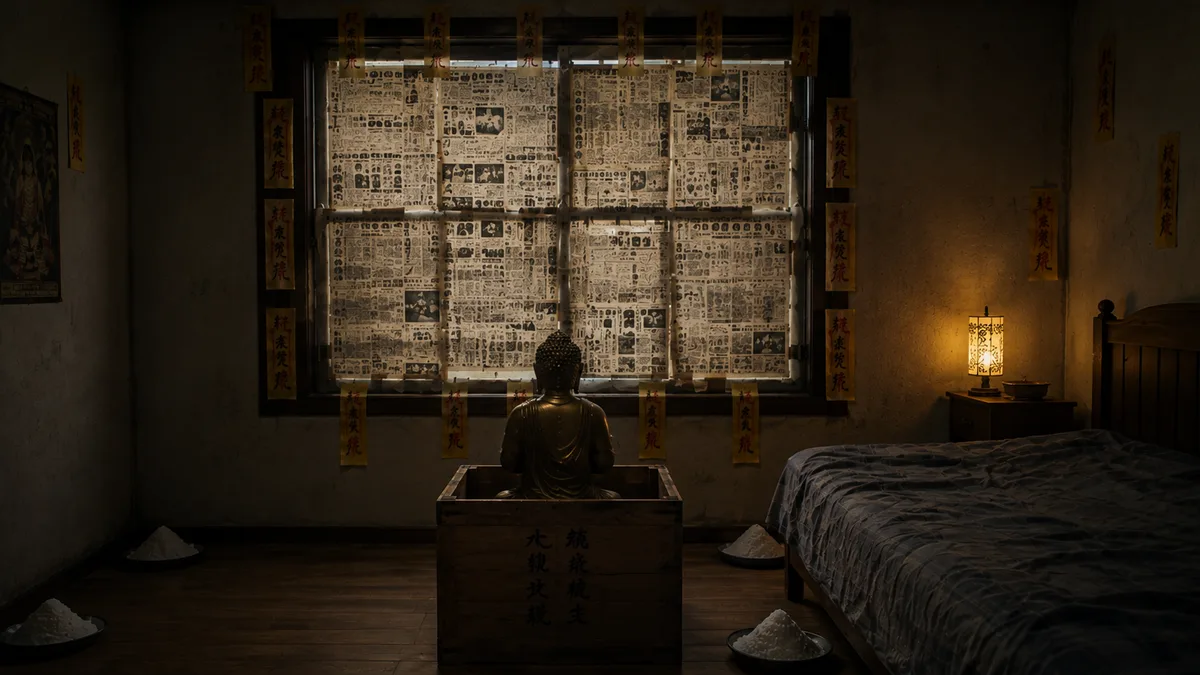
Past one in the morning, the window made a sound.
Knock. Knock.
Something was tapping the glass through the newspaper. Lightly. Patiently. Two taps, a pause, two taps. He sat on the bed with the talisman crushed in his fist and did not look at the window.
Then the tapping stopped.
Footsteps came up the stairs and stopped outside the door. His grandfather’s voice came through the wood: it’s morning, it’s over, come out now.
It was exactly his grandfather’s voice. Even the way it paused for breath was right.
His watch said it was a few minutes past one.
He looked at the corner of the room. The dish of salt nearest the window had begun to turn black, from the peak downward, as if something had burned it.
The voice outside the door called him again.
He faced the small Buddha and recited, all night, the only sutra he knew.
A van full of the same blood
At thirteen minutes past seven — he checked the time on the television over and over, then checked it against his watch — he opened the door. His grandmother and K-san stood outside, both wearing the colour of a night without sleep.
His father had arrived too, having driven up from the city through the dark. In the yard stood his grandfather’s little truck, his father’s sedan, and between them a nine-seater van. Around the van stood a ring of men, all of them from his grandfather’s line. His father’s brothers could not make it overnight; the ones who could come at once were men whose blood tie to him had worn thin — but it was blood.
The adults’ explanation: blood confuses her eye — even blood thinned almost to nothing. Fill a vehicle with people who share it, and she cannot tell which one is the one she chose.
They walked him to the van inside a wall of bodies. He sat in the very middle of the middle row, a man on either side, and K-san took the front passenger seat. Nine people in the van, counting him — walled in from all eight directions. The talisman stayed pressed in his palm.
Before they moved off, they gave him one instruction.
Close your eyes. Keep your head down. Whatever you hear, do not look up, and do not look at the windows.
The convoy rolled out of the yard — truck in front, van in the middle, sedan behind. He kept his eyes shut and listened to the tyres on the gravel and counted his own breathing.
No footage of that mountain road exists either. What circulates is a dramatised picture: three vehicles running nose to tail, with him wedged in the middle one.
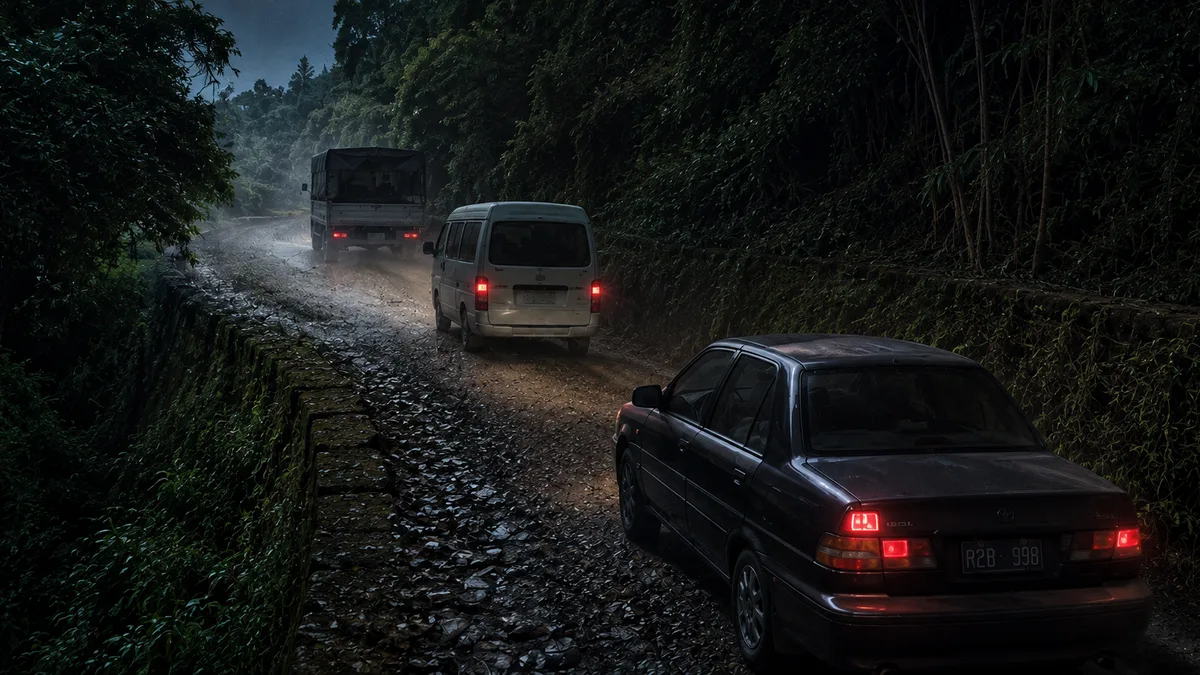
Then, through the engine noise, he heard it.
Po. Po. Po.
Someone in the van sucked in a breath. Then came low chanting. He broke the rule — opened his eyes to a slit and looked through his lashes.
In the middle of a field stood something white. Even at that distance, it was the wrong height.
A heartbeat later, something knocked on the glass of the moving van.
A man shouted. The engine howled, and the van flew on the gravel road. At some point — he could not have said when — the knocking was gone, and the po po po had fallen away behind them until it wasn’t there at all.
Where the road widened, the convoy stopped. They moved him into his father’s sedan, and it drove him straight back to the city.
He opened his hand.
The talisman he had held the whole way had turned black. All of it. Like paper cured over a fire.
He thought he had got away
He never went back to the village.
University, then work. Every Obon and every New Year, he had a reason. His grandparents never once blamed him. Some years his grandfather would call, and they would talk about school and then about work, and neither of them would mention that spring.
Two years before he posted his account, his grandfather died.
He did not go to the funeral. That was not his decision — it came from the family. His father went alone, and when he came back he said one thing: better this way.
He assumed that was the end of it.
A few days before he wrote everything down, his grandmother telephoned. Her voice was old and slow. She talked about the weather, and her health, and then she was quiet for a long time.
Then she told him. One of the jizō statues that seal Hasshaku-sama in had been destroyed.
She told him which one.
The one on the road that leads to his house.
What the outside world knows about her
Afterwards, pieces of the legend leaked out of the village, the way these things always do. Put together, they say this.
She is eight shaku tall — roughly two hundred and forty centimetres. The people who claim to have seen her cannot agree on the dress. White, some say. Black, say others. But three things never change: the hat, the height, and that low male laugh — po po po — coming out of the shape of a woman.
The rumour goes that whoever she marks is taken within days. Some tellings put it plainer: within days, you die. She prefers the young, and some say she is fondest of children.
The jizō statues keep her inside that one mountain village — for as long as every statue on the boundary stands.
The ways of holding her off are passed around only inside the village: salt, a Buddha, paper talismans, and blood. Whether they hold every single time, the account does not say.
No one has ever photographed her. Every picture that circulates was built afterwards, out of the descriptions.
As for the high-school student in the story — his account ends on a single line. When he thinks, he wrote, about the day he hears that po po po again —
The sentence stops there. He never finished it.