Bring a Doll, and Leave It on the Island
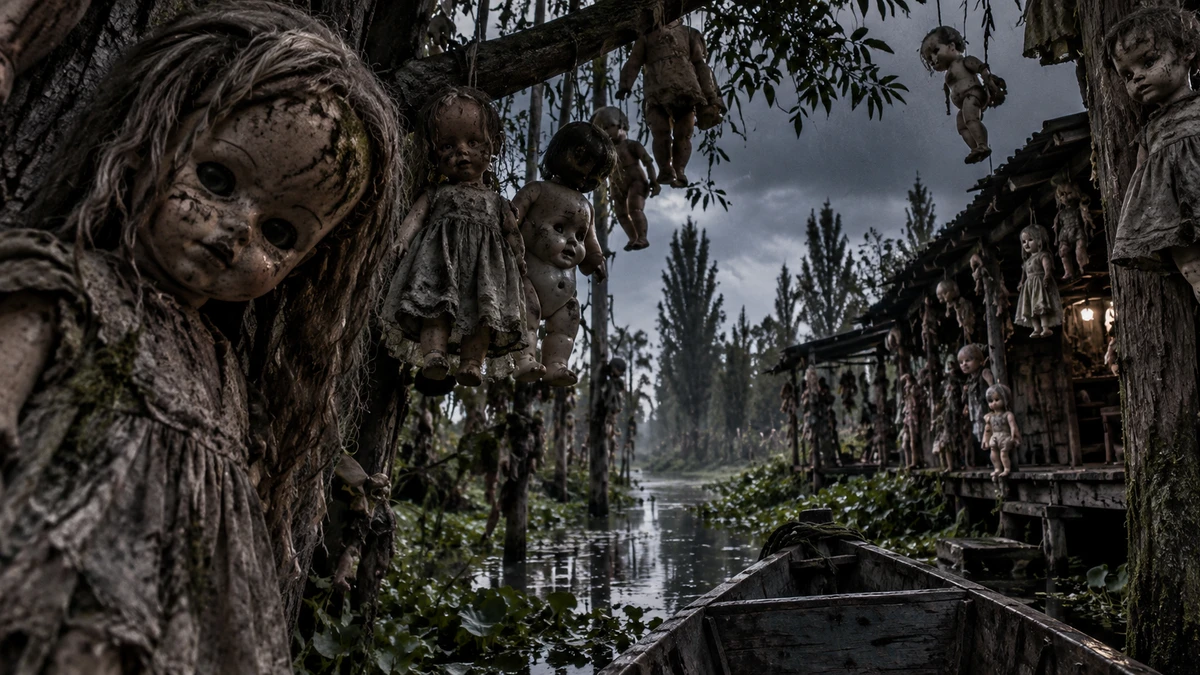
South of Mexico City, Mexico, there is a stretch of water called Xochimilco, where canals wind between man-made islands and painted wooden boats drift past the landing stages with music playing and flowers for sale. Then the boatman poles you past that part. He turns south into the quiet channels, the music thins out behind you, and there is nothing on either bank but willows and water plants. You see the trees first. Then you see what is hanging in them.
Thousands of dolls. They hang from the willow branches, they are nailed to the trunks, they are tied to the posts of wooden huts and strung along washing lines. Some have no heads. Some are nothing but heads. Some are burnt. Some have one glass eye open and the other socket empty, and some have a cobweb grown across the neck. The rain has soaked the colour out of their clothes. They seem to face the water, all of them, and the boat coming in.
The boatmen of Xochimilco will tell you that one man hung this island together, doll by doll, over fifty years, for a girl who drowned in the water in front of it. They will also tell you that the man died in the same spot. A British magazine ranked this place among the five most haunted on earth in 2024. The boatman has not read the ranking. He has his own order of things: when the boat touches the bank he points first at the white cross standing there, because the dolls can wait, and the water under that cross is where everything on this island began. It is also, the boatman says, where it ended.
The girl in the water plants
In the 1950s a man named Julián Santana Barrera came to live on this island. He lived there alone and lived off what he grew, and when the vegetables were ready he rowed them to market, sold them, and rowed back to the island. He lived that way, alone, for fifty years.
One day he found a girl in the water in front of the island, tangled in the plants along the bank, already gone. There is another telling on the island, in which he saw her fall in, went in after her and could not bring her out, and the place where she spent her last moments is where the white cross stands now. The people of the island do not argue over which telling is right. They only say that from that day on, his nights were different.
He began to hear things. Crying. Shouting. Footsteps going round the hut. Some say the voice was calling out for a doll: “I want my doll.” In the mornings, going out, he would see the shadow of a person on the island, when he was the only person on it. Then one day he woke to find every plant in his field dead, and nothing he tried would make anything grow again.
Not long after, a doll came floating in towards the island, on the same patch of water where he had found the girl. He fished it out and hung it in a tree. That was the first.
For the next fifty years he never stopped. On the way to market he would stop to search rubbish heaps, he pulled dolls out of the canal when the current brought them, and when people started bringing him old dolls he traded them for vegetables from the island. He was not particular. The more broken the better: no eyes, no hands, burnt, all of them would do. He told the people who came to look that the dolls were there to scare the scare away, and that every doll had a soul trapped inside it, and that at night, when he was alone, the dolls came out to keep him company.
At the end of the 1980s the canals of Xochimilco were restored and boats began to pass the island, and the people on the boats began to bring him dolls. So what hangs on the island today is his dolls, and the dolls of every boat that has come since.
Bring one, leave none
To reach the island you hire a boat at Xochimilco. Once the boatman has poled away from the bank and the passengers have settled, he lays down the rules: you may bring a doll, you may not take one away, and whoever takes one will have bad luck. That is what the island says.
On the way you pass one or two other islands with dolls in their trees, and the boatman will tell you that those are not the one. Some boats take their passengers to those and turn back, and some passengers only find out afterwards that they never reached the real one, which lies in the Teshuilo lagoon at the very end, where the water is stillest.
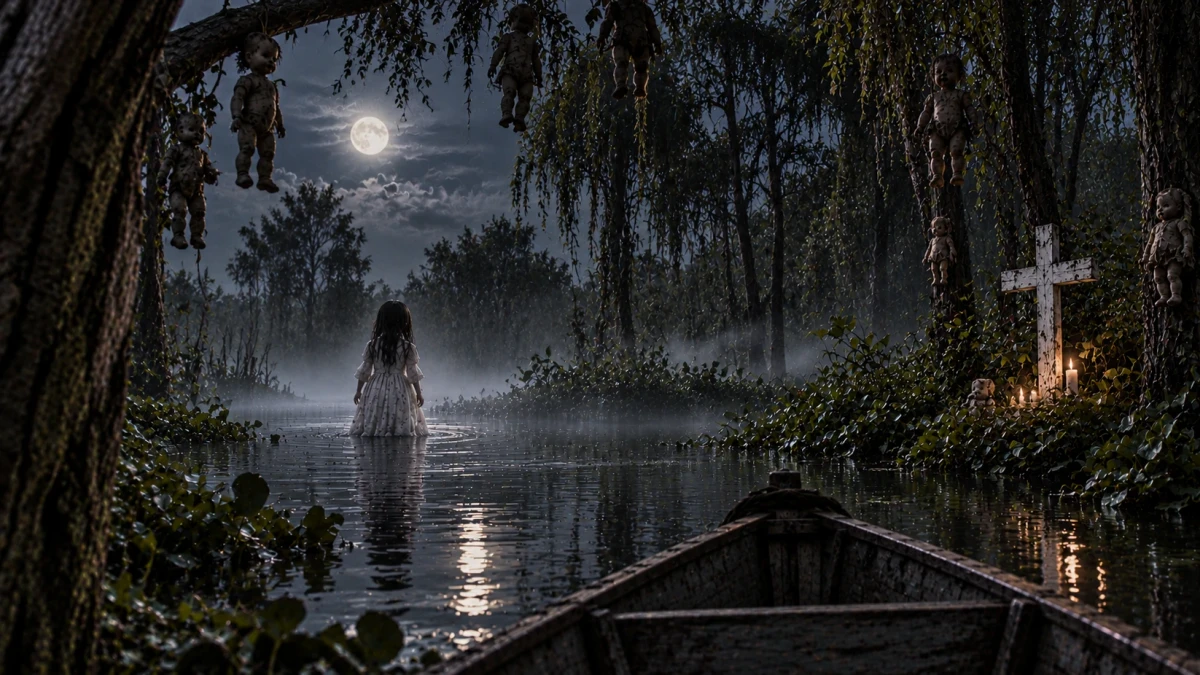
The old boatmen tell one more thing on the way. In the 1980s at least two visitors said they saw a little girl in a white dress playing at the edge of the canal, and when they went towards her she was gone. The families of those visitors still tell it: she was, they say, “as if she melted into the water.” The boatman finishes, the boat touches the bank, and the white cross is already in view.
No wind, and the lips moved
Once you step ashore you are standing among them. Dolls above your head, dolls at your side, one on every willow branch and one nailed to every post of every hut, and wherever you look there is a pair of eyes, or an empty socket, turned towards you.
This is what the people who have been say. Some say a doll turned its head. Some say a doll moved an arm. Some say eyes that had been shut were open. Some say a doll was no longer where it had been. Some say that among the dolls they heard whispering, very low, as if the dolls were talking to each other, and most of all after dark. Others say that on the island an invisible hand pulled their hair, or an invisible touch brushed their shoulder, and when they turned there was no one.
The old man’s nephew kept the island for eighteen years after his death. He said in interviews that he had seen, with his own eyes, a doll’s lips move. There was no wind.
Another relative keeps the island now. He says that at night he goes in with a workmate to wait for the visitors, and while they wait they hear a young woman crying, or moaning. A visitor from Texas, standing among the dolls, said that in daylight with people around it was not so bad, but at night, with all these dolls looking at you, it would not be a good feeling at all.
The sweets on the plate
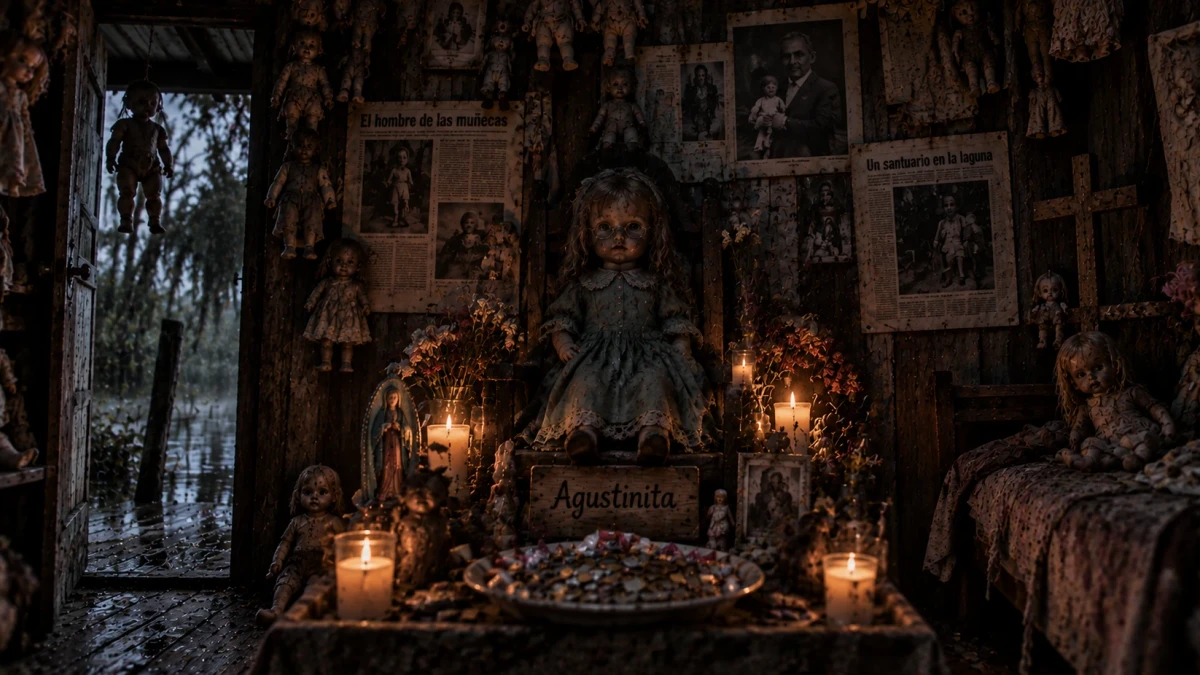
The hut the old man slept in has one room, and the door stands open now. The walls are covered with the newspaper clippings that local reporters once wrote about him, and between the clippings hang more dolls, and beside the bed more dolls.
In the middle of the room sits the one doll with a name. Of the thousands on the island, only she has one. She is called Agustinita, she wears glasses and a turquoise dress, and his nephew said the old man found her on the twenty-eighth of August, Saint Augustine’s day, which is why she is called what she is called. She has her own altar, and in front of the altar is a plate, and on the plate are the sweets and the coins that visitors leave.
The people of the island say she was his favourite, the one he talked to, the one who protected him. They say she walks the island at night, and that she can cure. The things on the plate are what people leave when they ask her for something.
You stand in front of the altar. The plate is full. You look behind her glasses, and she seems to be looking back.
The mermaids are coming for me today
On the morning of 17 April 2001 his nephew rowed over as he often did, bringing food and taking the vegetables to sell. That morning the two of them cleared the mud out of the canal first, and when that was done they sat down to breakfast together.
Over breakfast the old man told his nephew that the mermaids in the water were coming to take him, and that in a little while he was going to start singing.
The nephew had heard him talk about mermaids before. He had said for some time that there was a mermaid in the canal calling him, wanting him to go with her, so when he brought the mermaids up again that morning the nephew thought nothing of it. When breakfast was over, the nephew went to feed the cows.
An hour later he came back. The old man was floating in the water in front of the island, already gone, in the place where he had found the girl fifty years before.
The death certificate says heart failure. The old man was eighty that year. The island tells it differently. The people there say the spirit of the girl came for him and dragged him into the water. Others say the mermaids took him, the way he had said they would that morning. Both tellings live on the island, and no one there has tried to correct the other. Where he died there is now a black cross, with a plaque beside it marking this as the place where he died.
After dark
When the last boat leaves, the island belongs to the dolls and the man who keeps it. He says that at night he and a workmate go into the hut and wait, and as they wait they hear a young woman crying, and sometimes it is not crying but moaning.
The island has other nights to tell of: nights when the dolls whisper to each other, nights when they blink or turn their heads. The old man himself said that when he was alone the dolls came out to keep him company, and as for Agustinita, the island says she walks it at night.
He hung the dolls to keep the crying out. He hung them for fifty years, thousands of them, and died on the water where he had found the girl, and the crying is still there. Perhaps the dolls never kept anything out. Perhaps what the girl wanted was never a doll.
There is a saying on the island: from the Island of the Dolls there is no way back. You think you chose this boat yourself, but by the time the boatman lays down the rules you already have a doll in your arms, the one you picked out before you left home, and perhaps, when you picked it, it was not you doing the choosing. After dark, the one you left in the tree will face the water with the thousands of others, waiting for the next boat, and the people on the next boat will believe they came of their own accord too.