The White Door Beneath the Jinxin Building
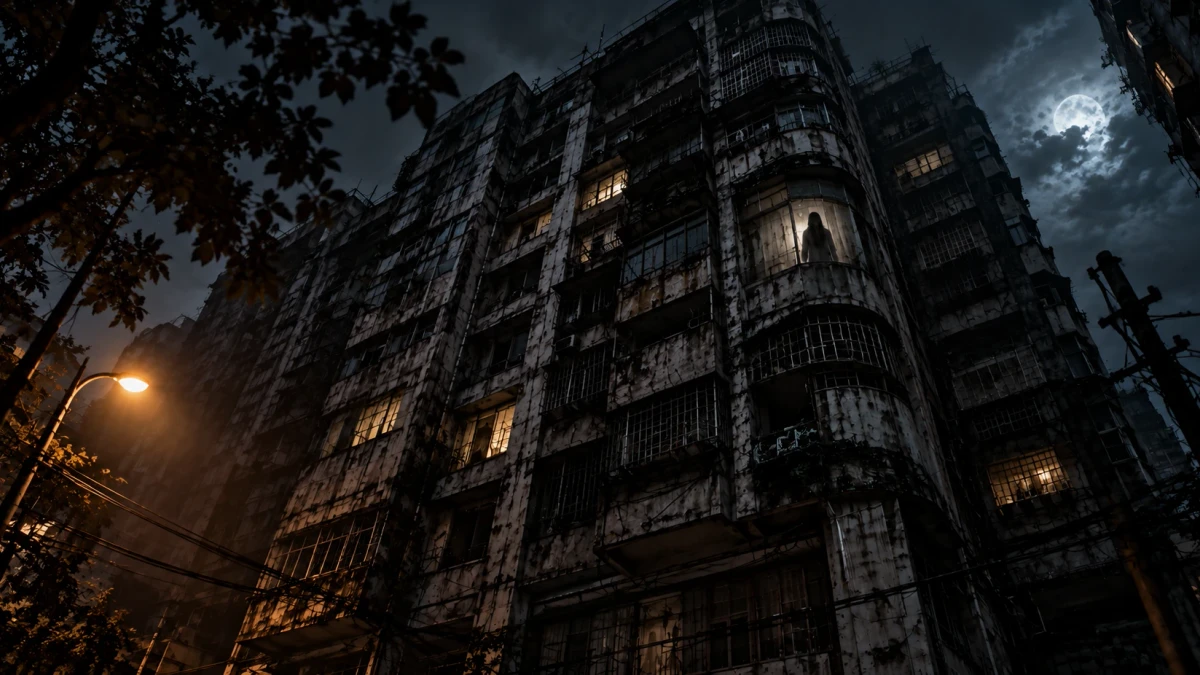
In Taipei, Taiwan, at the corner of Xinsheng North Road and Jinzhou Street in the Zhongshan district, an old fourteen-storey building stands pressed tight against the Jinzhou Street footbridge, as if it needed the bridge to stay standing. A covered walkway reaches out from the second floor to the edge of Xinsheng North Road. When the building was a hotel, that was the way guests came in.
The walls are weathered. Inside, the building is cut into small suites of about 23 to 33 square metres, more than twenty of them crammed onto every floor, along corridors so low that the ceiling seems to rest on top of your head.
It is called the Jinxin Building, and some call it Taipei’s number one haunted house. Over the decades, so the story goes, more than twenty people have died inside it. The people who live there have a saying: before you move in, have your birth chart read. Only someone whose fate is heavy enough can hold the place down.
The glass that would not break
When the building was finished in 1976 it was called the Butterfly Mansion, and what it sold was a dream. The first two floors were an imported-goods centre and restaurants. Above them were floor after floor of neat little suites. The basement held a beauty salon, a barber’s and a sauna. A revolving door opened straight onto the Jinzhou Street footbridge. The developer promised “hotel-style management”, and the roof even had a rescue helicopter pad.
The 240 suites were sold to many different owners, and those owners pooled them into a business called the Times Hotel. In time the hotel let its floors out one by one to middlemen, who took a whole floor and sublet it. Some floors went over to the sex trade. To keep customers from wandering, each floor was sealed off from the next, and even the doors to the outdoor fire escape were locked.
On the morning of 28 May 1984, the restaurant on the second floor caught fire.
The smoke had nowhere to go. It ran through the air-conditioning ducts and poured out into the rooms. The people in those rooms tried to break the windows, but the whole building was wrapped in a glass curtain wall, one sealed sheet of glass from floor to floor. Among the people trapped inside, it is said, was a taekwondo athlete, and even he could not break it.
The glass would not break, so they had no choice but to run for the stairs. A hotel of 240 rooms had only two staircases, and many of the people caught in the fire said afterwards that the iron doors to the stairs were locked.
The glass would not break and the doors would not open. Three people could not bear the heat and the smoke, and jumped. Nineteen people died in the fire.
When it was over, a cleaner was sent in to sweep up. He remembered how thick the ash was, above his ankles, and how hard it was to sweep.
Later, the building changed its name to the Jinxin Building. In recent years, people who did not live there have sought it out to end their lives, several of them in 2023 alone.
The outdoor fire escape on the side of the building is old and shaky. Follow it down and it breaks off at the second floor. It never reaches the ground. Forty years ago it was the iron doors to the stairs that were locked. Forty years later, the way down the outside of the building still does not go all the way.
The ghost stories the building left behind almost all happen inside it: in the corridors, and in the lifts that carry people from one floor to another.
Every corner turns into another corridor
Because it was built as a hotel, the inside of the Jinxin Building still follows a hotel’s plan.
Walk to the end of a corridor and turn the corner, and there is another corridor. Doors line both sides, one after another, and after a few turns it is hard to say which way you are facing. The lights are dim. Some doors have images of deities hung on them, others have paper talismans pasted across them, and walking past them all, it is as if every person behind those doors were on guard. Outside the lift on the fifth floor there is a poster of a lotus flower.
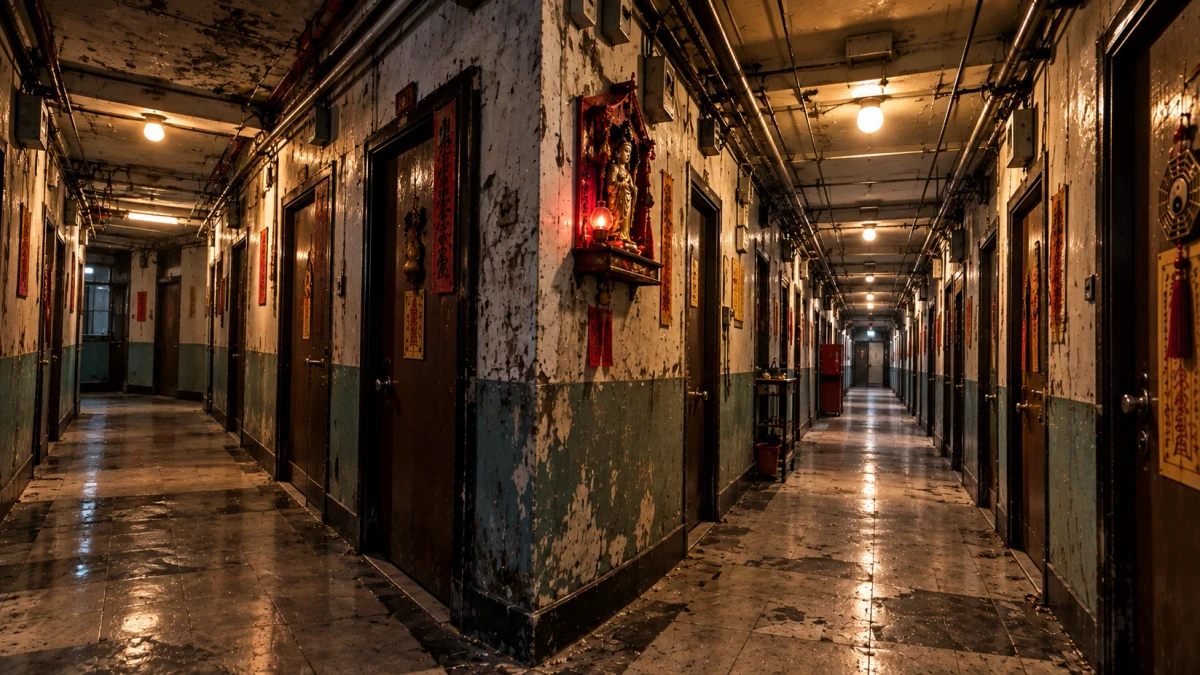
Behind a few of those doors, nobody lives. People in the building say that is where the crying comes from: a woman’s crying, in flats where nobody lives. One resident says they sometimes hear crying.
Other tenants say they have seen figures drifting past the windows.
But in this building, the place where things happen most is the lift.
The white door
A man who lived on the tenth floor got into the lift one day, and the lift began to move on its own.
This is how he described it afterwards: “The lift went up to the 14th floor by itself, then down to the basement, then up to the 14th floor, then down to the basement. In the end it stopped in the basement, and when the doors opened there was a white door. Closed.”
Another time it was a delivery rider, sent to the building with an order. As the lift went up it began to shake, and shake hard, and then the whole car dropped fast. It stopped for a moment at the sixth floor, then kept going down, all the way to the first basement.
The doors opened, and in front of him was a sealed white wall.
His legs gave way under him. Only at the very end did he make it back to the ground floor.
One of them lived there. The other had only come to drop off a meal. At different times, in the same building’s lifts, both were carried down below ground. When the doors opened, one saw a closed white door, and the other saw a sealed white wall.
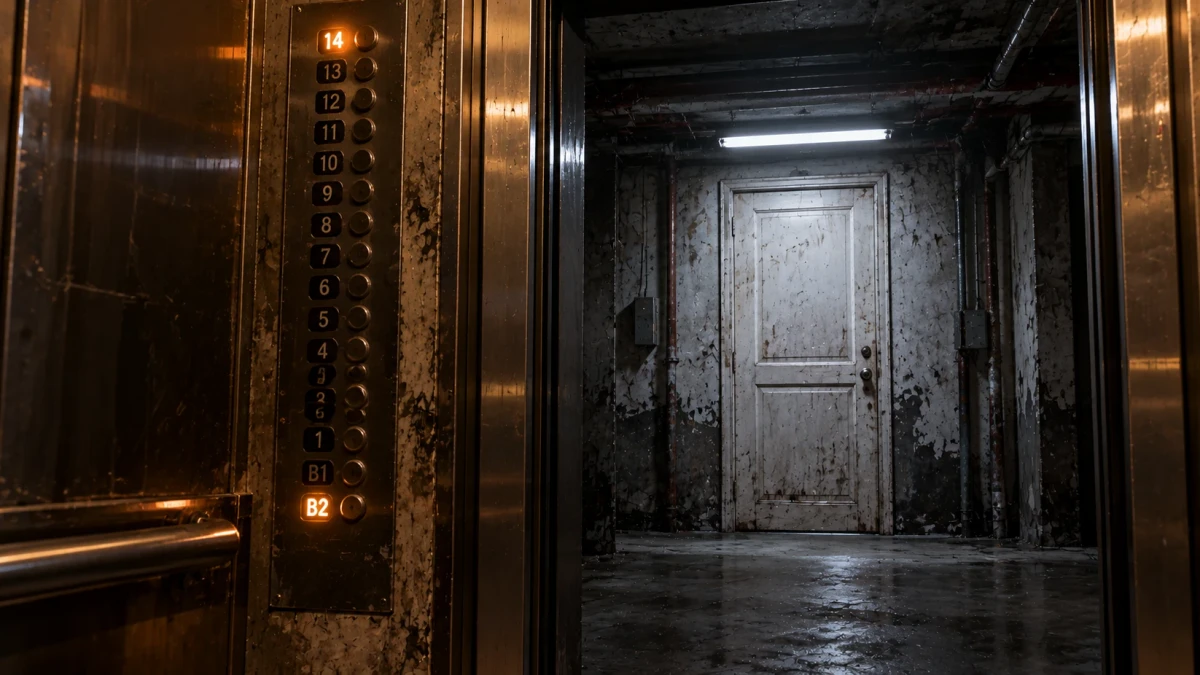
Neither of them was going down to the basement. The lift went down anyway and stopped in front of the white door, as if someone on the other side had called it and was standing there, waiting for the doors to open.
The figure that rose from the floor
On the roof of the Jinxin Building there is a small shrine to the Earth God. The god used to sit beside the building at street level, and was later carried up to the roof above the fourteenth floor. Residents say that once the god went up, the whole building changed for the better.
The cleaner who swept the ash in 1984 never really left the building.
After the fire the whole place was refitted and the suites were sold off cheaply. He did not mind that people had died there, and he bought one. He could not keep it in the end, and he moved up to the roof, into a small hut. The hut stands right behind the Earth God’s shrine. In the hotel’s day, residents say, it had been a lookout.
Once, half asleep, he saw a blurred figure rise up out of the floor.
After that he could never quite settle, so when a temple procession came through the building, he had someone paste a talisman on the door of his hut.
In 1984 he had stood in this building with ash above his ankles, sweeping. Many years later, at the very top of the same building, he watched a figure rise out of his own floor.
The floor where the lift doors open
A young police officer had just been posted to the Zhongshan precinct. The flats in this building were cheap, and he wanted to buy one.
He arranged to view a suite with the owner. On the day, he arrived early, said hello to the caretaker downstairs and took the lift up on his own.
As he stepped out of the lift, he met a young woman, very pretty. Before he could say a word, she asked him whether he had come to see the flat.
The two of them fell into conversation. They got on well, and talked for nearly half an hour.
Then the owner arrived.
The officer turned round, and the young woman was gone.
He told the owner what had just happened, and what the young woman looked like. As the owner listened, their face went stiff. The woman he was describing, the owner said, sounded like the previous tenant.
Two months earlier, she had taken her own life.
Before the owner arrived, someone else had got there first. She was there when the lift doors opened, and the first thing she asked was whether he had come to see the flat. Perhaps the suite he had come to see was the one she used to live in.
The ones who never moved out
One day at noon, people from several temples came up to the roof of the Jinxin Building to perform a rite. A spirit medium fell into a trance, and the others chanted scripture with their ritual instruments as they went over every corner of the roof. They found strange-looking picture frames engraved with incantations, and small incense burners in the stairwell, though nobody knew what they were being used to worship. All of it was treated as the kind of thing that draws in bad luck, and all of it was taken away.
Why the building has left so many ghost stories behind, the people who live there have never said. But someone in the building is always praying for protection, as if everyone who moves into this building learns, before long, that the tenants are not the only ones living there.
Some say they have seen people who are already dead, still walking around inside the building.
Tenants come and go quickly here. A suite falls vacant and someone moves in almost at once, and the faces in the corridors keep changing.
When someone meets a neighbour they have never seen before in one of the Jinxin Building’s long corridors, there is no telling whether that neighbour has just moved in, or never moved out.