The Station That Does Not Exist — Kisaragi Station
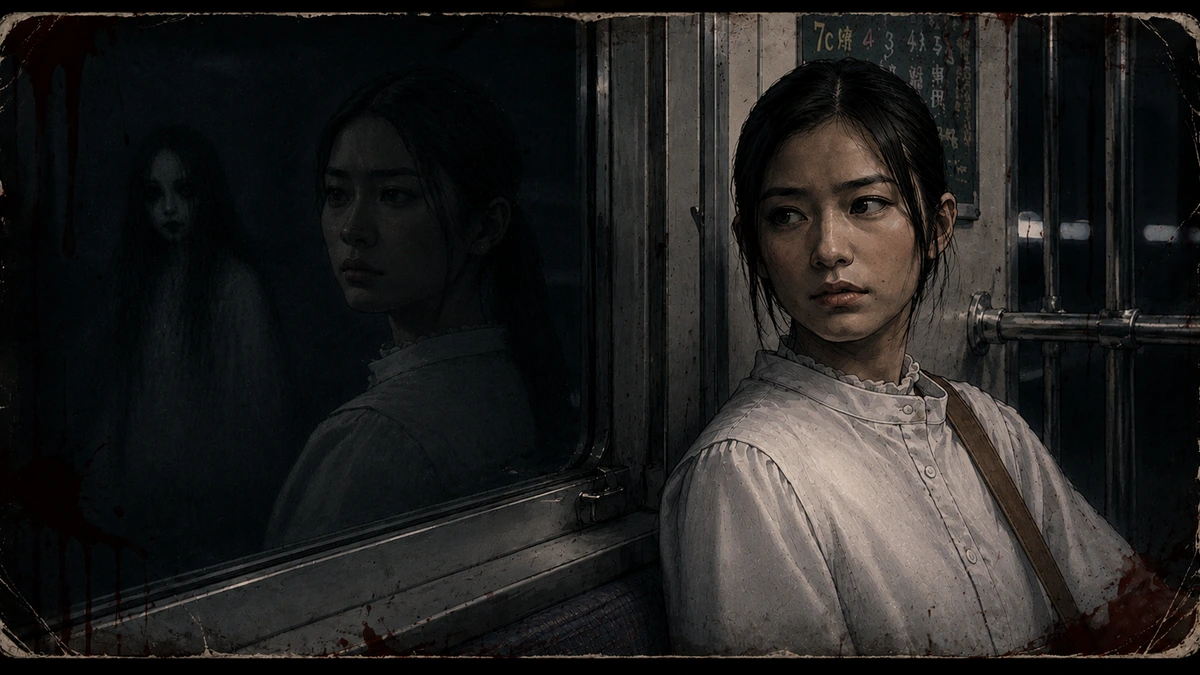
It was January, and it was cold. She was on the train she took home every day.
The train passed a station.
By the time she looked up, the platform had already slid away behind her. The lights were on. There was nobody standing on it. The train had not slowed down.
The first time, she assumed she had misread it.
Then it passed another one.
She knew those stations by name. The same stairwells, the same lit advertising panels, seen every evening of her life. They went past the window one after another, and not one of them made the train slow down.
This is a commuter line through a built-up area. Twenty minutes should have covered four or five stops.
She turned and looked down the carriage.
The other passengers were all there. Some seated, some standing with a hand through a strap. Nobody looked up. Nobody spoke. Nobody so much as glanced towards the doors.
She walked to the front car to find the conductor.
The window of the driver’s cab had been covered over from the inside.
She turned back to the window.
Outside there was nothing. Not the ordinary dark of night. A dark with not one light in it. No street lamps, no shop signs, no convenience store, no level crossing blinking red. On a commuter line through a town, there is no such thing as nothing outside the window.
The glass gave her back the strip lights of the carriage, and her own face.
The reason any of this survives is that she was typing it as it happened.
At 23:14 on the night of 8 January 2004, she spoke up on an anonymous Japanese message board. Her first line was this:
It might just be me imagining things. Do you mind if I ask something?
Hasumi was the name she used on that board. Beyond that name, nobody knew who she was, where she lived, or what she looked like.
She was not writing it up afterwards. She was on that train, putting what was in front of her onto the screen, while a room of people who did not know her waited for the next line.
Then the train stopped.
Both Panels Beside the Name Were Blank
The doors opened. She stepped down.
Gravel underfoot. Air cold enough to sting. The doors closed behind her, and the train carried its motionless passengers away into the dark ahead.
There was no member of staff on the platform. No ticket gate. No timetable. No vending machine. One lamp for the whole platform.
The wind brought her the sound of grass. Beyond that the platform was silent. Standing under that lamp, she was the only thing there that moved.
The name board stood at the far end.
The name on it was Kisaragi.
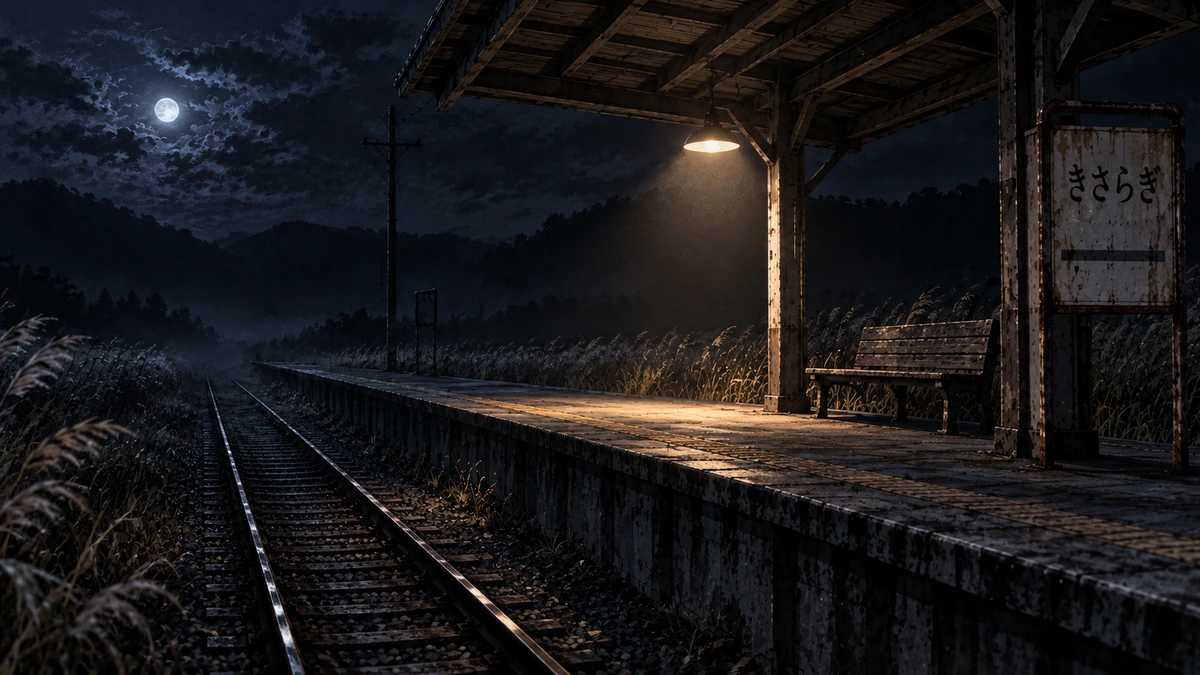
A Japanese station name board comes in three panels. The middle one is the station you are standing at. The panels either side carry the stations before and after it, so that anyone stepping off knows where they are in the line.
Both side panels were blank.
No station before. No station after.
She walked off the platform and went round it. No houses. No road. No power poles. Grass, and mountains further out. She tried to get a taxi. There was no taxi to get.
Kisaragi is an old name for the second month of the lunar calendar. One of the ways the Japanese explain the word writes it as the month you put another layer of clothing on.
The day she stood in front of that name board was in January.
The Emergency Line Took Her for a Prank
She dialled 110, the police.
She told the person who answered that her train had not stopped, and that she was now standing at a station called Kisaragi.
They took her for someone making trouble.
She called home.
She could not say where she was. She could name the station she had boarded at. She could give the time. She could say that this station was called Kisaragi. But there is no Kisaragi on that line.
She opened the location service on her phone. It returned an error.
The police did not believe her. Her family could not reach her. Her own phone could not say where she was. There was nobody anywhere who knew what place she was standing in.
Drums, From a Direction With No Houses In It
She decided to follow the track.
Railway lines always run to somewhere with people in it. What she was looking for was a house with a light on, a road with cars on it, anyone at all who would understand what she was saying.
She had been walking a while when she heard it.
A drum.
And bells.
Festival music.
It was the middle of the night. In that direction there were no houses, no shrine, and no lights.
She kept walking. The sound stayed exactly where it was, neither closer nor further away.
There Was a Man on the Track, and He Had One Leg
There was something ahead of her.
At first she took it for a signal post.
Closer, it turned out to be a person.
An old man, standing in the middle of the track.
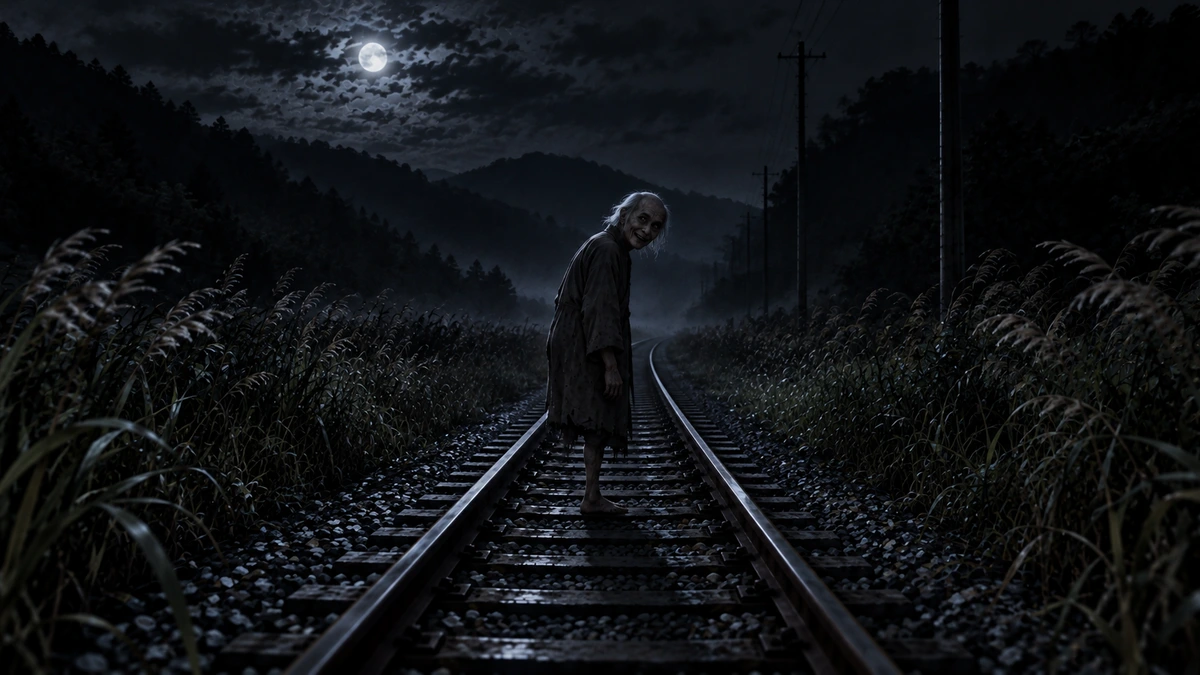
He had one leg. No crutch. No wheelchair. Nobody holding him up.
That stretch has no level crossing and no service path. Grass and mountain on both sides. To be standing in the middle of that track, he would have had to walk the same long stretch she had just walked. She had been out there a long time and had not passed a soul.
He spoke to her.
She did not understand him, and she did not answer.
She lowered her head and moved aside to let him by.
When she looked up again, the track was empty.
You can see a long way in both directions along that stretch. He had not walked off. He was simply not there.
The Car on the Other Side of the Tunnel Did Not Go to the Station
Ahead of her the track ran into a tunnel.
There were no lights inside it. She walked in, listening to her own footsteps knock back and forth off the walls.
The tunnel is called Isanuki.
On the far side, a car was parked at the roadside. There was a man in it, and he asked her where she was going.
She said she wanted to get back to a station.
He told her to get in. He could take her to Hina Station.
Behind her was the tunnel, and the sound that never came any closer, and a railway line that did not end.
She got in.
The car pulled away and began to climb.
That was not the direction of a station. That was the direction of the mountains.
Trees started coming into the headlights. The road narrowed, the asphalt gave out to gravel, and the beams picked out nothing but two ranks of trunks falling away behind.
After a while, the man began to talk.
Not to her.
He was talking to himself, in words she could not follow. He did not stop, and he did not look at her once.
The car kept climbing.
03:44
She opened her phone one last time.
The battery is nearly gone. Something is wrong with him, and I am going to watch for a gap and run. He has been muttering to himself for a while now and I cannot understand a word of it. Just in case, I will treat this as my last post.
That was 03:44 in the early hours of 9 January 2004.
Between do you mind if I ask something and I will treat this as my last post, four and a half hours had gone by.
Nobody closed the thread. People kept posting into it. People kept asking. Some of them sat there until it got light.
There was no next post.
Other People Have Got Off at the Wrong Stop Since
Hasumi said she had boarded at Shin-Hamamatsu. That is a real station in Hamamatsu, Shizuoka Prefecture, the terminus of the Enshu Railway. The line runs every day and every stop on it is exactly where it should be. Kisaragi is not on the timetable. It is not on the route map either.
Since her, other people have got off at the wrong stop, at places the timetable does not have either.
Somebody got off at Yami Station, where the dark beyond the platform was total, no direction readable in it, only the knowledge that the place connects through to Kisaragi. Somebody got off at Tsukinomiya Station, and walked out into a city nobody has seen, towers with no visible top, not one legible character on any sign. Somebody got off at Gosho Station. Gosho, in Japanese, is the word for the life that comes after this one.
Itsuki Asazato, who writes on modern Japanese strangeness, has collected these stations into a list. Every station on that list is a place nobody knew existed until somebody stepped off there in the middle of the night.
He calls the whole category a modern spiriting-away.
Being spirited away is a very old idea in Japan. Somebody goes missing at the edge of the mountains, or on the night of a festival, or off their own doorstep. There is no trace of them and no way to explain it, so the village says the person was taken and hidden: by a god of the mountain, by a tengu, by something on the other side. A few of them walk back days later and cannot say where they have been. Others never come back at all.
What takes people now is not the mountain. It is a train. And the person being taken is typing the whole thing out for strangers to read while it happens.
On 8 January 2022, eighteen years to the day after she spoke up, Enshu Railway printed a run of tickets with Kisaragi Station on them. One day only, five hundred sets. They set up three locations with differently shaped punches and clipped a hole in every one by hand.
Within the hour all five hundred sets had been taken.
Both panels beside the name are blank. No station before it, no station after it. There is only one way to get to that place: board a train that is not going to stop.