The Woman Who Asks If She Is Pretty

In Japan, in the spring of 1979, primary school children walked the last stretch home by themselves.
That year there was somebody standing on that stretch.
She was tall. Her hair hung long over a pale beige coat, and the lower half of her face was covered by a white surgical mask. She stood in the shadow of a utility pole, beside the torii gate of a shrine. She did not walk on and she did not move, and what she was doing there was waiting for a child to pass.
When no child was coming she did not go home either. Some said she sleeps at shrines. Others said she turns up where gravestones are kept.
When one did, she spoke.
“Am I pretty?”
The part of her that showed above the mask was beautiful. The children who saw her all said so: the eyebrows, the eyes, the line of the nose. Some of them also said her eyes were like a fox and her voice was like a cat.
So the children usually nodded.
That was the first mistake.
The spring the children stopped walking home alone
It started in Gifu prefecture, in the middle of the country.
In December 1978 a story went round the farming villages there. An old woman got up in the night to use the toilet, which stood away from the main house, so that she had to go outside to reach it, and out in the dark she saw the woman and dropped to the ground with her legs gone from under her.
By the following spring every schoolchild in the country was talking about her. The newspapers took her up as well, and what one of them printed was a drawing of her. One town in Gifu went as far as telling parents not to let children out after dark.
The schools moved too. Teachers sorted the children into groups by route home, and each group walked together. As they went, the ones who lived nearest arrived first. One peeled off, then another, and the line grew shorter and shorter, until whoever was left had to finish the last stretch of the walk alone.
The boys carried stones in their pockets, to throw at her and drive her off if she really was there. One girl walked the whole way with a harmonica held to her lips, to blow the moment she saw the woman, so that any adult nearby would hear it.
Because of her, patrol cars went out in Koriyama in Fukushima and in Hiratsuka in Kanagawa, where people had called the police to say they had seen her. Because of her, whole school districts in Kushiro in Hokkaido and Niiza in Saitama switched to walking home in groups.
By August the summer holidays had come, the children stopped seeing each other every day, and it stopped, as though someone had cut the power.
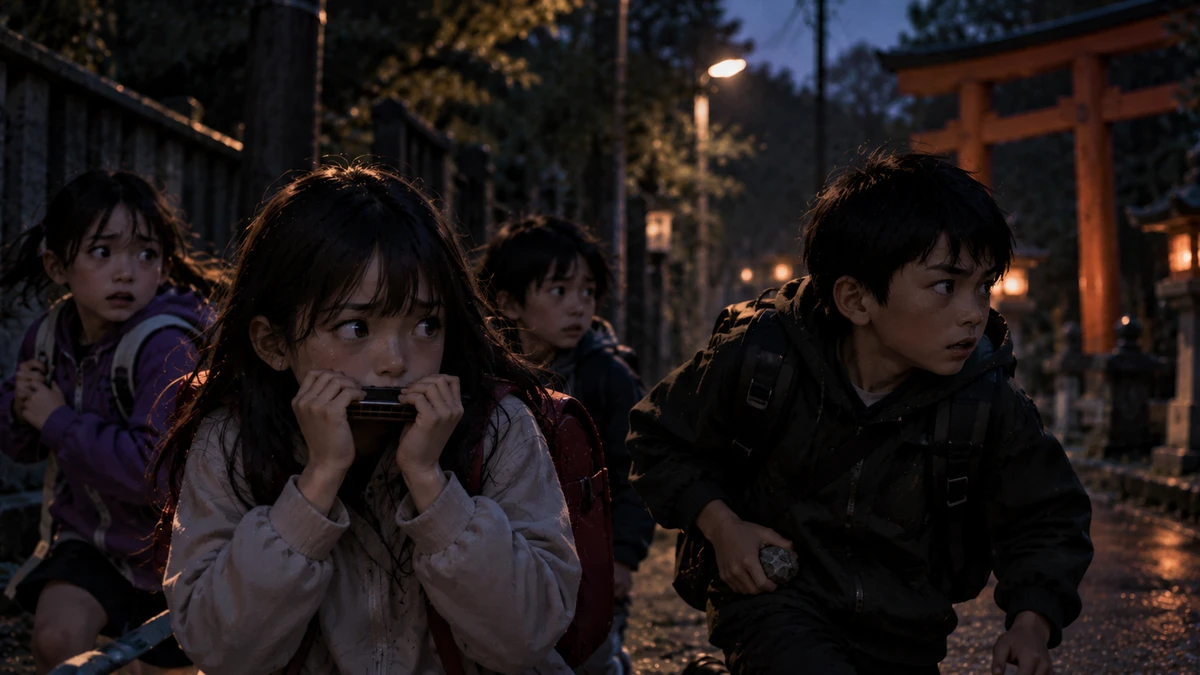
She was standing beside the torii gate
That year, in Tokyo, several girls came running into a music room to say that a girl at the next primary school had been stopped.
It had happened a few evenings before. The girl was walking home from cram school and cut through the grounds of a shrine to save time. There was nobody in the grounds. Halfway across she saw a woman standing beside the torii gate.
“Am I pretty?”
The woman was tall and the eyes above the mask were lovely, and the girl, caught out, answered politely: “Yes.”
The woman took the mask off.
The mouth was cut open from the corner of the lip all the way to the ear, on both sides of her face.
The girl screamed.
There was a sickle in the woman’s hand. In the shrine grounds that evening there were only the two of them, and that is where the girl’s own mouth was cut open with it.
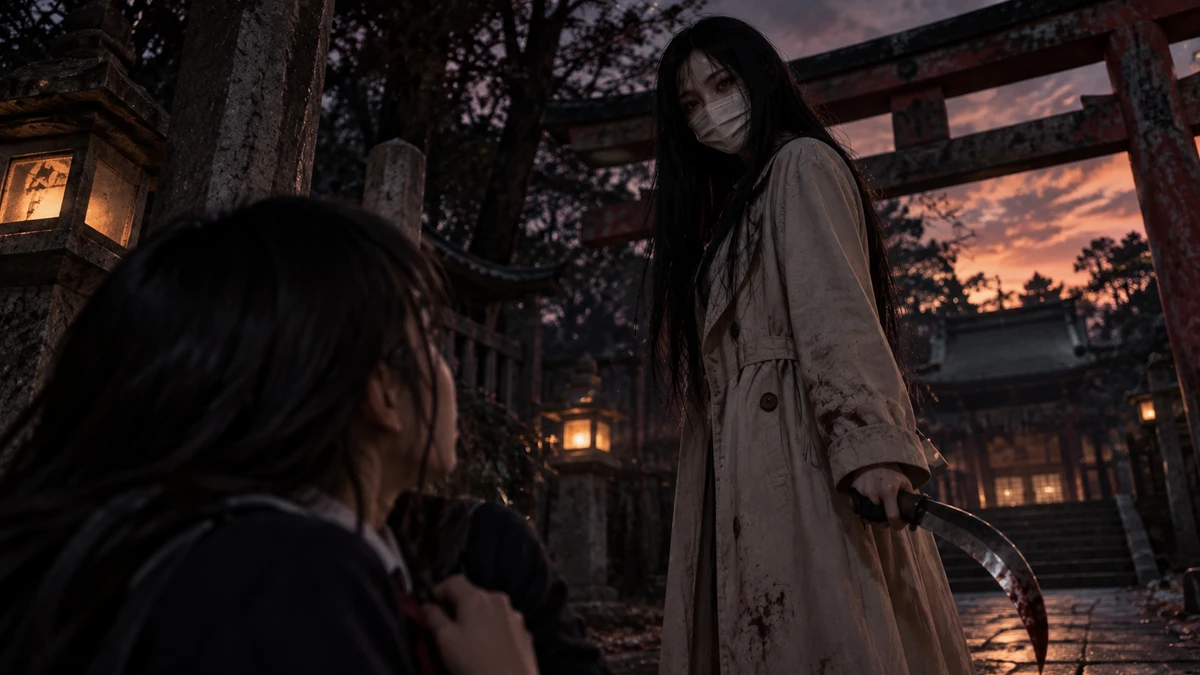
No answer is a safe answer
Sometimes she says nothing at first. She taps you on the shoulder from behind and waits for you to turn round by yourself, and the question starts then.
“Am I pretty?” is not a casual question. There is a second question behind it.
Say yes and the second question comes: she lowers the mask so that you get a proper look at the mouth, and asks again, “Even like this?” Say no and she does not bother with a second question. She starts there.
The second question works the same way. Say yes and she is delighted, and then she tells you: “Then I will make you the same.” Say no and the blade she carries comes out. In the versions that came later she has no need of it, and the mouth is something she tears open with her hands, and some say there are a hundred and thirty teeth inside her own. Two other versions are shorter still: in one she does not ask at all and the child is simply taken away, in the other she catches you and eats you with that mouth.
So your answer does not decide whether something happens to you. It decides whether it happens at the first question or at the second.
That is why every child that year went out carrying something. A piece of hard amber barley candy in a pocket. The character for dog inked on a palm. A word ready to shout at her three times, the word for hair pomade. In Kyoto what they taught was to answer “average”, neither pretty nor ugly, because she stalls on it.
None of it is meant to beat her. The candy is to make her crouch, the character is to make her look twice, the word is to make her take half a step back. All of it buys seconds.
And none of it has a source. Every child had heard about the pomade, every child had heard about the candy, and not one of them could say who had tried it and come back to tell the rest.
Whether those seconds are enough to run in, nobody knows either. She covers a hundred metres in six seconds. Some say three. Some say she has no need to run at all, that she floats along the ground after you.
Sometimes there is more than one of her
In the versions people told, she is not always alone.
One of them makes her three sisters. Three women stop you together, the lower half of all three faces behind masks, all three mouths cut to the ears. Some told it differently: only one of the three was born that way, and the other two did it for her sake, one cutting her own mouth open and one drawing it on with lipstick.
The question is a different one: “Which of the three of us is the prettiest?”
You choose one, and the other two start.
There is not even room to get it wrong here. You have to point at one of them, and the other two are standing right there, waiting for you to lift your hand.
People were being chased long before that
On 20 April 1876 a Tokyo newspaper carried a story.
On a mountain road in Shiga, a man walking alone was joined from behind by a woman. She said she was going the same way and asked him to let her walk with him. They went on side by side for a while, and then he glanced at her and there was something wrong with her eyes.
He walked faster.
She was beside him at once.
He turned, and her mouth was split to the ears, her eyes were throwing off light, her tongue was whipping about like flame, and she was shouting at him. She bit down in the soft place between his ear and his eye. He was a hot-blooded man and a strong one, so he threw her off and ran the whole way home, and passed out the moment he was through his own door, and lay in bed for ten days.
More than a century before that, in Edo, there was a woman who opened her mouth herself.
A collection of tales from the period tells it. A man’s wife, for reasons nobody could name, hated him. She fell ill, and it became clear she was dying, and he sat with her day and night. Then one evening she sat up, put her own fingers inside her mouth, tore it open on both sides to the ears, and with her hair standing up on her head threw herself at him.
The servants and the neighbours ran in, threw bedding over her, and six or seven of them lay on top of it until she was still.
Her body was wrapped in the bedding, put into a long chest and carried to the temple. The husband was not right after that, and inside a hundred days he was dead too.
She is still asking
After August 1979 the roads were quiet again.
She did not stop, though. Children were still telling her story in the 1990s, and children are still telling it now, one year group handing it to the next: the same question, and the same set of ways to get out of answering it, which nobody has ever tested.
In the legend, the children she asks end up with a mouth like hers.
So after dark, she is not the only one out on the roads in a mask.