Longwang Eighteen Pools: The People Who Took Her Up the Mountain Had Been Dead for More Than Twenty Years
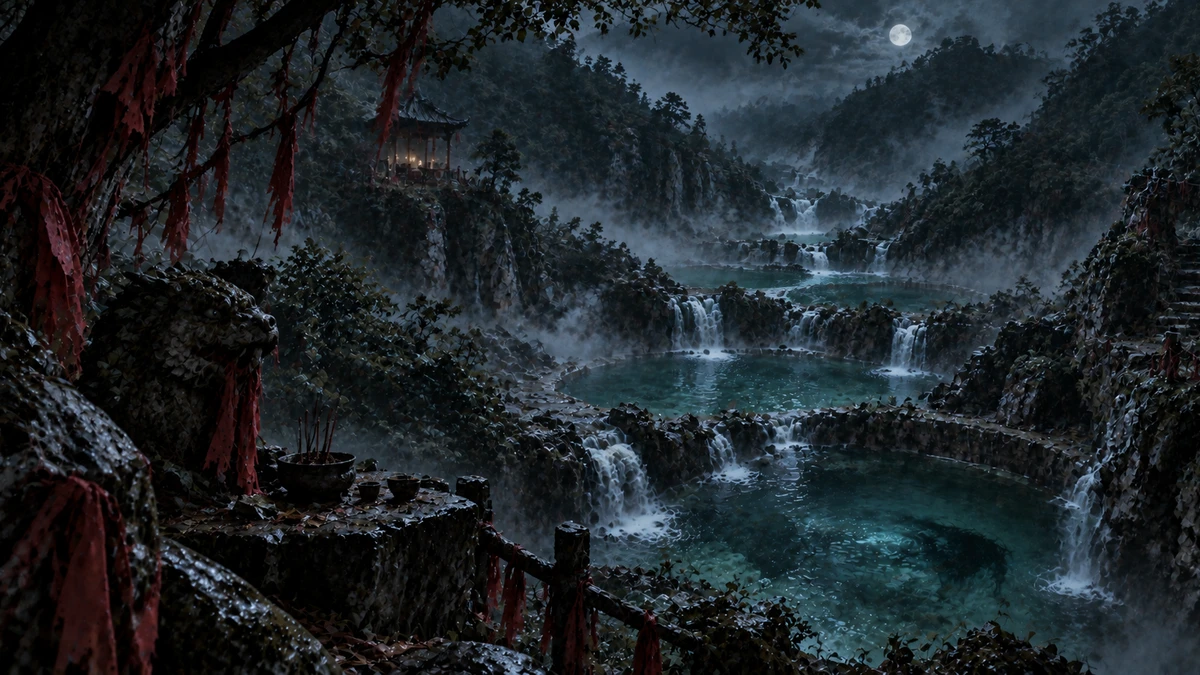
In Duqiao, a town in the city of Linhai in Zhejiang Province, China, there is a village called Longwang, and behind the village, up in the hills, there is a gorge. It is called Longwang Eighteen Pools.
The gorge runs about twelve kilometres, from the village at one end to Lantian Mountain in the next township at the other. The stream drops through it in steps, each step a waterfall, and under each waterfall lies a pool. Eighteen of them, the saying goes, and nobody has found the bottom of any. The hills on both sides are high and thickly wooded, and animals come out of the trees. For years, one or two hikers a year died in the gorge or were never seen again, and more than once the rescuers sent in after them had to be rescued themselves. The old people say that most of those who died slipped in and drowned, and that a body that goes under often takes days to come up.
When a child in Longwang cries and will not stop, the adults do not comfort it. They say one thing.
Keep it up and we’ll throw you into the Eighteen Pools.
The child stops crying.
The village has other things to say. They say the gorge is heavy with the cold air of the dead, that on some nights pale blue fires drift along the hillside above it, and that nobody with any sense goes near it after dark without a reason. They say you must never go in when the river is in flood. The gorge is narrow, and when the water comes it comes as a whole valley of water at once, and there have been people, in flood years, who saw a crowd standing at the edge of a pool, and when they went closer the crowd waved them on. Come closer. A little closer. And then the water arrived. Those who die in the gorge by accident, the village says, cannot leave it. Each of them needs someone to take their place before they can go.
The village said these things for years. Until 16 February 2020 they were only things the village said.
On the footage, she walks in alone
On the morning of 16 February 2020 a woman of thirty-nine went out of her house. Her days were all the same. She walked to the village shop for something to eat, then to her parents’ house or back to her own, and at most she stopped on the road to talk. She was timid. She never went far.
At noon she had not come back, and the family assumed she was at her parents’. At dinner there was still no sign of her. The whole family went out and searched every corner of the village. Nothing.
Then a villager said he had seen her early that morning. She had bought something at the shop and walked straight into the Eighteen Pools.
The family ran to the village office and looked at the cameras. There she was, walking in at the mouth of the gorge. All day, she did not walk out.
There is one way in and one way out. In those weeks every village around had a checkpoint on its road, for the epidemic, watched day and night, and if she had come out anywhere else she would have been seen at once. So she was still in the gorge.
The hair on the bottom of the pool
At about twenty to six that evening the village head sent more than three hundred villagers up into the hills.
The torches went up in a line. Every knoll along the path, every barbecue stall, every shed by the road was turned over. Firecrackers went off all the way up, on the chance that she would hear them and come towards the sound. The police station sent its officers, the patrol squad and the volunteer rescue team, and they joined the villagers on the hillside and went over it a metre at a time.
At night the temperature in the hills fell below freezing and the gullies iced over. It had rained for days around the New Year, the pools were full and fast, and the paths beside them were wet and slippery, and one careless step would put a person in the water.
Her husband tried to jump into a pool and feel for her with his hands. They caught him and held him. He shouted for her until his voice went, and the stones cut his feet open until they bled.
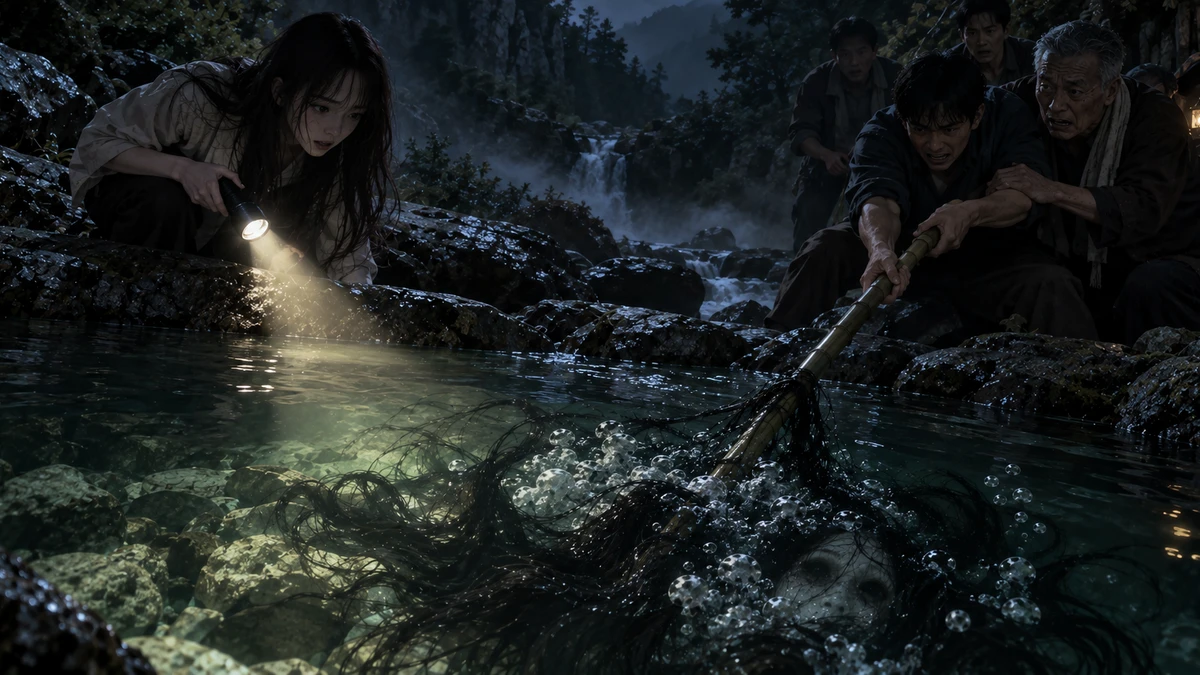
The water was clear to the bottom. They stood on the banks with their torches on it, and where it ran fast and foamed, the old men tied sickles to bamboo poles and drew the blades slowly through the water, feeling for anything that would catch.
The story that circulates says something else happened that night. Her younger sister was at the back of the line when she heard a sound from a pool behind them, a dull knocking, thump, thump, thump, and under it something like a voice, too far off to make out. She did not call the others. She ran towards it alone and put her torch on the water, and between the stones on the bottom something was caught that looked like hair. She shouted, men came with a pole and hooked at it and brought up nothing, and they were turning to leave when the water began to boil with white foam and the black strands came up thicker and thicker, and the man holding the pole tried to pull it back and could not. It felt, he said, as if someone under the water had hold of the other end. Holding hard, and pulling down. The others rushed to hold him, and one of the villagers looked down and saw a face coming up through the water, white as paper, the eyes entirely black. He thought he had seen that face somewhere, decades ago.
He shouted that there was a ghost and scrambled up the bank.
When the others looked, there was nothing in the pool, and wrapped around the pole were a few handfuls of weed.
They searched until dawn and found nothing.
The next day the village went up in groups of ten with their own food, beating gongs and drums behind the police. The women who could not climb rode tricycles and scooters round the mountain roads. The old men and women went out on their sticks. The family printed more than a thousand missing-person notices and the village pasted them along every road as far as Yongquan, Dongcheng and Xiaozhi. The city police sent a special unit with two drones and tracker dogs, and there were three full-scale searches of the gorge. They found no woman and no footprint, and one of the dogs that went up with them worked itself to death on the mountain.
No woman, no footprint, no lead of any kind. So the police began to treat it as a crime. Everyone in the village between forty and sixty who had been in or out of the gorge in those days went onto a list, and the officers worked through the list day and night, one name after another, and turned the village inside out, and found nothing to hold on to.
While the search went on, the villagers were saying something else among themselves. Had the dead in the gorge taken her for a substitute?
Her husband said that if there was nothing left of her but bones, he would bring the bones home.
The leader of the rescue team said that around Taizhou, the longest anyone had lasted lost in the hills was twelve days. That was years before, in Xianju, and it was a strong young man.
Twelve days passed. Thirteen. Fourteen. Fifteen. Sixteen.
The one in red comes down the mountain
On the morning of 3 March a neighbour out for his morning exercise saw her.
She was coming down the mountain. Slowly. She had been wearing red on the day she went missing, and against the whole green hillside the red showed from a long way off.
The neighbour shouted one thing. A ghost. Then he ran.
He stood a long way off, still shaking. A woman who had vanished into the Eighteen Pools seventeen days before had just walked down out of them.
The village came running and stood around her in a ring, and every one of them said the same thing afterwards: if they had not seen it with their own eyes they would never have believed it. She had lost a great deal of weight. Her clothes were full of holes. She said only that she was hungry and that she was tired. At the hospital the doctor found almost nothing in her stomach. Her mind was in a bad state, he said, but her life was not in danger.
Seventeen days. Below freezing at night. No food, no gear, and no experience at all of surviving in the wild.
The people who took her climbing
When she was well enough, she told her family what had happened that morning.
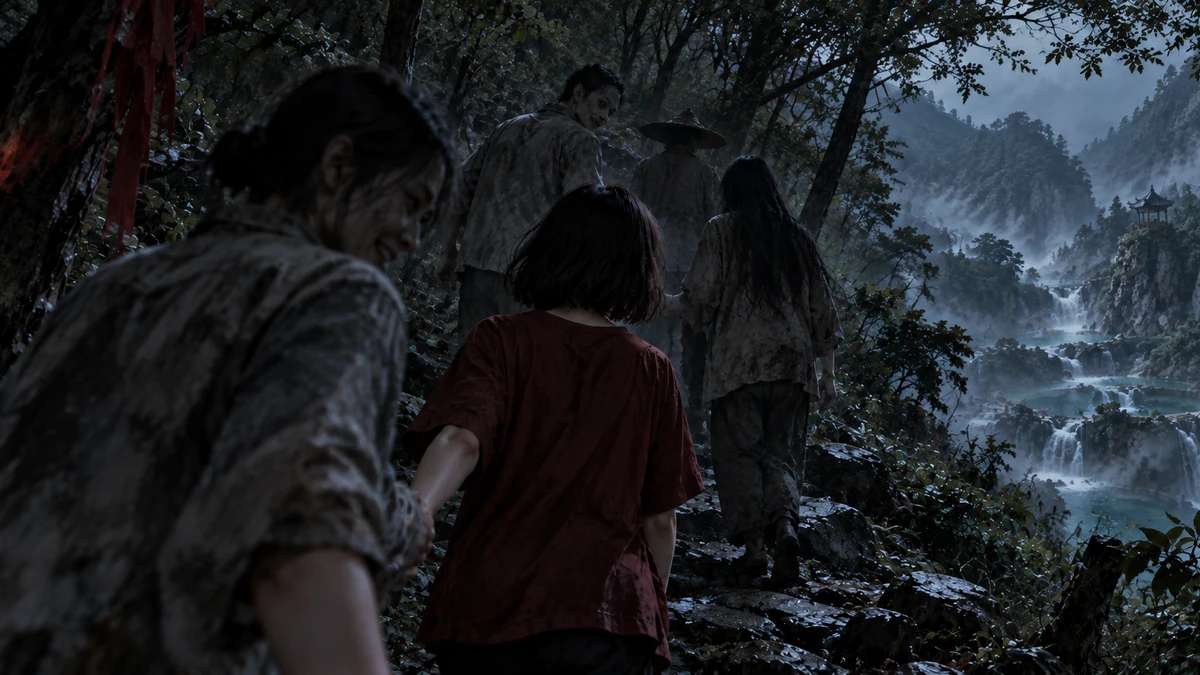
She had bought what she wanted at the shop and was walking home when she met some people. They were warm and friendly, and they wanted her to come climbing with them in the Eighteen Pools. She said she could not help herself. She went with them. They crossed one mountain and then another, and when she was thirsty she drank from the stream, and when she was hungry she ate wild fruit, and when she was tired she slept by the path. Her family shouting her name, the gongs and the drums, the firecrackers. She heard none of it.
Some people. Who wanted her to come climbing.
The family’s first thought was traffickers. They went back to the village office in a fury and went through the footage again from the beginning, and then again. She walks in alone. All the way along the path, she is walking alone.
Nobody in front of her. Nobody behind her. Nobody beside her.
She walked in by herself and spent seventeen days crossing the mountains behind a few people.
A name from a village a few miles away
She told her family the names of the people who had taken her.
The family listened and could not say a word. Every one of those people was dead.
One of the names nobody in the family had ever heard. They asked around, and in a village a few miles away they found that there had once been a person with that name.
That person had died more than twenty years before.
In the village the story grew stranger with every telling. The word that the villagers had used during the search, substitute, nobody would finish now. She had come back. Whose path she had walked for seventeen days, following those people, nobody could say.
Across a strait, in the mountains of Taiwan, there is a creature of folklore whose whole purpose is this. The folklorists who study the stories call it the mosina: small, able to take the shape of a person, and known for leading people into the hills. The ones it leads away turn up in places they could never have reached on their own. It feeds them roots and cow dung, and they take it for good food. The people down in the valley have to shout the missing person’s name, over and over, loud enough to call them back. And the adults of Taiwan use it, too, to frighten their children. Keep wandering off and the mosina will take you.
They are still waving from the pool
The old people used to say that anyone who died by accident in the Eighteen Pools could not leave. They had to draw a living person in to take their place first. She was drawn in. Seventeen days, one mountain after another. And on the seventeenth morning she walked down alone.
Not one of the people who took her came out behind her.
This is how the village tells it now. Those people are still in the gorge. They walked her for seventeen days and at the end they did not keep her, not because they did not want her, but because it was not yet her turn. Go to the pools when the river is in flood and the figures waving from the bank are still there, waiting for the next one to walk out of the shop and go up into the hills alone.
When a child in Longwang cries and will not stop, the adults still say the one thing. Keep it up and we’ll throw you into the Eighteen Pools.
The child stops. The children know that someone from the village really was taken in, and really was brought back, and that the people who brought her back have been dead for more than twenty years.