The Bell That Still Rings Over Poveglia
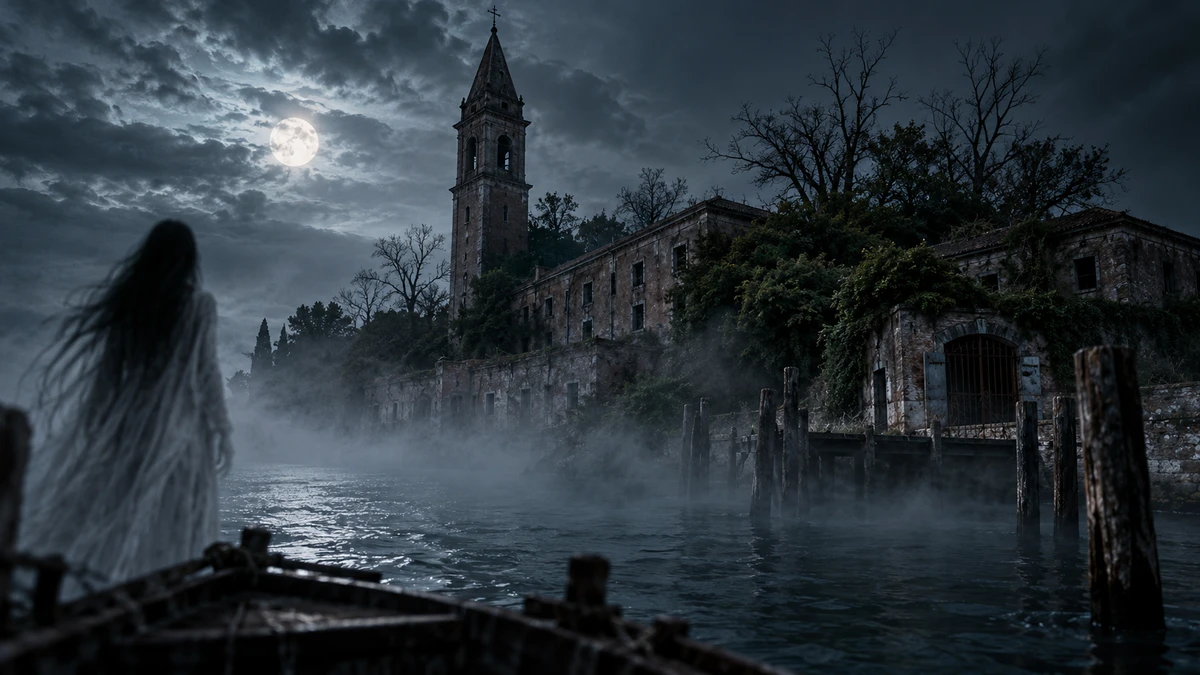
There is an old saying in Venice, Italy: when a wicked man dies, he wakes up in Poveglia.
Poveglia is a small island in the southern part of the Venetian lagoon. It is a mass of trees, and at its southern tip it is joined to a second, smaller island, an octagon of built-up ground raised more than six hundred years ago as a defence. Above the trees rises an old bell tower, and beside it stand the long, abandoned wards of a hospital. Wooden shutters hang off their hinges, some of the roofs have caved in, and ivy with stems as thick as a man’s forearm has pushed its way into the wards. Nobody has lived on the island for a very long time.
During the centuries of the plague, the Venetians say, so many people died that boats carried many of them out to this island to be burned and thrown into pits. It is said that more than 160,000 infected people spent their last days here, and that half of the island’s soil is human ash. The fishermen of the lagoon give it a wide berth, afraid of what might come up in their nets: the bones of their ancestors, polished smooth by the waves. In Venice, when children beg for a ghost story, Poveglia is the one the adults tell them, and it is a story every child regrets asking for.
It has been called the most haunted island in the world, and some call it the most terrifying. But the worst of its stories do not come from the plague years. They come from the hospital that was built there later.
Do Not Dig
In 1793, a ship put in at Poveglia. The island was then a quarantine station for Venice, where ships and travellers from abroad were held until it was certain they carried no disease into the city. Not long after the ship arrived, its sailors began to fall ill one after another. The ship was cut off, with rowing boats keeping watch day and night so that nobody could leave it, but the workers who had come out from Venice to unload its cargo started falling ill too. That summer, three shelters went up on the island: one for the sick, one for those who might be sick, and one for the guards.
Those who died on the island were buried on the island. Before the burials the earth was soaked in salt water, and over the graves was laid a stone with a warning carved in Latin: Do not dig. Here rest those who died of the contagion. 1793.
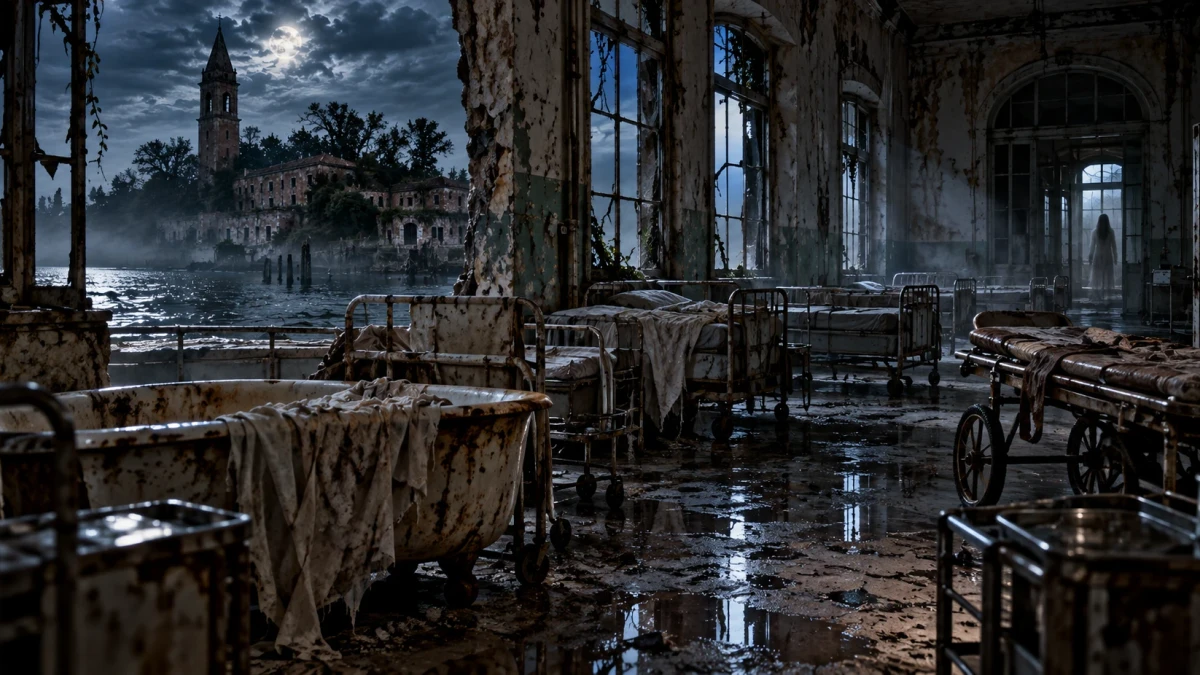
In 1922, a hospital opened on this island of plague graves. Ward after ward went up, and it stayed open until the end of the 1960s. When it was emptied, there were too many beds, gurneys and bathtubs for anyone to bother clearing out, so they were left where they stood, and there they have stayed for more than fifty years.
The first people to say they had seen anything on the island were the patients.
The Mist Beneath the Bell Tower
Not long after the hospital opened, the patients began to say they had seen the ghosts of plague victims, and that at night they could hear low, menacing whispers coming out of the walls. They believed the dead were asking for help. Nobody listened, because they had already been judged insane.
According to the legend, one of the hospital’s doctors experimented on his own patients, trying to find the cause of their madness. He operated on their brains with crude hand drills, hammers and chisels, and he took patients up into the bell tower to torture them.
A few years later, the doctor himself began to say that he had seen the ghosts of the plague victims. What his patients had been saying for years, and no one had believed, he could now see for himself.
One day he threw himself from the bell tower. Some say it was the ghosts that led him up there. The nurse who found him said he was still alive when he hit the ground at its base. Then a mist, grey as ash, rose up out of the earth and smothered him.
Ghosts, Ghosts
On a Saturday night in July 2016, five young people from Colorado, in the United States, packed a full kit of ghost-hunting equipment and hired a water taxi to take them out to Poveglia. They planned to spend the night on the island. As they climbed off, they told the boatman to come back for them in the morning. Once the boat had gone, the five of them were alone.
When the night closed in around the island, fear and anxiety got the better of them, and all five began shouting for help at the top of their voices. Shortly after midnight, a sailboat heading back to port along the Malamocco channel passed the island, and the people on board heard someone shouting out of the dark: “Ghosts! Ghosts!”
The skipper called the fire brigade. By the time the firefighters reached the island in their lagoon fire boat, the five were terrified. The firefighters calmed them down, took them on board and brought them back to land. Afterwards the five said they had heard voices in the dark, and moaning, and that they had dropped all their equipment and fled to the jetty, where they kept shouting until the firefighters took them away.
They had arranged to be collected the next morning. They did not make it past midnight.
Crying in the Snow
Six months later, on a Saturday in January 2017, members of a paranormal investigation group landed on Poveglia. They arrived in the afternoon and stayed until two in the morning. That night there was fog over the island and snow falling, and the temperature dropped to minus one degree. They had come in two layers of clothing with thermals underneath, and the night was still hard to bear.
As soon as they landed, they split up across the abandoned hospital. Some took photographs, some filmed, some recorded every sound around them, and some carried equipment meant to catch any voice that might speak in the dark.
The island was so still that they later described it as absolute calm.
It was in that stillness that two of them heard a little girl’s voice.
She was crying.
Afterwards they said there were only two places on the whole island where they had sensed anything at all: the hospital kitchen, and the garden beside it, where the branches in the undergrowth were moving strangely. What they had picked up on the island, their president said, were traces left by the many dead buried there.
They took everything home with them, the photographs and the hours of video from that night, to go through it piece by piece and find out what they had recorded.
Before any of that, the president summed up the night in a single line: “No demonic presence, just a little girl crying.”
The Side Table in the Chapel
In early summer 2014, two Australian journalists spent a night on the island.
The sun was setting when they arrived, and once it was dark the warmth drained off the island fast. There were no lights, only a sliver of moon and an old pocket torch. In the wards, cast-iron baths on lion-claw feet sat rusting where they had stood for decades, among hundreds of hospital beds, gurneys, steel bedside tables and surgical instrument benches, and grey shower curtains and partition curtains swayed in the breeze. Earlier, the two had come across three large gulls on the island, torn apart and rotting.
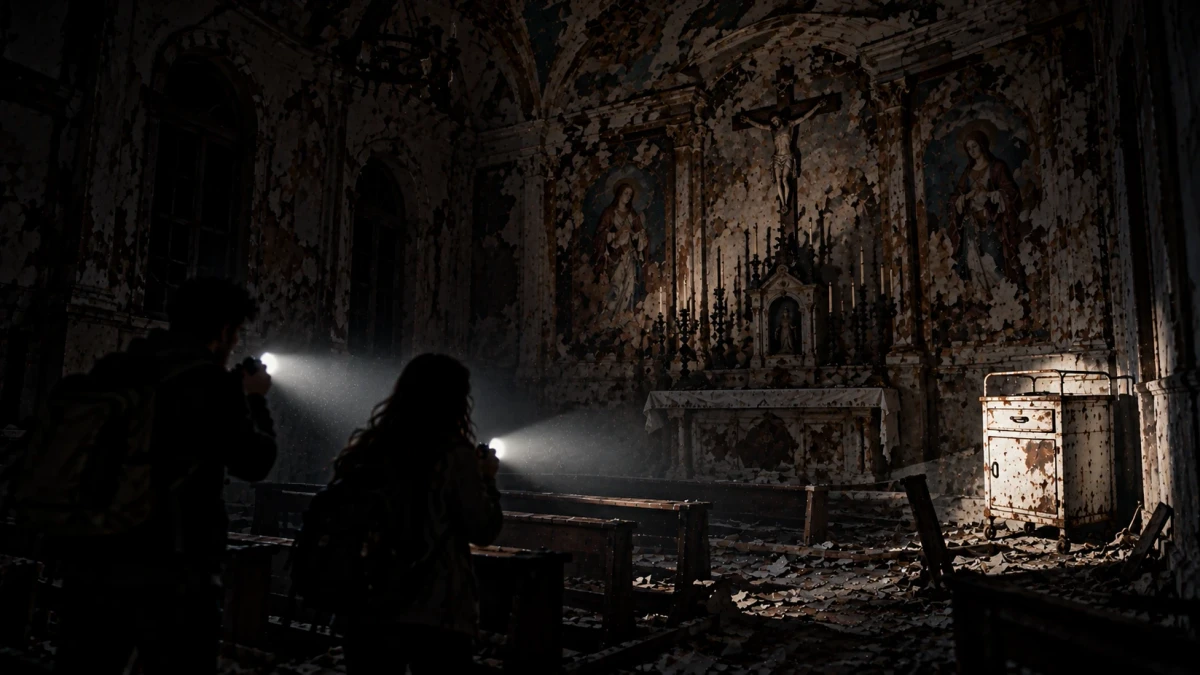
With the torch, they went from room to room and photographed every one. One of the rooms seemed to have been the hospital’s chapel. Its ceiling fresco was peeling away, only two or three pews were left, and although a chapel had no reason to hold hospital furniture, a steel bedside table stood in it, at the far right of the room.
When the photographs were done, one of the two stepped into an old ward lit only by a ring of light from a torch and a phone, and looked down. Their shadow lay twisted across the floor, thrown out of shape by the beam bouncing off the old beds and the reeking mattresses. The hairs on the back of their neck stood up, and they left the room at once. Out in the dark the rustling was getting louder. They swung the torch into the deepest corners of the rooms and down to the far ends of the corridors, and for the rest of that night they did not sleep.
At last the sun came up. Light crept back into the rooms, and the contorted shadows, their own or otherwise, withdrew. They had seen no ghosts and heard none, yet they were sure the island held more than empty rooms, even if they could not say what.
The two of them walked back through the rooms they had photographed in the dark a couple of hours earlier. Every room matched its photograph, except the chapel.
The steel side table that had stood at the far right of the room a couple of hours before now stood at the far left.
Both of them could see it plainly. The table had moved, and the camera had caught it in both places. As for what moved it, the article ends with one line: “We won’t ever know, and sometimes it’s best not to ask.”
The Bricked-Up Tower
The bell tower stands over the whole hospital, long since bricked up. The Venetians say the doctor who jumped from it is still inside, his remains walled up in the brick.
The bell was taken down long ago, and the clock on the tower, made in 1745, has long since lost its hands. Yet the people who live nearby say that on still nights they can hear the bell toll, one stroke after another, carrying across the lagoon from the island.
And for more than fifty years, no one alive has made a home on that island.