The Thirteenth Step — The Ghost Bridge of Tunghai University
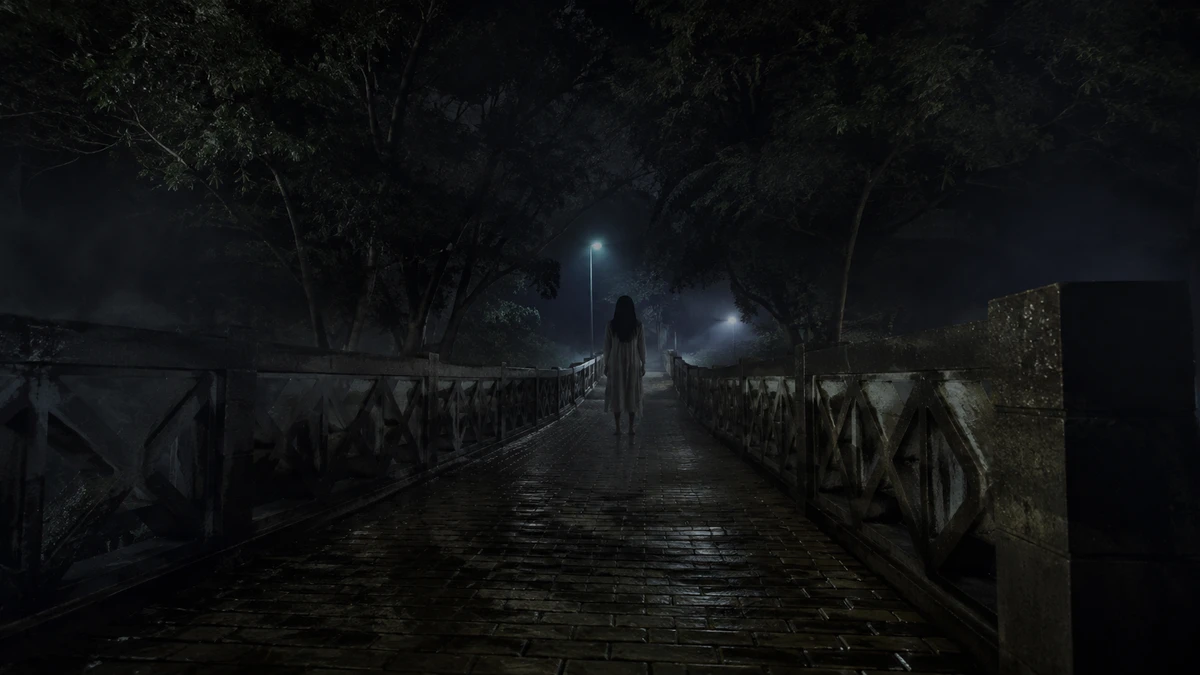
Twelve.
He stops at the foot of the bridge and counts again.
This little footbridge is the only way back from the faculty buildings to the men’s dormitories. A drainage creek runs under it. Acacia trees stand on both sides. The light from the one streetlamp gives out halfway across, and the far end is black. In daylight nobody counts the steps here. But every boy at this university knows the rule: after midnight, you count.
Twelve. Same as in the daytime.
He looks at his watch. Eleven fifty-eight.
Two minutes to go.
The bridge beside the men’s dormitories
Tunghai University sits on Dadu Mountain, above the city of Taichung in central Taiwan. The men’s dormitories are a cluster of white-walled blocks that the students call the White House. From Dormitory 17, the path towards the faculty buildings crosses a drainage creek on a small bridge, with a short flight of stone steps at its end. The ground around it is bare and quiet, and right beside it stands a grove of acacia trees. At night, when the wind moves, the leaves make more noise than people do.
In daylight there is nothing to it. The creek is shallow. The bridge is short. The steps number twelve, and students taking the shortcut are over them in a few strides.
Night is different. Once the dormitory windows go dark one by one, the only light left on this path is the single lamp at the foot of the bridge. Under the lamp post there is one circle of light. Beyond the circle there is nothing but the shadows of the acacias, and the sound of the creek coming up through the planks.
The students at Tunghai call it the Ghost Bridge. The Female Ghost Bridge, in full.
The name came from a girl.
Midnight, on the bridge
This is how the story is told.
There were two students in the chemical engineering department, a couple. Neither family would have it. They met in secret and hid each other’s letters, and in the end they decided to stop waiting. They would leave. They set a night and a time — twelve midnight — and a place: this bridge, beside the men’s dormitories. From there they would go down the mountain together, away from the university, anywhere at all.
That night, she arrived first.
She stood in the middle of the bridge with her packed things in her hand, watching the path from the faculty side. Under the streetlamp, no one. The acacia grove made its sounds, and every time she turned to look, it was only the wind.
Twelve o’clock passed.
Half past twelve passed.
She set her bag down by the railing, then picked it up again. Footsteps came from the dormitory side — a student back late, who glanced at her and walked on. Then the path was empty again, and she was the only person on it.
She did not leave. A person who has promised to run away with you does not simply fail to come. Perhaps his family had found out. Perhaps something had held him up. Perhaps he had the time wrong. She stood on the bridge and went through every possibility, and then went through them all again from the beginning. Beneath her feet, the water in the creek ran the whole night.
He never came.
Towards dawn, the acacia grove turned from black to grey.
Before the sun was up, she went down from the bridge.
The next day, someone found her in the water below.
After twelve, there is one more step
She never left the bridge.
From then on, the rules grew among the students of Tunghai, passed from mouth to mouth, one rule at a time — and every one of them was about this bridge. None of the rules is written down anywhere. A freshman hears them within his first month: from the seniors, in the dormitory corridors, from a roommate coming in at two in the morning.
First: after midnight, do not cross the Ghost Bridge alone.
Second: if you must cross, count the steps when you reach them. In daylight there are twelve. Count after midnight and there are thirteen. The steps are old, their edges worn round, and on a night after rain they shine, one above the other, all the way up. Nobody can tell you which step is the extra one. You only learn it when you reach twelve and find there is still one more beneath your foot. When you are standing on the topmost step, do not look back. Look back, and you will see her.
Third: sometimes there is a girl on the bridge. A student, long hair over her shoulders, standing where the lamplight does not reach. She will come up to you and ask one question.
“What time is it?”
Do not tell her the right time. Say anything — any hour at all — except the true one. Whoever answers correctly, she will not let go of. The boy she waited for did not come at twelve, and so she is still asking, to this day, what time it is.
She only asks boys. Boys coming over from the dormitory side.
Sometimes she asks a second question. “Which department are you in?”
Do not say chemical engineering. Say it, and you are the one who never came.
Fourth: if, while you are on the bridge, someone behind you calls your name — however familiar the voice — do not turn around.
Nobody can prove any of this, and few care to test it. What survives is description, and from the descriptions later hands have built dramatised pictures: a lone figure climbing the wet steps after midnight, the lamp above him, nothing but dark ahead.
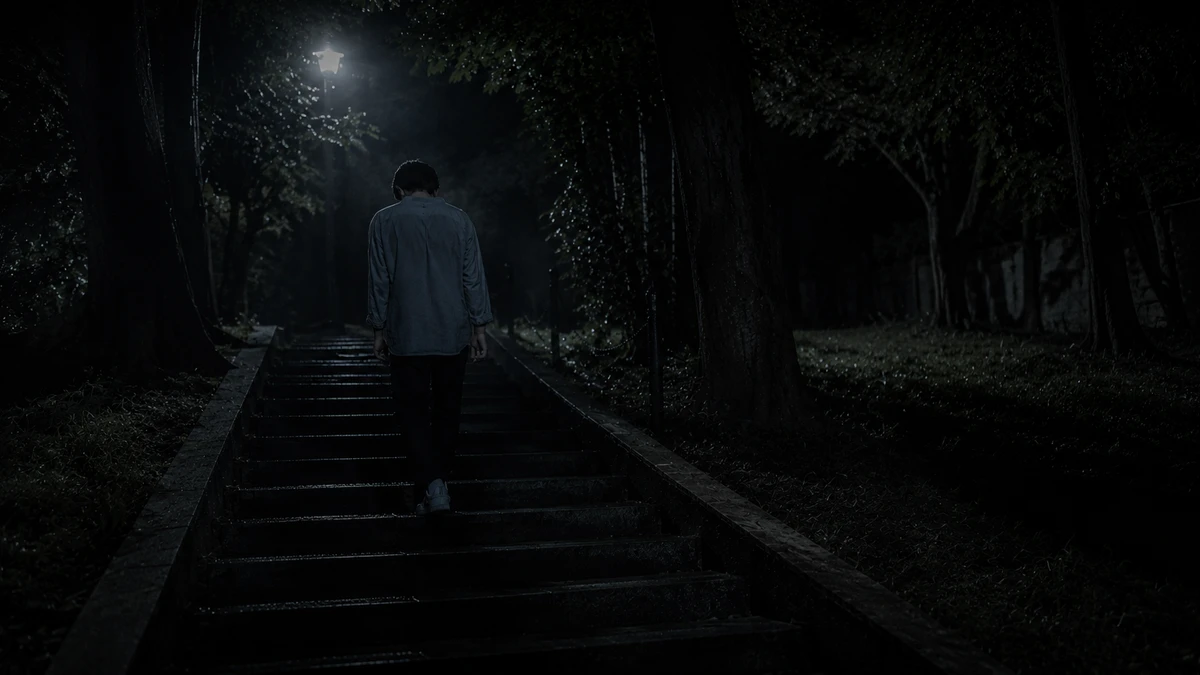
The rules are handed down from one year of students to the next. But the first people to put them in print were not students.
She was in the newspapers in 1997
This story is older than the internet.
On 31 October 1997, the Min Sheng Daily ran a piece on campus ghost stories, and the girl on Tunghai’s bridge was in it. What the paper printed was what the dormitories had been saying all along: a student who had waited on the bridge for someone who never came, appearing there in the small hours, and asking everyone she met the same question.
What time is it.
That newspaper is nearly thirty years old. And before anyone printed the story, it had already been passed down the dormitories for more years than anyone can count.
The university never hid the name. Tunghai’s early official website listed the Ghost Bridge among the sights in its campus guide, presented to new students and visitors as one of the legends of Tunghai. In 2017, a news headline called the bridge “officially certified”.
But what put the bridge in front of the whole of Taiwan was a phone, in March 2018.
Someone went live in the small hours
In the small hours of a morning in early March 2018, a man walked into Tunghai University alone, went to the Ghost Bridge, and opened a live stream on his phone.
The plan was simple. Go up on the bridge himself, and walk it for the people watching. On screen he walked and talked, chatting back to the comments, climbing the steps, crossing the bridge, coming back. The campus at that hour was silent; the stream carried nothing but his own voice, his footsteps, and the wind. The one streetlamp on the bridge was the only light in the frame. Behind him, the trees were a wall of black.
He felt nothing at all.
The people on the other side of the screen were not so lucky. Hundreds were watching at once, and at almost the same moment they all saw the same thing — in the dark of the trees behind him, a figure in white, hanging in the air. No feet to be seen. Hair down. Mouth open, in the shape of an O.
The comments started to pour in.
“You should get out of there.”
“It’s behind you.”
“There’s a shadow behind you.”
They came faster and faster, climbing up from the bottom of the screen, one on top of the next. He kept his eyes on the screen, reading the comments, noticing nothing, talking on. In the frame, the white shape stayed in the tree at his back and did not move.
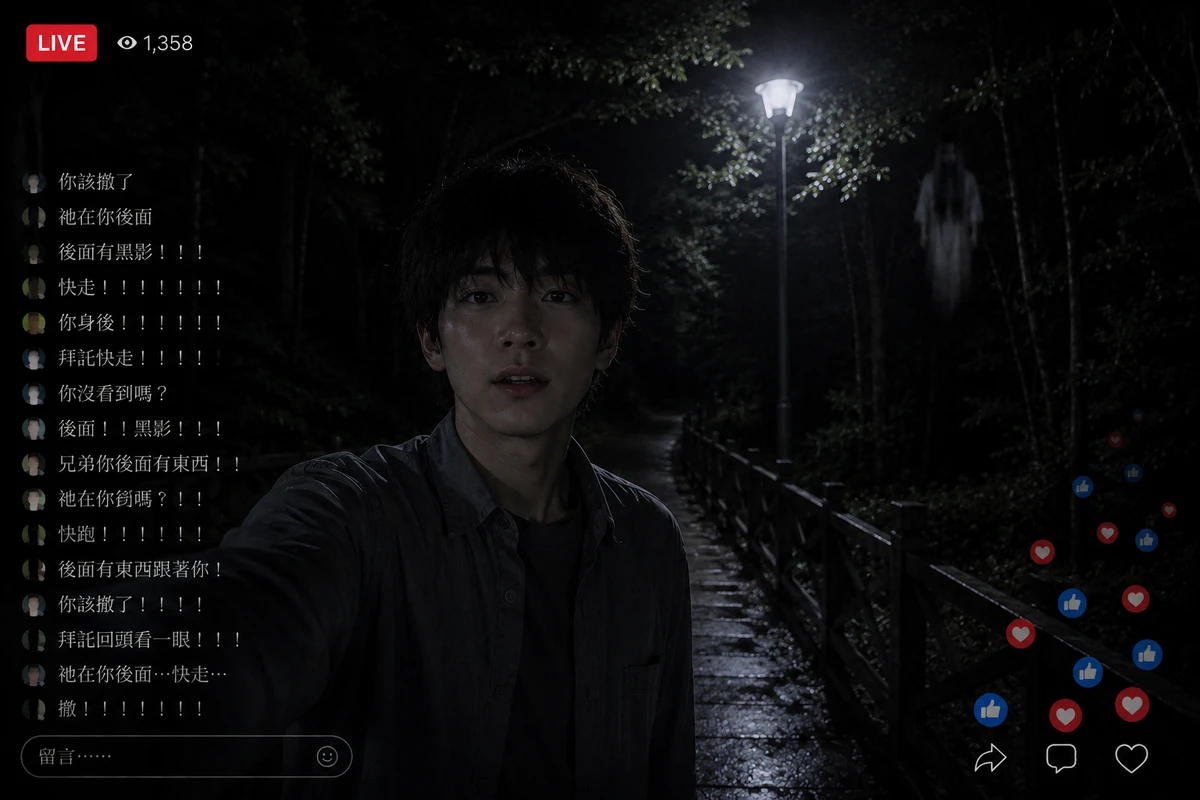
After the stream ended, the screenshots spread. Within days, thousands of people had felt their skin crawl on the far side of a screen, and the news followed. On 27 February 2020, the story of the bridge reached cinemas as the film The Bridge Curse (女鬼橋), which took NT$58 million at the Taiwanese box office. Since then, the whole of Taiwan has known that there is a bridge at Tunghai where, after midnight, there is one step more.
The bridge is still there. It is not that bridge.
Most of the people who go to the bridge do not know one thing.
Between 2002 and 2004, Tunghai University built its Humanities Building beside the men’s dormitories. The old bridge of the legend — the one across the drainage creek, steps and all — was filled in during the works. After the building was finished in 2004, the university put up a new stone bridge there, linking Dormitory 17 and Dormitory 11.
When the construction fences came down, the students went back to using the crossing on their way home to the dormitories, and went back to counting the steps at midnight. The stone is new. The story is old.
The people who go to count the steps at midnight now are standing on the new bridge.
But once twelve o’clock has passed, when you reach twelve, there is still one more step beneath your foot.
Nobody knows which bridge that step belongs to. Only this: when you count it, do not look back.