Taiwan's Most Haunted Hospital: Xinglin
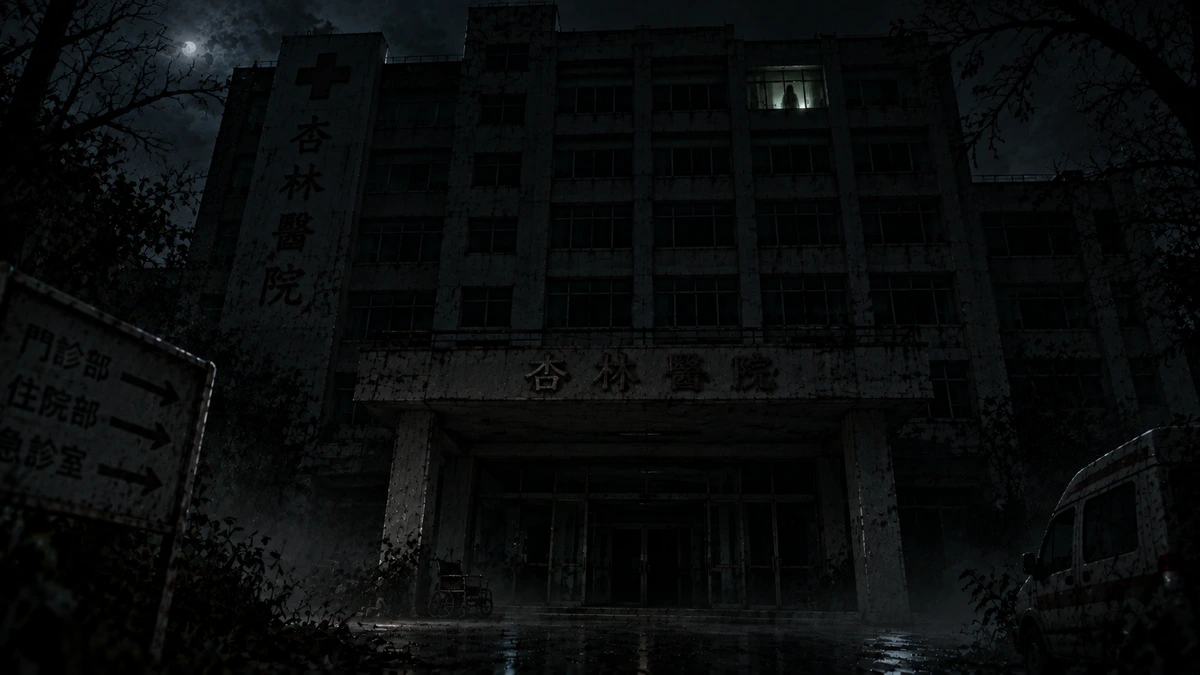
The corner of Ximen Road Section 1 and Xining Street is one of the busiest places in Tainan’s West Central District. There is a department store across the way. A cinema and a park are a short walk off, a junior high and a senior high beyond that. The traffic does not stop all day.
On one side of that junction stands a seven-storey concrete building. Three hundred ping of floor space, about a thousand square metres, with a light well running from the ground floor to the roof.
Its windows are gone. The glass and the frames with it were stripped out long ago or have rotted away entirely, so every room now opens onto the outside through a hole in the wall. One visitor described the building as a natural sponge, full of empty pores.
From the street, looking up, those holes are black. The line between the rooms and the air outside is not there any more. Wind, rain and anything that wants to get in goes in through the holes.
Every other building on that road was in use. For thirty years, that one was not.
After dark, the signs come on one by one along the street. From the ground floor to the seventh, nothing in that building is lit.
It has stood like that for thirty years.
Nothing Was Ever Taken Out
Xinglin is one of the oldest words for medicine in Chinese. The story goes that a physician in the Eastern Han named Dong Feng treated the sick on Mount Lu and refused payment, asking only that anyone who recovered plant an apricot tree. Year after year, the trees below the mountain grew into a forest. Plenty of hospitals in Taiwan have taken those two characters for a name. This one in Tainan is the most famous, and not for its medicine.
It opened in 1975 as Xinglin General Hospital, founded by three doctors, and for its time it was among the largest and best equipped in the city. Seven floors. Outpatient clinics, wards, operating theatres, a mortuary: everything a general hospital is supposed to have.
Then, in 1991, the authorities found that the hospital had been falsifying medical records and issuing false certificates of admission, claiming insurance money from the civil service and labour insurance schemes, with irregularities in its tax filings as well. On 1 June 1993 it was ordered to close. A little over two months later, on 21 August, it was formally wound up.
The real question is not why it closed. It is how.
It was never cleared out. The beds stayed in the wards. The drugs stayed on the shelves. The equipment stayed where it had been parked, the paper records stayed in their cabinets, and when the doors were locked, seven floors and everything inside them were left exactly as they were.
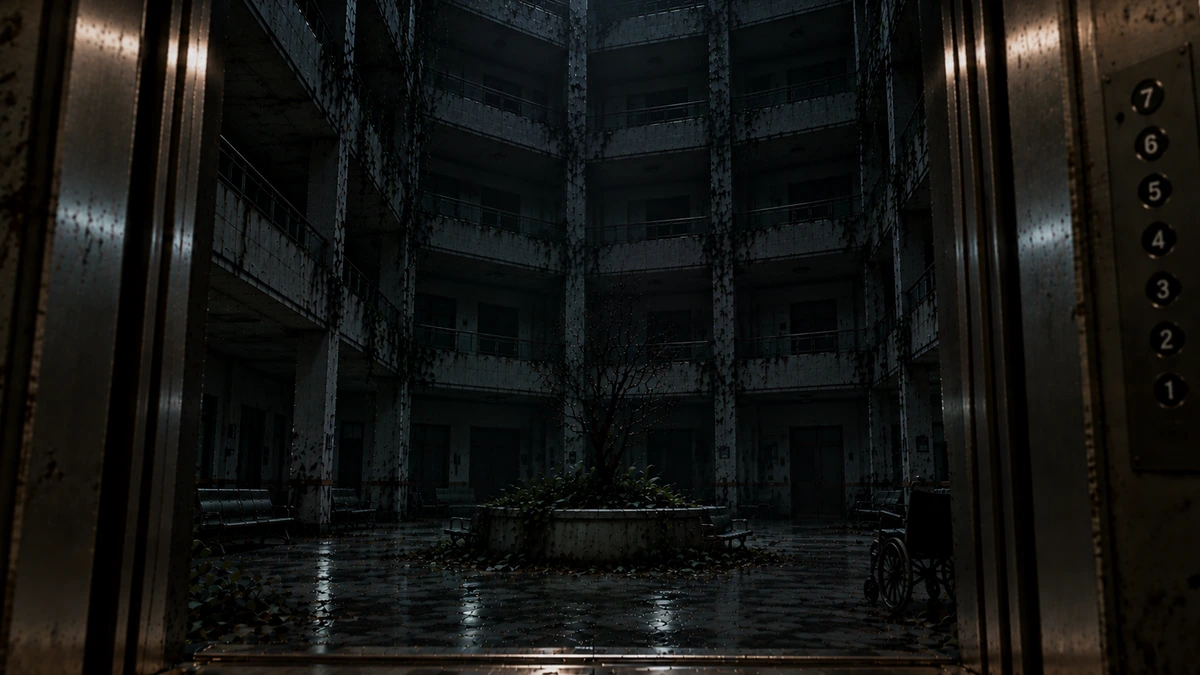
People who went in years later describe grey corridors strewn with debris, grass growing tall in the light well, faded photographs scattered across the floors of the wards, and a newspaper clipping still stuck to a peeling wall, the paper old and the ink pale, the date on it still legible: 1993.
It was never demolished either.
And so it stayed on that corner doing nothing at all. The press eventually gave it a title: Taiwan’s largest haunted house.
Across the Street, Something Moved Upstairs
The first accounts did not come from inside. They came from the pavement.
Someone standing on Ximen Road put a telescope on the building and said there was a long-haired woman in there.
That street is not a back alley. Buses stop on it. Scooters queue at the lights. The department store doors open and shut all day. He was standing in the middle of all of that, across a full road, with a telescope trained on the holes in the wall. Those holes run from the ground floor to the seventh, and behind every one of them is an empty room.
Others said that passing at night they saw lights moving inside the building, drifting one way and then the other. Others said there was someone crying in a fifth-floor ward. In thirty years the accounts have never stopped.
All of them have one thing in common. Everyone telling them was outside. Whatever they saw or heard, there was a road or a stretch of darkness in the way.
Seen from the pavement, the building is safe. It is simply there. You can look at it, or not look at it, and then turn and walk away.
The people who actually went in came back with something else.
The Door Was Called the Gate of Peace
Two young men climbed in one night on a dare.
They did not go far. They stopped at a door. Chinese hospitals mark their fire exits with three characters that read, literally, gate of great peace, and while a hospital is open nobody gives that door a second look. It hangs there, waiting for an emergency that never comes.
The two of them stood in front of it, took a photograph, and checked in, tagging their location for anyone who wanted to see it.
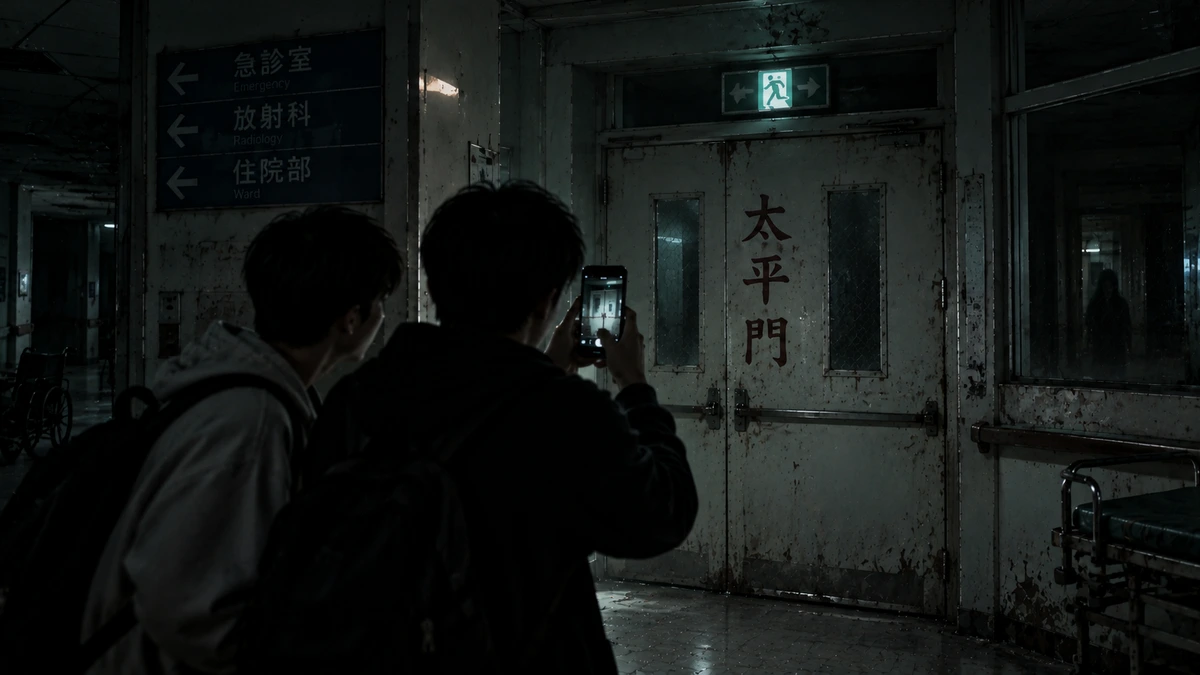
Then one of their phones rang.
He answered it. On the other end was a voice in distress, calling out for someone to come and save him.
The story ran in the news afterwards under the words ghost call.
Whoever was on that line asking to be saved never said where he was.
The two of them were standing inside the hospital.
They Went In Together and It Was Their Bodies That Went First
Almost every haunted building in Taiwan reaches this point in the story. Sooner or later somebody decides to go and look. Xinglin made it easy. It is not up a mountain or out in the countryside. It is in the middle of the city, and there is a red brick wall by the car park next door that you can simply climb.
In 2008 a group who had arranged it online went in together. More than ten of them.
A group that size going over the same wall and down the same corridor, so that in theory nobody could be separated and nobody could be left behind. In ghost stories it is the one who gets separated that something happens to.
It did not take long before people in the group started to go wrong.
One of them said his left leg felt as though something had hold of it, and he could not move it.
Another said he was dizzy and could not breathe properly, as though he were being throttled.
Another said his back had gone heavy and rigid and he could not straighten up.
The rest began to feel light-headed and weak, and then the whole group ran, screaming, scattering out of the building.
Nobody got lost inside. Nobody was shut in. What failed was their bodies, one after another, starting at a leg, a throat, a back.
That is the account that has been repeated most often since. Not because anyone saw anything, but because several people said at the same time that something was pressing down on them.
They Reached the Lift on the Ground Floor and the Smell Came Out
In February 2025 a man had been out of contact for several days. His family could not find him and reported him missing.
On the afternoon of 26 February the police went into Xinglin Hospital.
In through the ground floor. When they reached the lift, the smell came out.
It was the kind of smell you recognise at once, too strong to be mistaken for anything else.
In the lift shaft on the ground floor lay a man, dead for some days.
Identifying him as the person they were looking for came down to the clothes he was wearing.
The examination found no third party involved in the death.
He had been inside that building for days.
For all of those days, Ximen Road was on the other side of the wall. Buses pulled in at the stop. The department store opened its doors. The lights changed, and the crowds at that junction never thinned.
One wall.
Nobody knew there was anyone inside.
People Have Been Walking Past It the Whole Time
At the end of 2018 the bank next door bought the building and began to renovate it, and part of the space later opened again as shops.
So when the police walked in in February 2025, this was not a house nobody went near.
And the man his family had spent days looking for was inside it, and had been for days.
Counting from the day the doors were locked in 1993, people have been walking past that building without stopping: on their way to work, on their way to school, waiting at the lights, waiting for someone outside the department store across the road. Thirty years of them. The holes in the wall are directly above their heads, one after another, from the second floor to the seventh.
From the street, you cannot tell whether there is anyone inside.