The Xinhai Tunnel: The Fare Who Is Not in the Back Seat
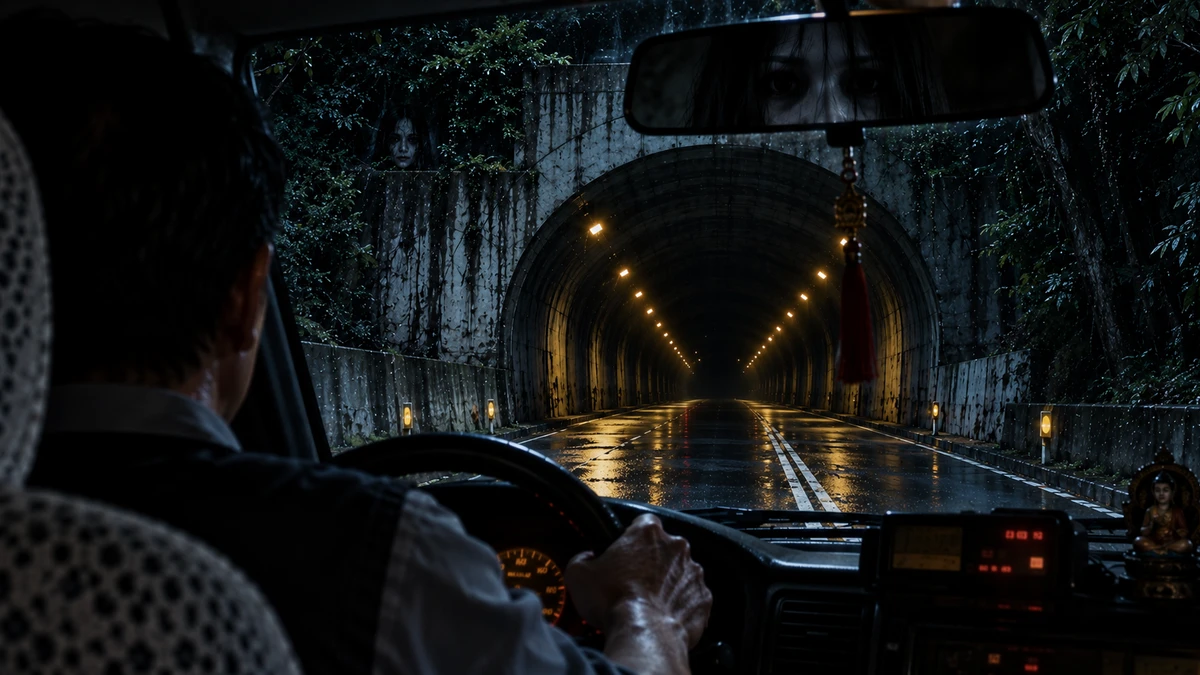
On the south side of Taipei, Taiwan, where Xinhai Road cuts through a small hill, there is a tunnel less than five hundred metres long. At the Da’an end, right beside the tunnel mouth, stands the Taipei Second Funeral Parlour. On funeral days the mourning music plays from morning until noon, and both sides of the road are lined with undertakers’ signs. Across from the parlour is Fuzhou Hill. It used to be nothing but graves, packed shoulder to shoulder, and you could see them through your windscreen as you drove in.
The far end of the tunnel is Muzha, in Wenshan District. The quickest way there from the city has always been the same: past the funeral parlour, into the hill, and out the other side.
Ride Faster
This is what the people who ride this road say.
Some went in at midnight and came out at dawn. Some went in and never came out at all.
Ride in alone at night and there is a voice at your ear that will not stop: “Ride faster. Ride faster.” Most people who hear it start chanting the Buddha’s name under their breath and keep chanting until they are out. If you are lucky, the voice falls silent at the tunnel mouth, and then you hear one last line: “It’s no use.”
One man was riding a scooter through the tunnel with his pregnant wife on the back, on the way to work, and all the way through there was someone at his ear: “Ride faster, you’ll be late.” “Ride faster, it’s fine, it’s safe.” “Come on, why so slow?” He had a pregnant woman behind him, so the harder the voice pushed, the slower he rode. The scooter went over anyway. The back wheel came right up off the road, his face went into the windshield, and he was covered in blood.
Thirty years ago there were already enough stories about this tunnel to make a list: “Some went in and could not find the way out, some picked up passengers who suddenly vanished, some had their cars go out of control for no reason, and some thought they saw the tunnel, drove into a house instead and wrecked the car and themselves.”
Thirty years on, the list is still growing.
The Graves Above, the Funeral Parlour at the Door
The tunnel was dug in 1971 through Zhongpu Hill and opened the following year on the eve of the Lunar New Year, and from then on the city no longer had to go the long way round to Muzha. In 1978 the funeral parlour was set up at the Da’an end, at the tunnel mouth, crematorium included. Fuzhou Hill was still a public cemetery then. The graves ran all the way down to the houses at the foot of the hill. At Tomb-Sweeping Festival people climbed up to tend them; the rest of the year the hill was graves and nothing else.
The lamps inside are yellow. The weather at one end is often not the weather at the other. The tunnel runs dead straight, but the Muzha end opens straight onto a sharp bend with a slight downhill, and that stretch has always been good for crashes.
So a driver feels the difference the moment he goes in. Graves overhead, a funeral parlour at the door, four hundred metres of yellow light in a straight line ahead, and an exit hidden behind a bend.
The graves were moved off the hill later, one by one. The stories did not move with them.
Turn Round, and the Back Seat Is Empty
Midnight. A taxi pulls up at the tunnel mouth.
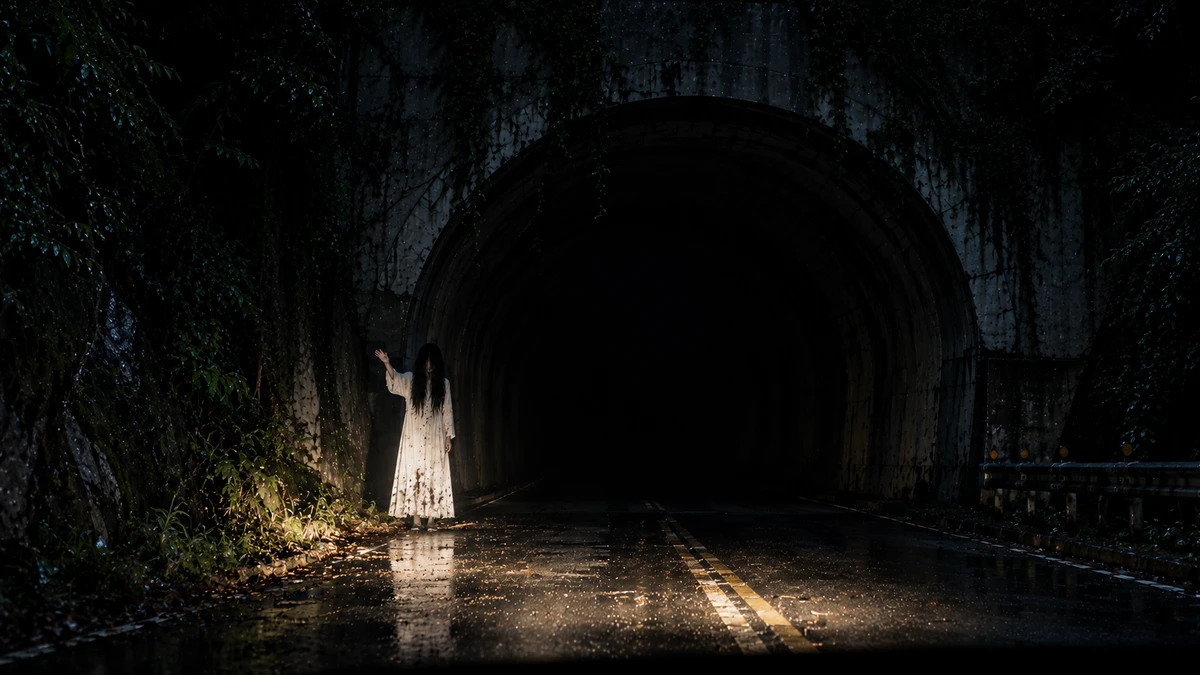
A woman with long hair, dressed in white, stands where the streetlight does not reach, and she only raises her hand when the headlights sweep across her. She gets in the back and says one thing: the other side of the tunnel. The driver watches her in the mirror. She does not speak and she does not move.
The car goes in, and the yellow lamps pass over the roof one after another. Four hundred and some metres. Less than a minute.
Out the other end, at the place she named, the driver turns round.
The back seat is empty.
Other drivers say she did get out, that the fare was left on the seat, that he pocketed it and drove off, and that the next morning he reached into his pocket and pulled out a wad of ghost money.
The older version does not begin at the tunnel mouth. It begins at a hospital. Late at night a young woman walks out of the hospital and gets into a taxi, saying she needs to go home through the Xinhai Tunnel. The driver goes cold at the words, because on that road “the whole hill is graves, it sits right next to the crematorium, and there are a lot of ghost stories,” but he takes her to the house she names anyway. She says she will go in for the money. She goes in through the door and does not come back. The driver waits a long time, gets out and rings the bell. A middle-aged woman opens it, pays the fare and tells him that was her eldest daughter, who died in childbirth at that hospital a few days ago. She took a taxi home last night too. Her mother paid then as well.
So one driver brought her home last night, another tonight, and perhaps another tomorrow, every one of them stopping at the same hospital gate, every one of them ringing the same bell.
So when a hand goes up at the tunnel mouth, do not stop.
Eighty on the Dial, and the Car Is Not Moving
One midnight in 1992, a taxi driver was driving out of the Xinhai Tunnel towards Muzha Road.
The steering stopped answering. It was the same tunnel and the same lamps, but his sense of direction had gone, “endless and unreal,” and the road ahead stretched on with no exit in sight. He hit the brake. The brake had gone too.
He did not want to stop inside the tunnel. He just wanted out.
Foot to the floor, the needle climbed to eighty, and the car did not move.
The dial said eighty, and the tunnel wall outside the window did not shift at all, as if the whole tunnel were running forward with the car. However fast he drove, the tunnel ran just as fast.
He did get out in the end. How, he could not say. The car was suddenly moving again and the exit was suddenly ahead of him, as if the tunnel had had its fun and let the car go.
From that night on, perhaps every time he drove into the Xinhai Tunnel he looked at the speedometer first, and as the needle climbed he kept one eye on the wall outside the window, to make sure it was still sliding backwards.
The Taxi Before the Exit
Not everyone is caught inside. Some people see it from the outside.
A man drove his girlfriend home a little after eleven one night, put a song on, and sang along as he went into the tunnel. Nothing happened in there. No endless road, no figure at the roadside. He kept singing. Just before the exit it occurred to him that the funeral parlour was right ahead and he had better stop, and as the thought passed he caught a movement on the passenger side. The glove box.
The glove box opening, slowly, slowly, open.
He reached over and shut it, made himself look at the rear-view mirror for three seconds, saw nobody in the back, so he turned the music off and drove home like a good boy. Down in the car park under his building, just as his heart was settling, there was a voice at his ear, saying over and over that it was late, it was late, it was late.
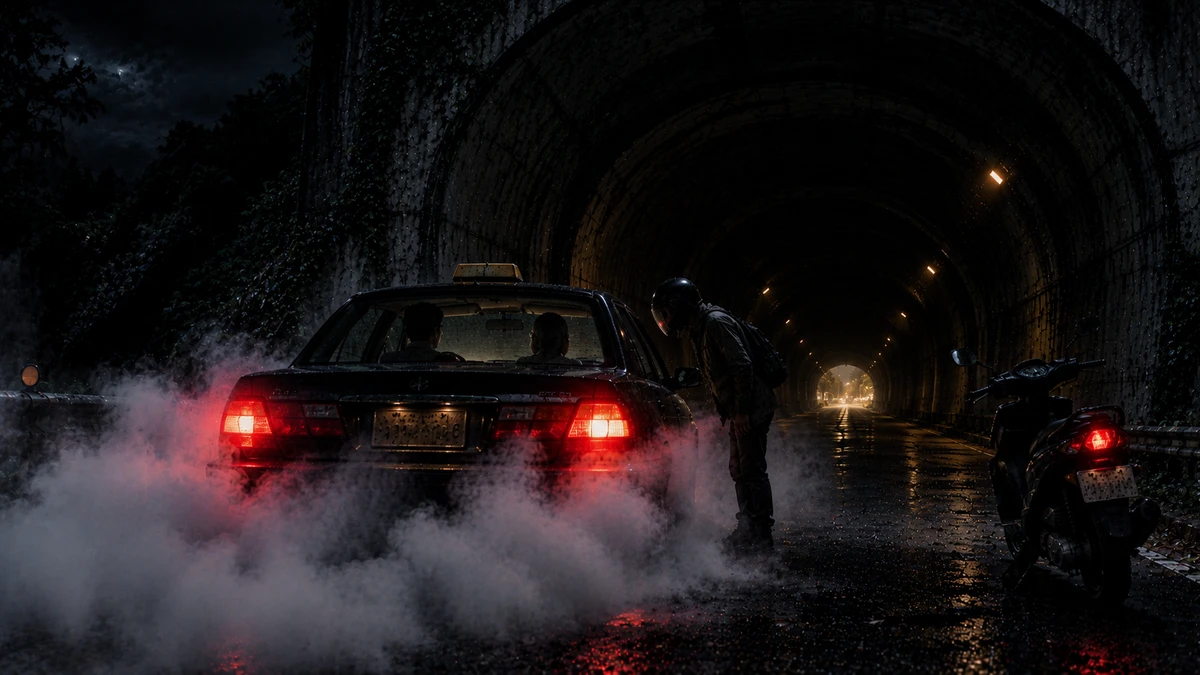
Another man was riding a scooter through the tunnel in the small hours. Near the exit he saw a taxi stopped at the roadside, its nose pointed at the world outside, and the car simply sat there and did not go.
He rode closer.
The rear wheel was grinding against the road, throwing up a cloud of white smoke, as if the driver had the brake and the accelerator down at the same time, and the car was not moving. Inside, the driver and the passenger sat perfectly still, both of them staring straight ahead, their faces strange, as if they had no idea what was happening to them, and as if they had not noticed that one more person was now standing outside their window.
The exit was right in front of them, close enough for their headlights to reach.
But to judge by those two faces, the exit was a long way off, as far off as four hundred metres of yellow lamps still to be driven through, and then driven through again.
He came no closer. The taxi stayed where it was, the rear wheel still grinding, the smoke still pouring off it, and the two people inside still staring at an exit they could not reach.
Broad Daylight, and the Radio Changes Voice
None of this keeps to the night.
In 2020, before Ghost Month had even begun, a man was driving home in broad daylight with plenty of traffic around him and a song on the radio. He passed the funeral parlour, the nose of the car went into the tunnel, and the radio changed at once. The song was gone. In its place was a man’s voice, thick with static, phrase after phrase of what sounded like chanting, and you could not make out the words, only that the voice was not the radio station’s.
The dashcam caught that stretch. The same thing had happened a month or so earlier. Both times it began the moment the nose of the car entered the tunnel.
The tunnel is under five hundred metres and takes less than a minute to drive, but the moment the nose of the car goes in the radio changes voice, and whose voice it has become, the person behind the wheel will not learn in that minute; all he can do is keep driving.