One Too Many in the Line — The Legend of the Little Girl in Red
Fengdongshi is a rock. It sits on the boundary between Beitun and Tanzi in Taichung, central Taiwan, about 360 metres up. The name is literal enough: when the wind comes, air moves through the cracks in the stone and the stone makes a sound.
On 1 March 1998, a family walked up to it.
The path is narrow and paved, cut between orchards — pomelo, orange, persimmon — and then acacia and tung trees further up. It runs 1.4 kilometres. Thirty minutes at an easy pace. Somebody in the group had brought a camcorder, and they filmed the whole way.
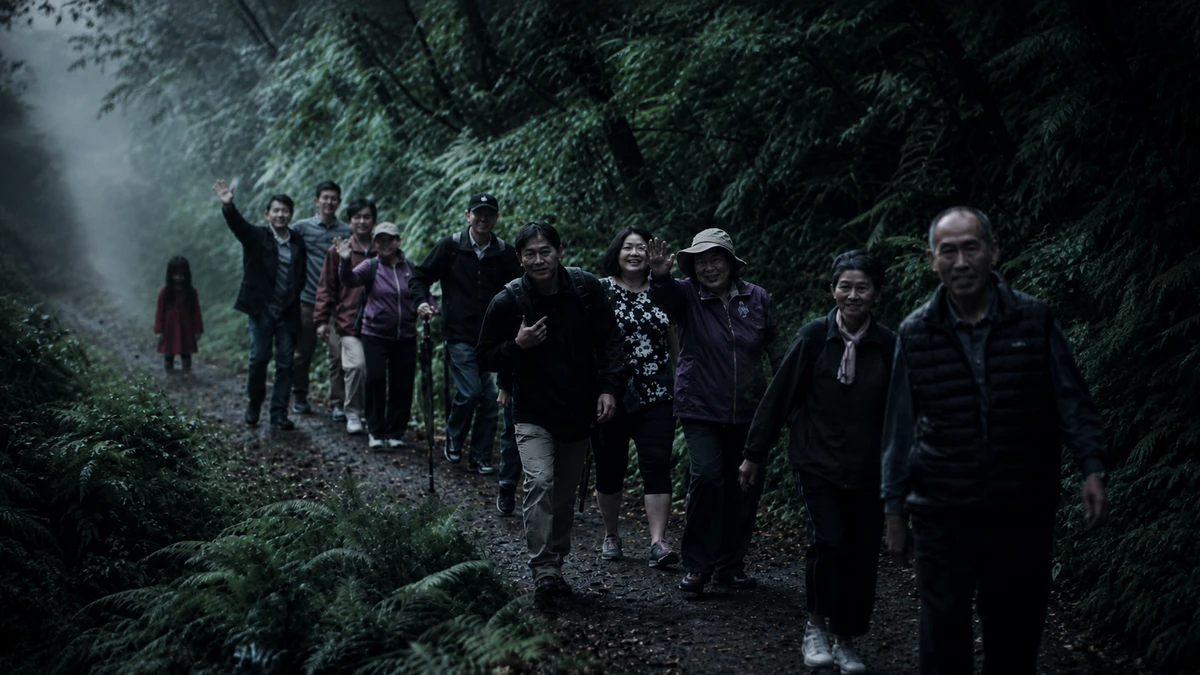
Nothing on the tape is remarkable. The party is strung out in a long line against the hillside. People near the front turn around. Somebody waves at the lens. Somebody laughs louder than the people beside them. The camera drifts to the leaves at the edge of the path, then to the filmer’s own shoes.
This is what a home video is supposed to look like. No subject, no point. Someone just wanted to keep the afternoon.
The trouble started at home.
Count them again
They played the tape back, and somebody started counting heads.
At the very end of the line, there was a child.
The child is wearing red — small clothes, a child’s clothes. The face is wrong. Old, pale, drawn: an elderly woman’s face on a small body. The walk is wrong too. Too light. The feet do not seem to be finding the concrete.
Rewind. Play it again. She is still there.
Go back frame by frame. She follows the group the whole way, never hurrying, never falling behind, holding the same distance from the last person in the line. She does not look at the camera. She does not look at anything. She simply keeps pace with a group of strangers on a Sunday walk, for as long as the tape runs.
And not one of the people who were on that hill that day could remember a child like that.
The image at the top of this page is a recreation of that frame — the mist, the path, a line of people smiling at the camera, and the one keeping its distance behind them.
The tape leaves the house
For a while it was only a home video that kept getting rewound. Shown to relatives. Shown to neighbours. Everyone saw the same thing, and nobody could say who she was.
Then one of the people who had been on that walk died of illness.
The family sent the tape to a paranormal programme on television.
In 1998 that was not a small decision. Handing over your family’s tape meant handing over every face on it — and whatever was walking behind them — to an entire island.
5 May 1998
That May, GTV27 launched a new show called 神出鬼沒, a paranormal talk programme; its first pair of hosts were Zhang Yueli (張月麗) and Zhou Mingzeng (周明增). The tape, submitted by a viewer, was broadcast there.
After that, everybody had seen it.
The programme’s producer later said on a talk show that the footage was absolutely not faked. The station’s editor, working on that sequence, would not look at the screen.
This was Taiwan in the nineties, at the height of the paranormal television boom. TTV had been running its ghost-story segment inside 玫瑰之夜 since 1991. TVBS had 接觸第六感 from 1993. CTN had 星期天怕怕 from 1996. SET Metro had 穿梭陰陽界 from 1997. Every week something new crawled out of the screen.
But those shows broadcast stories. Somebody talks, somebody listens, the lighting is low.
The tape was not that. The tape was a family filming a walk, and the person holding the camera had no idea what they were filming.
The island argued about it. Some said she was a mountain sprite. Some said a vengeful spirit looking for a replacement. Some said she was simply a straggler from another hiking party, and the camcorder’s light had turned an ordinary face into that face. Some said the tape had been tampered with.
Years of arguing, and nobody has ever said who she was.
The mountain already had something in it
She did not walk into an empty frame. The hill she walked into already had something in it.
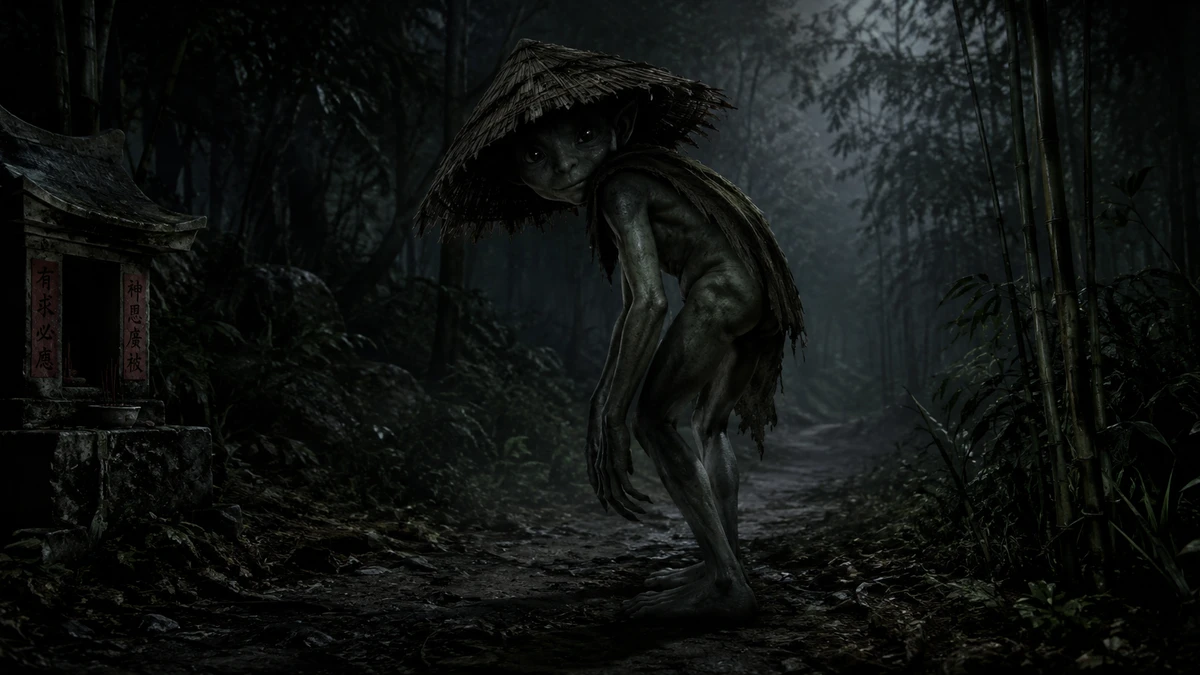
In Taiwanese Hokkien it is called Mô͘-sîn-á — written in Chinese as 魔神仔, and in several other ways besides: 毛神, 摸神, and 芒神, that last one said to come from the silvergrass thickets on the slopes where it appears. Hokkien communities tell these stories. So do Hakka communities. So do Indigenous peoples. When somebody goes missing on a mountain and is later found, those are the words that come out. Older books describe something similar: the fourth-century In Search of the Supernatural and the Qing-dynasty Strange Tales from a Chinese Studio both have mountain spirits that lead people away.
The usual description is small, quick, shaped like a child. But there is another version in circulation — tall, with a very white face and bright rouge on the cheeks, a woman.
It does one thing. It takes people. Into the hills, down to the water, somewhere they cannot walk out of.
The ones who are brought back tend to come back dazed. They say they have just eaten well — chicken, rice, plenty of it. Then their families open their mouths and find grasshoppers, crickets, mantises, cow dung, earthworms, twigs, dirt.
One case recorded in 2008: a young man was gone for twelve days. When he was found, his mouth was smeared with cow dung. He said mosina had made him eat it, and had made him catch grasshoppers for himself.
Which is why the search is not an ordinary search. Relatives consult the local gods first — the mountain god, the earth god, the city god, whichever one holds that ground. Then they go up with gongs and drums and firecrackers, and they walk, and they shout the missing person’s name — shouting the name is how you call somebody back out of that place. The noise is not for the searchers. It is for whatever is holding on to the person they are looking for.
None of this started in 1998. It is much older than the tape.
“Mosina ask people for their clothes”
In 2014 the anthropologists Lin Mei-rong and Li Chia-kai published a study of these accounts, 魔神仔的人類學想像. Lin is an adjunct research fellow at Academia Sinica’s Institute of Ethnology and has spent her career on Taiwanese folk belief. She collected the versions — scattered, similar, never quite identical — and set them side by side.
In an interview with Academia Sinica she placed the little girl in red inside the mosina category, along with the Yellow Flying Hero of Yushan.
These stories are not confined to remote peaks, either. She has described one from the Nangang hills at the edge of Taipei: the older generation there warned children that mosina lived in those hills and would take small children away. Not a ghost story told for fun. An instruction, given to children who had to walk past that hill every day.
Out of all the accounts she found motifs that keep recurring. Two of them:
People taken by mosina are often found afterwards up a tree, or in a cave.
And mosina ask people for clothes to wear.
That second one is worth stopping on.
Because the first thing anyone sees on that tape has never been the face. It is the clothing — red, and cut for a child.
Some things outlast the people in them. The Somerton Man: the nameless body on the beach was like that too: the man is gone, the objects remain, and they get taken out and examined again and again.
How far the tape travelled
In 2015 a film called The Tag-Along opened in Taiwan, directed by Cheng Wei-hao, adapted from the legend. It was released on 27 November that year, played the Golden Horse Film Festival as the closing film, and took four nominations at the 53rd Golden Horse Awards. A sequel followed in 2017, a prequel — The Tag-Along: The Devil Fish — in 2018, and a video game in 2024.
A home video grew into a franchise.
Nearly three decades on, almost nobody who grew up in Taiwan does not know her. Most of them have never seen the original footage, and all of them can describe her: red clothes, a face that is wrong, walking behind.

All of that came later. The path that was filmed that afternoon is still exactly where it was.
What the story turned into
The rock tilted in the 921 earthquake. The city government reinforced it and built a park beside it in 2003 — pavilions, benches, playground equipment. It is the end point of the Dakeng trails numbered six, seven and eight, and it is busy at weekends. Parents take their children up. Thirty minutes, 1.4 kilometres.
The wind still moves through the cracks in the stone. The stone still makes its sound.
And the tape is still there, the frames are still there. The line of walkers is still the same line, still laughing, still waving, not one of them looking back.
The child in red at the end of it is still following.